Blog
Attribution Models for B2B SaaS: What Each Measures and Where It Fails
Attribution models compared by deal size, sales cycle and buying group. What first-touch, last-touch, U-shaped and W-shaped each measure and where they fail.
Account based advertising limits ads to a named list of target companies. Learn how it works and how to build a strategy for 50 to 200 B2B SaaS accounts.
 Ishan ManchandaNov 23, 2026
Attribution models compared by deal size, sales cycle and buying group. What first-touch, last-touch, U-shaped and W-shaped each measure and where they fail.
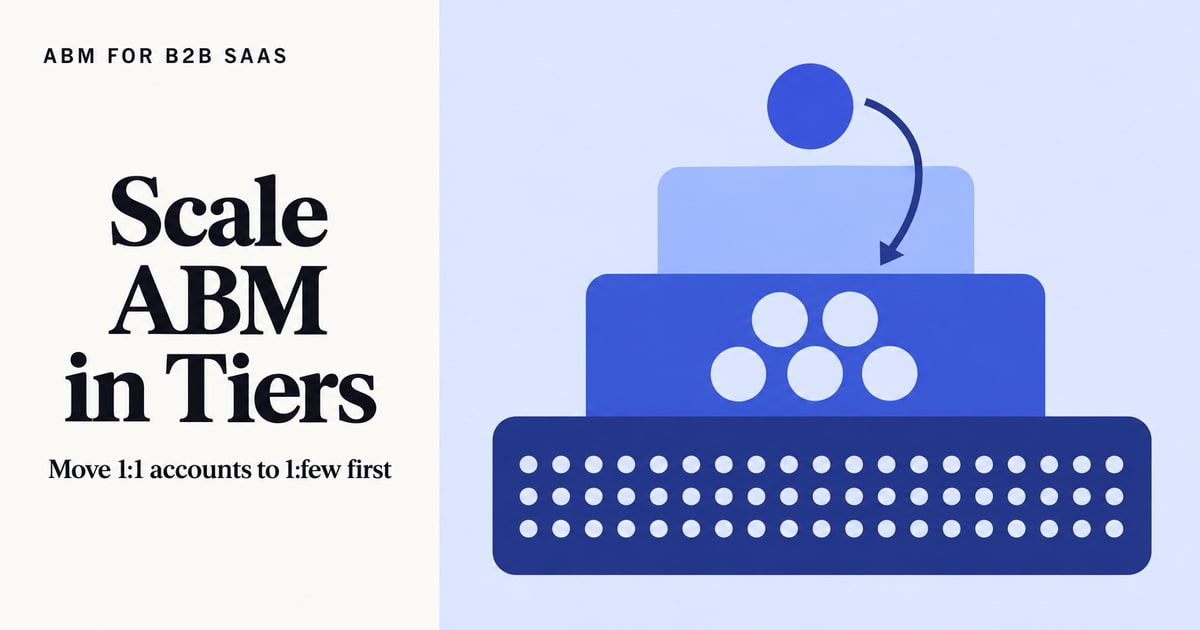
Learn how to scale account based marketing campaigns by migrating accounts from 1:1 to 1:few before 1:many, with triggers, capacity math and metrics.
Build an intent data workflow that ties each signal to a named owner, action and deadline, then judge campaigns on pipeline per account, not clicks.
Request a quote and our experts will contact you within 24 hours with tailored solutions and pricing.
Last updated: Nov 23, 2026
By ABM for B2B SaaS Editorial Team. Last updated October 28, 2026.
Account-based advertising is a paid media approach that limits ad delivery to a named list of target companies instead of audience segments, so every impression goes to an account the sales team has chosen to pursue. Most B2B SaaS teams that try it hit the same wall. The list is right, yet the leads are interns and analysts. In 56 audited LinkedIn accounts, individual contributors and entry-level staff consumed 36% of budget (GrowthSpree, June 2026, source code L26). This guide covers how account-based advertising works inside account-based marketing (ABM). It also shows how a 50-to-200 account list meets ad platform minimums, and how to build that list on firmographic fit before spending anything.
Key Takeaways
- Account-based advertising serves ads only to people at a named list of target companies, so list quality sets the ceiling on results.
- LinkedIn's Matched Audiences minimum is 300 matched members, so a 50-to-200 account list needs role layers, combined lists or 1:few clusters to run.
- A company list without seniority, function and company-size exclusions sends budget to individual contributors and firms too small to buy.
- Account-based advertising is judged on account-to-opportunity rate and pipeline per target account, not impressions or clicks.
Account-based advertising works by uploading a list of target companies to an ad platform, matching it to member data, and serving ads only to people at those companies. LinkedIn's Matched Audiences documentation lists a 300-matched-member minimum before a company list can run (Microsoft Learn, 2026), so list size and role filters decide whether delivery starts.

Account-based advertising is the paid media channel of account-based marketing. It differs from standard B2B advertising in what it targets: companies first, people second. The mechanism has four steps:
Matching works differently by channel. People-based platforms such as LinkedIn and Meta match to profiles. IP-based programmatic display matches to company network addresses. For a small list, the people-based route gives tighter control over roles, which is why most budgets start there.
LinkedIn and Meta together account for nearly 85% of B2B social ad spending, according to an EMARKETER September 2025 forecast (EMARKETER, 2026). A Factors.ai vendor report covers 850+ B2B companies. It shows LinkedIn's share of combined LinkedIn and Google budgets rising from 31.3% in Q3 2024 to 39.8% in Q1 2026, with a 1.6x return on ad spend against 1.18x for Google (Factors.ai, 2026). Treat that as a vendor benchmark, not independent research.
Nearly seven in 10 B2B buyers prefer to complete purchases without a sales rep, according to a Gartner survey of 646 buyers reported by Digital Commerce 360 (Digital Commerce 360, 2026). Paid media reaches the account before a sales development representative (SDR) does. For the wider picture, see how ABM fits alongside demand generation.
A list of 50 to 200 accounts can run on LinkedIn only if enough people at those companies match, because the Matched Audiences minimum counts matched members, not companies. The documentation sets the floor at 300 matched members and warns that an audience can still read "too small" because of privacy-setting filtering (Microsoft Learn, 2026).

Matched Audiences is LinkedIn's feature for uploading a company or contact list and serving ads to the members who match it. A short list of small companies may fall under the floor. A list of 150 mid-market and enterprise accounts, each with many LinkedIn members, is far more likely to clear it. Check the audience count in Campaign Manager before building creative.
Do not clear the floor by adding companies that fail the fit check. That fills the audience and wastes the budget.
Vendor and agency pages quote high match rates for company lists. None of those pages states a method, and LinkedIn publishes no benchmark. Treat any match rate as an unsourced practitioner claim and read your own audience count instead.
The recommended account tier sizes below come from a practitioner source with no stated sample (GrowthSpree, June 2026, source code ABM26).
| Account tier | Number of accounts | Typical treatment |
|---|---|---|
| 1:1 | 10 to 50 | Bespoke content and outreach per account |
| 1:few | 50 to 200, in 5 to 15 clusters | Shared content per cluster |
| 1:many | 200 to 500 | Programmatic tactics across the list |
A 50-to-200 account program sits in the 1:few tier, which is also the tier that fits LinkedIn's audience floor best.
Account-based advertising leaks budget when a company list is the only filter, because the list brings in every person at every firm on it. In 56 audited LinkedIn accounts, individual contributors and entry-level staff consumed 36% of budget, and 20% of spend reached firms under 50 employees (GrowthSpree, June 2026, source code L26).

What we found: In the L26 audit of 56 LinkedIn accounts and $9.4M in ad spend, decision-makers received 33% of budget against a target of 60% or more. Non-buying job functions caused 30% of wasted spend (GrowthSpree, June 2026, source code L26).
LinkedIn clicks for B2B SaaS run $8 to $25 by vertical (L26). The table applies the audited shares to a hypothetical 1,000 clicks. The formula is 1,000 clicks × cost per click × audited share of budget. It is illustrative arithmetic, not a measured cost, and the two shares may overlap, so do not add them.
| Leak | Share of budget (L26) | Illustrative cost at $8 per click | Illustrative cost at $25 per click |
|---|---|---|---|
| Individual contributors and entry-level staff | 36% | $2,880 | $9,000 |
| Firms under 50 employees | 20% | $1,600 | $5,000 |
Stack job function and seniority on top of the company list with AND logic. A practical specification looks like this:
| Layer | Include | Exclude |
|---|---|---|
| Job function | Functions that own the problem, plus finance, IT or security, and procurement | Functions that never buy the product |
| Seniority | Manager, Director, VP, CXO | Entry level, individual contributor |
| Company size | Employee count that matches the ICP gate | Firms under the minimum employee count |
Apply the size gate before upload, not after. The list should already carry an ideal customer profile (ICP) check on employee count and deal size. LinkedIn's September 2026 guidance for the Companies hub also suggests a job seniority filter to confirm decision-makers are being reached (Social Media Today, 2026).
A buying group is the set of people at a company who take part in a purchase decision. Forrester's 2026 research on nearly 18,000 buyers states: "The typical buying decision now includes 13 internal stakeholders and nine external influencers" (Forrester, 2026). It also found that "procurement professionals now serve as decision-makers more than half the time (53%) in the average business buying cycle." (Forrester, 2026)
Seniority-only targeting can miss procurement. Build function-based role sets, and keep exclusions to roles that never take part in the decision.
An account-based advertising strategy for B2B SaaS has six parts: a target account list filtered by fit, account tiers, role-based audience layers with exclusions, a channel and budget split, content for each buying group role, and account-level measurement agreed with sales. A team running 50 to 200 accounts can build all six without a dedicated platform.

Published ranges for buying group size and sales cycle by deal size (source code BC26, no sample stated):
| Deal size | Stakeholders | Sales cycle |
|---|---|---|
| $25K to $100K | 5 to 8 | 49 to 84 days |
| $100K to $250K | 7 to 10 | 84 to 126 days |
| $250K to $1M | 10 to 15 | 126 to 180 days |
Procurement joins 62% to 78% of US enterprise deals and 85% to 94% of Indian enterprise deals (BC26, published ranges). Larger deals need more roles in the audience layers and more content variants.
Target cost per sales-qualified lead (SQL) rises with deal size (source code B26):
| Annual contract value | Target cost per SQL |
|---|---|
| $15K to $50K | $1,000 to $3,000 |
| $50K to $150K | $3,000 to $8,000 |
| $150K+ | $8,000 to $20,000 |
Ads create awareness, and sales coordination turns it into meetings. Give SDRs the account list, the audience layers and the ad themes, and agree who acts when an account engages. For signal handling, see acting on intent signals.
For tooling, N.Rich's 2025 survey of 107 B2B teams found most ABM teams still run on LinkedIn, a CRM and spreadsheets, with only a minority on a dedicated platform (N.Rich, 2025). The ABM software comparison covers that choice.
A free consultation. Bring your target account list and brainstorm the next step with an ABM expert. Meet with an expert
Account-based advertising is measured on account-to-opportunity rate and pipeline per target account, compared with holdout accounts that receive no ads, not on impressions or clicks. Account-to-opportunity rate is the share of target accounts that open a sales opportunity in a set period. Only 26% of surveyed ABM teams call their program successful (N.Rich, 2025).

Holdout accounts are target accounts that receive no ABM treatment, kept as a comparison set. Compare opportunities and pipeline per account between the served group and the holdout group. Inside LinkedIn, the Companies tab shows engagement level, members targeted and paid impressions per company. Those are leading signals, not outcomes.
Wait for a full sales cycle before judging pipeline. Published ranges run from 49 to 84 days for $25K to $100K deals up to 126 to 180 days for $250K to $1M deals (BC26, no sample stated).
In the N.Rich survey, 77% of organizations running ABM reported increased pipeline, and 69% reported improved engagement at target accounts (N.Rich, 2025). That is vendor research with a disclosed sample of 107 teams.
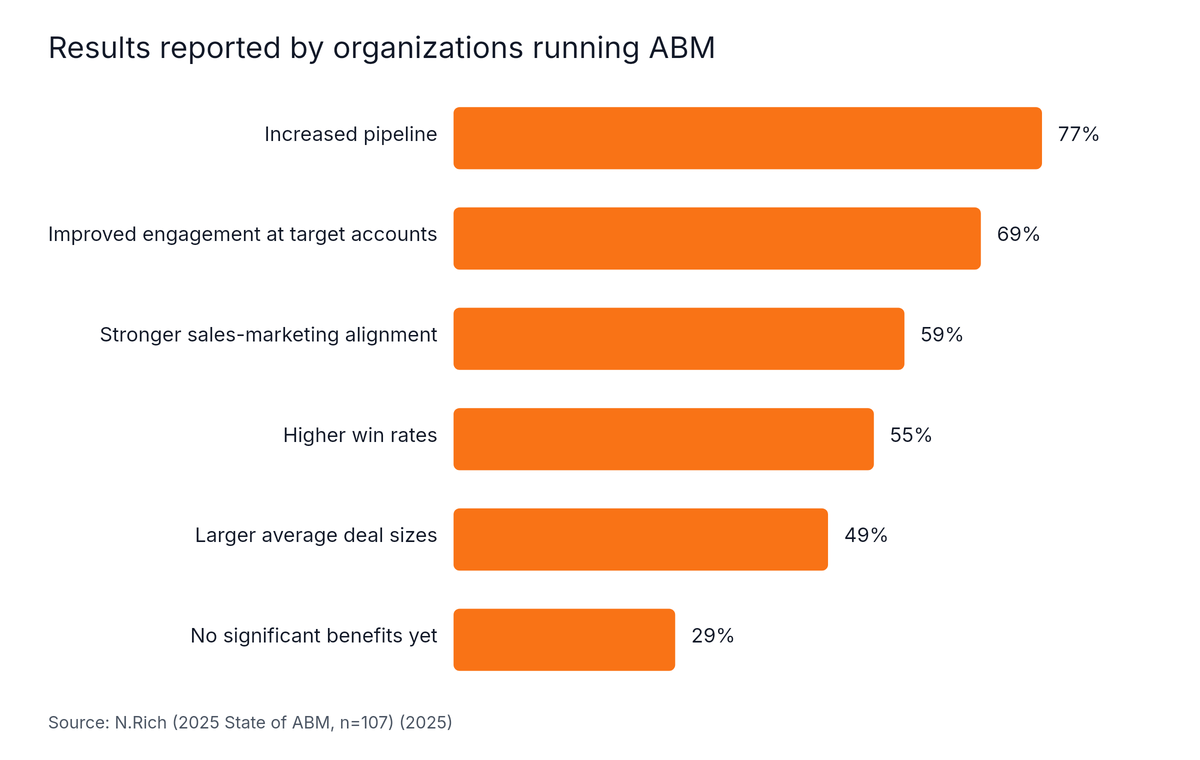
Source: N.Rich (2025 State of ABM, n=107), 2025
Pipeline gains are common, but not universal: 29% reported no significant benefits yet. For the reporting model, see pipeline per target account. For crediting multiple touches, see ABM attribution.
Account-based advertising is the wrong tool when the target list cannot clear the platform's audience minimum, when no seller follows up on engaged accounts, or when annual contract value (ACV) sits below roughly $15K. In the 2025 N.Rich survey of 107 B2B teams, 31% rated their ABM program unsuccessful (N.Rich, 2025).
The same survey shows 10% rating their ABM program very successful, 16% successful, 43% mixed and 31% unsuccessful (N.Rich, 2025).
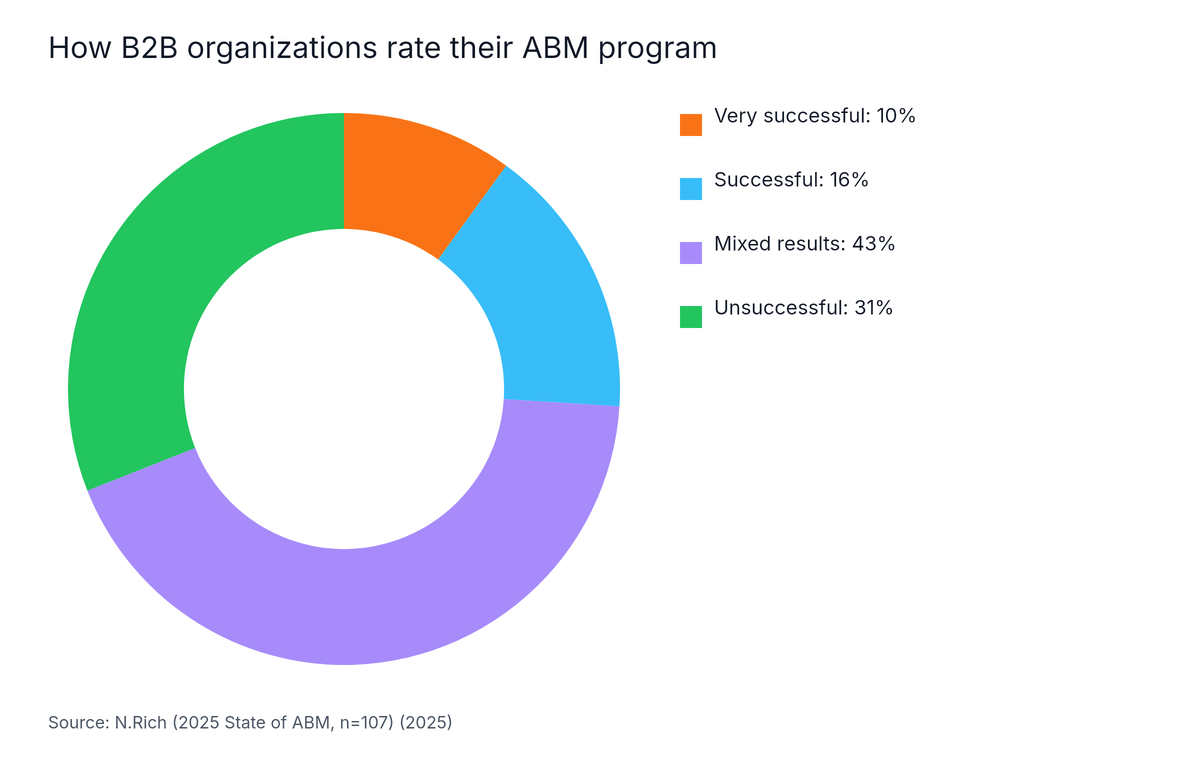
Source: N.Rich (2025 State of ABM, n=107), 2025
A mixed result is the most common outcome. It usually points to list size, missing exclusions or weak sales coordination, all fixable before the next budget review. For stage fit, see ABM versus inbound marketing.
An account-based advertising strategy for a B2B SaaS company has six parts: a target account list filtered by fit, account tiers, role-based audience layers with seniority and function exclusions, a channel and budget split, content for each buying group role, and account-level measurement agreed with sales. Each part limits wasted spend on people who cannot buy.
Account-based advertising is the paid media part of account-based marketing (ABM). ABM is the wider go-to-market approach that coordinates content, sales outreach, events and ads around named companies. Advertising delivers paid impressions to people at those companies, while ABM also covers sales coordination and measures pipeline per account.
Published ranges suggest 10 to 50 accounts for 1:1 treatment, 50 to 200 accounts in 5 to 15 clusters for 1:few, and 200 to 500 for 1:many. Common lists of 500 to 2,000+ named accounts often exceed what a small team can sustain. These are practitioner ranges with no stated sample.
LinkedIn can run account-based ads on 50 accounts only if the list matches at least 300 members. The minimum counts matched people, not companies. Teams clear it by combining lists, adding role layers, or grouping accounts into 1:few clusters. A list can still read as too small above 300 because of privacy filtering.
A dedicated ABM platform is not required for account-based advertising. N.Rich's 2025 survey of 107 B2B teams found most ABM teams run on LinkedIn, a CRM and spreadsheets, with only a minority using a dedicated platform. The decision depends on deal size, team size and whether a platform's data justifies its cost.
Account-based advertising works when the list, the roles and the follow-up are right, and it fails quietly when any of them is wrong. Pick fewer accounts. Reach the whole buying group. Measure pipeline.
The next step is to run your list through an ideal customer profile check, starting with firmographic data for target accounts, before uploading anything.
Written by
Ishan Manchanda
Ishan Manchanda is co-founder of GrowthSpree, a B2B SaaS marketing consultancy founded in 2017 that has managed $60M+ in ad spend across 300+ B2B SaaS companies. He focuses on demand generation, go-to-market strategy and pipeline growth, and has been featured in Silicon Valley Times, SaaS Mag and the Unbounce podcast.