Request a quote and our experts will contact you within 24 hours with tailored solutions and pricing.
Account Based Marketing Agency: What Scope to Demand and How to Avoid Platform Lock-In
An account based marketing agency is an outside team that plans and runs account-based marketing (ABM) for a defined list of named target accounts, and the safest ones keep strategy, licences and data in your hands rather than tied to one platform. Account-based marketing (ABM) is a go-to-market approach that focuses sales and marketing effort on named companies instead of broad audiences. Most agency pitches end with a platform recommendation, often for a platform the agency resells. Buyers then sign a retainer and discover the licence, the ad accounts and the audiences belong to someone else. Good scope starts with a clear ideal customer profile (ICP) built on firmographic data. This guide shows what a fair scope contains, how to spot a reseller, and which questions and clauses to settle before signing.
Key Takeaways
A fair ABM managed service scope names eight workstreams and labels each as included, excluded or billed separately.
A platform-independent account based marketing agency discloses partner status, rebates and referral fees in writing.
An agency tends to beat a platform when nobody in-house owns the ABM program; independent outcome data is thin, so treat thresholds as heuristics.
Licences, ad accounts, audiences and data should sit in the client's name, with short notice periods and a clean exit.
ABM agencies are a poor fit for teams without a seller working named accounts or without a defined ICP.
By the ABM for B2B SaaS Editorial Team. Last updated October 28, 2026. Sources and sampling notes are listed on the Methodology page.
What should an account based marketing agency's managed service scope include?
An account based marketing agency's managed service should cover eight workstreams: strategy, account selection, creative, media management, platform administration, data, reporting and sales enablement. Each needs a written label of included, excluded or billed separately. Forrester found that 73% of B2B purchases involve three or more departments (Forrester, 2026), so scope must reach the whole buying group.
A printed scope checklist with eight rows lying on a desk beside a pen and a closed laptop
A managed service is an arrangement where the agency operates the ABM program day to day against agreed deliverables, instead of only advising. That makes the scope document the main protection a buyer has.
Scope matrix by workstream
The matrix below shows how each workstream is commonly split. Treat it as a checklist for your own proposal review, not a market average.
Workstream
Usually included
Often excluded or billed separately
Question to ask
Strategy
Tiering, goals, playbooks
Executive workshops
Who writes the tier definitions?
Account selection
Fit scoring, list build
Third-party data fees
Whose data feeds the list?
Creative
Ad and email copy
Video, landing pages
How many assets per tier?
Media management
Campaign setup, optimisation
Media spend itself
Who owns the ad accounts?
Platform administration
Configuration, audiences
The licence
Whose name is on the licence?
Data
Enrichment, hygiene
Intent data subscriptions
What exports on exit?
Reporting
Pipeline per account
Custom board decks
Is there a holdout comparison?
Sales enablement
Account briefs, alerts
Rep training
Who coordinates with SDRs?
Tie scope to the ICP and the buying group
Scope should open with account selection. Target accounts should match the deals that actually close, so ask the agency how it defines fit using firmographic and technographic criteria. Then check that creative and outreach cover several roles per account. Forrester reported that 64% of business buyers at manager level and above were Millennials or Gen Z (Forrester, 2026), and that "Today's B2B buying groups are bigger, more networked, and increasingly led by digital natives." (Forrester, 2026). Generic one-persona campaigns undercut that.
Targeting also needs exclusions written into scope. A published audit shows what happens without them.
Our results: In the L26 study of 56 LinkedIn accounts and $9.4M in ad spend (GrowthSpree, June 2026), decision-makers received 33% of budget against a target of 60% or more. Individual contributors and entry-level staff consumed 36% of budget, and non-buying job functions caused 30% of wasted spend.
Ask every agency how its scope keeps spend on the roles that decide. Reporting belongs in scope too. Require pipeline per account rather than activity metrics, so the retainer is judged on outcomes.
How do the four ABM agency models compare?
Four operating models run ABM today: an independent strategy-only agency, an integrated B2B agency, a platform-powered reseller managed service, and an in-house team with a platform. They differ mainly in incentives and lock-in risk. No independent study compares their outcomes: Inflexion Group's 2026 benchmark rests on 16 interviews and a survey of 40 large organisations (Inflexion Group, 2026), so rankings are heuristics.
Four distinct wooden building blocks in a row, each a different shape, on a pale table
A reseller is an agency that earns margin, rebates or referral fees when a client buys a particular platform. That incentive does not make the work bad, but it does shape the advice. The same Inflexion study found nearly 20% of marketing resources going to ABM (Inflexion Group, 2026), so the cost of a wrong model is not small.
Model
Who may profit from your platform choice
Typical scope
Lock-in risk (editorial judgment)
Best fit
Independent strategy-only agency
No one, if fees are flat
Strategy, list, measurement
Low
Teams with an operator in-house
Integrated B2B agency
Sometimes, via partner programs
Strategy plus creative and media
Medium
Teams needing content and channels
Platform-powered reseller managed service
The agency, via margin or rebates
Platform bundled with operation
High
Teams that already chose the platform
In-house team plus platform
The platform vendor
Everything owned internally
Medium (vendor changes)
Teams with ABM owners and budget
The lock-in column is an editorial rating, not measured data. The no-platform option stays open in every row: ABM can run on LinkedIn and a CRM, and an independent agency should be willing to scope that version. For a view of what platforms cost in features and commitment, see the ABM platform and software comparison.
When does an ABM agency beat buying an ABM platform?
An ABM agency beats a platform when nobody in-house owns the program, the target account list is short, or strategy and sales coordination are the bottleneck instead of data. Inflexion Group's 2026 benchmark concluded that "success now depends more on how programmes are organised and skilled than on how much they spend" (Inflexion Group, 2026).
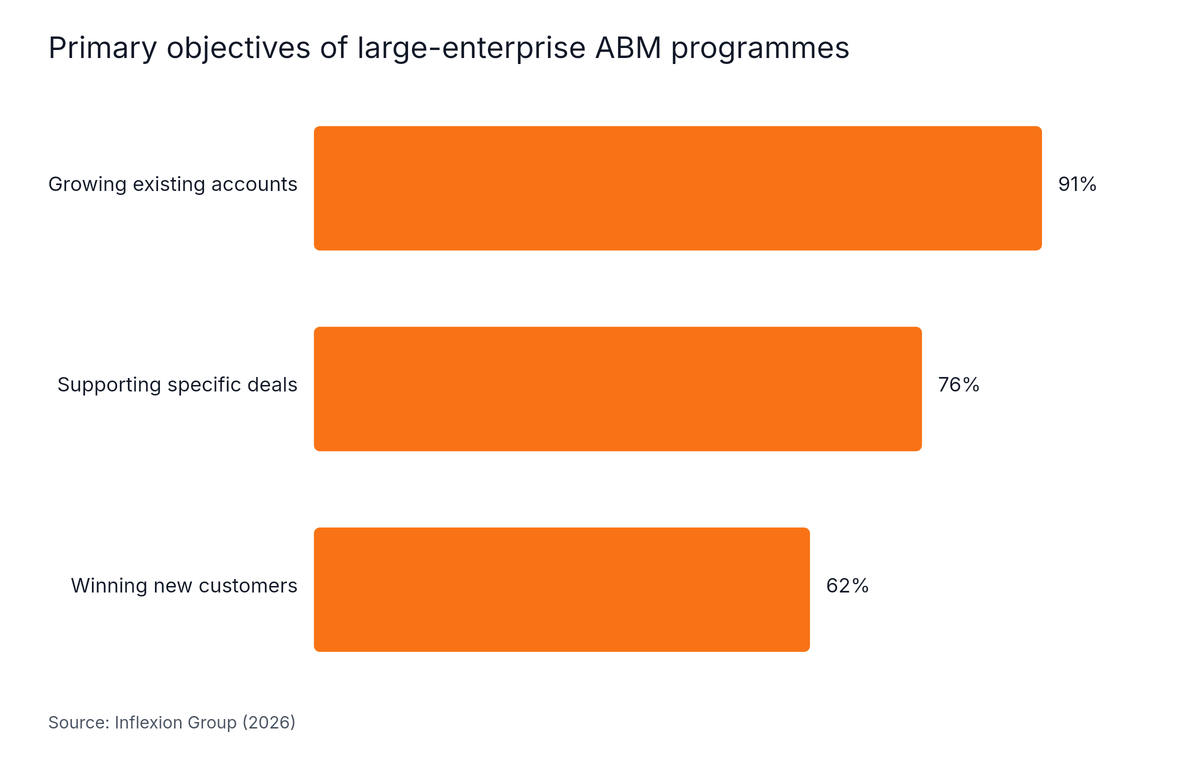
Horizontal Bar chart: Primary objectives of large-enterprise ABM programmes. Highest: Growing existing accounts at 91%.
Inflexion's study is small and skews to large enterprises. Among them, 91% named growing existing accounts as a primary objective, 76% named supporting specific deals and 62% named winning new customers (Inflexion Group, 2026). Ask the agency which of these objectives its scope serves.
Heuristics for choosing
Independent data on when an agency beats a platform is thin, so these rules are judgments, not findings:
No ABM owner in-house: an agency or contractor comes first, because a platform without an operator becomes a dashboard nobody uses.
An owner exists and the list is large: a platform may earn its cost, provided someone can act on its signals.
Small list, one or two sellers: LinkedIn and a CRM often do the job, with agency help on strategy only.
Platform already owned: an agency can run it through an operator seat, which avoids a second licence.
How do you find an account based marketing agency that is not a platform reseller?
A platform-independent agency is one that earns nothing from your platform choice: it discloses partner status, rebates and referral fees in writing, and will draft a proposal with two or three vendor options, including no platform. Reseller relationships can be detected with written disclosure requests, licence ownership checks and a platform-agnostic proposal.
A magnifying glass held over a signed contract page highlighting a line of small print
Five reseller tests
Request written disclosure. Ask for partner tier, margin, rebates, referral fees and co-sell incentives for every platform the agency mentions.
Ask whose name is on the licence. A licence on the agency's paper is the clearest lock-in signal.
Look for a bundled platform. If the retainer includes a platform with no separate line, markup is hidden.
Ask for a platform-agnostic proposal. Two or three vendors, plus a no-platform option, each with costs.
Read the pattern. If every recommendation across every client scenario lands on one vendor, treat the agency as a reseller.
Why vendor changes matter
Platforms change hands, and an agency built around one tool inherits that risk. One independent ownership table dated 12 November 2024 records Terminus merging into DemandScience while 6sense and Demandbase remain independent (Veza Digital, 2024). This is a single secondary trade source, so confirm current ownership at the vendor. The point stands: an agency's tooling and reseller deals can shift under you, which is another reason to hold the licence yourself.
Which contract terms and questions prevent ABM platform lock-in?
Five contract terms protect an ABM program from platform lock-in: the licence sits in the client's name, ad accounts and audiences belong to the client, data exports on request, notice periods stay short, and exit transfers creative and configurations. Forrester's public-sector research finds 14 internal stakeholders per purchase on average (Forrester, 2026), so contracts should outlast any single sponsor.
An open brass padlock resting on a folded contract beside a pen
An operator seat is a user login on the client's own platform licence that lets an agency run the platform without owning it. It is the cleanest structure for agency-run platforms. The Forrester figure rises to 18 in APAC (Forrester, 2026), so teams in that region should expect even more handovers between contacts. Fees are opaque, since no independent source gives typical retainers, so an itemised, line-by-line quote is the safer benchmark.
Contract clause checklist
Clause
What to require
Red flag
Licence ownership
Licence in the client's name; agency holds an operator seat
Licence on agency paper
Ad accounts
Client owns accounts, agency gets access
Agency-owned ad accounts
Data and audiences
Export of lists, audiences and records on request
Data held "for security"
Term and notice
Short minimum term, defined notice period
Long auto-renewal
Exit transfer
Creative, configurations and documentation handed over
Fees to release assets
Questions to ask before signing
Do you earn margin, rebates or referral fees from any platform you recommend?
Can you write a proposal with a no-platform option?
Whose name will be on the licence, ad accounts and data?
What exactly is excluded from the retainer: media, licences, intent data?
Who works on the account day to day, and who coordinates with our SDRs?
How do you define fit and intent when building the target account list?
Will reporting show account-to-opportunity rate and pipeline per account?
Will you hold out holdout accounts, meaning target accounts kept out of treatment so results can be compared?
What do we receive if we leave after the minimum term?
Hiring an account based marketing agency is the wrong move when no seller works named accounts, annual contract value (ACV) is low, or the ideal customer profile is still undefined. Forrester's January 2026 buying research puts a typical B2B decision at 13 internal stakeholders and nine external influencers (Forrester, 2026), which shows how many roles an account program must reach.
ABM for B2B SaaS publishes a rule of thumb that ABM typically pays when ACV exceeds $15K and at least one seller works named accounts. Below that price point, the cost of reaching several stakeholders per account usually exceeds the return. This is a published rule with no stated sample, not a study finding.
Other limits apply:
Demand generation may fit better. Teams chasing lead volume from broad audiences should look at where demand generation ends and ABM begins before paying for named-account work.
Regional rules differ. Privacy rules around intent data, email outreach and visitor identification vary, especially in Europe. Ask agencies how they handle them; this page is not legal advice.
Evidence is thin. The benchmarks cited here come from small samples of large enterprises, and none compares agency-led, platform-led and in-house outcomes.
Fees are unverified. Published retainer ranges are agency or directory claims, so only an itemised quote is reliable.
I'm evaluating ABM managed services: what should be included and when does an agency beat a platform?
ABM managed services should include strategy, account selection, creative, media management, platform administration, data, reporting and sales enablement, each labelled included, excluded or billed separately. An agency beats a platform when no one in-house owns the program or when strategy and sales coordination, not data, limit results. A platform fits teams with an owner and the capacity to operate it.
We want external ABM strategy help but do not want an agency that just recommends its own platform: how do we find one?
Find a platform-independent ABM strategy agency by requiring written disclosure of partner status, rebates and referral fees, asking whose name is on every licence, and requesting a proposal with two or three vendor options including no platform. An agency that cannot produce a platform-agnostic proposal is probably acting as a reseller.
How much does an ABM agency cost and what is usually billed separately?
No independent source gives reliable typical ABM agency fees, so published retainer ranges should be treated as agency or directory claims. Media spend, platform licences and intent data are the items most often excluded from a retainer. Ask for an itemised, line-by-line quote that separates fees, pass-through media and licences.
Can an ABM agency run ABM on a platform we already own?
Yes, an ABM agency can run a platform you already own, usually through an operator seat on your licence. This keeps the contract, data and configurations in your name. Confirm the agency has hands-on experience with that platform and agree in writing who administers it and what transfers when the engagement ends.
Verdict: which agency model fits which team?
When choosing an account based marketing agency, choose an independent strategy-only agency when an in-house operator exists and lock-in is the main worry. Choose an integrated agency when content and channels are the gap. Choose a reseller-run service only after written disclosure and a licence in your name. Choose in-house plus a platform when owners and budget exist. Keep the no-platform route on the table throughout.
Demand a scope matrix with every workstream labelled.
Test for reseller incentives before the pitch ends.
Hold the licence, ad accounts and data in your name.
Stay away from agencies if no seller owns named accounts.
Next step: bring your target account list and compare it against the scope matrix above with someone who has no platform to sell.
Meet with an expert: A free consultation. Bring your target account list and brainstorm the next step with an ABM expert.
Written by
Ishan Manchanda
Ishan Manchanda is co-founder of GrowthSpree, a B2B SaaS marketing consultancy founded in 2017 that has managed $60M+ in ad spend across 300+ B2B SaaS companies. He focuses on demand generation, go-to-market strategy and pipeline growth, and has been featured in Silicon Valley Times, SaaS Mag and the Unbounce podcast.
 Ishan ManchandaNov 9, 2026