account based marketing contentaccount-based content marketingaccount-based content vs standard content strategy
Account Based Marketing Content: How It Differs from Standard Content Strategy
Account based marketing content is written for named accounts and buying group roles, not traffic. See how briefs, KPIs and distribution change, with 2026 data.
Request a quote and our experts will contact you within 24 hours with tailored solutions and pricing.
Account Based Marketing Content: How It Differs from Standard Content Strategy
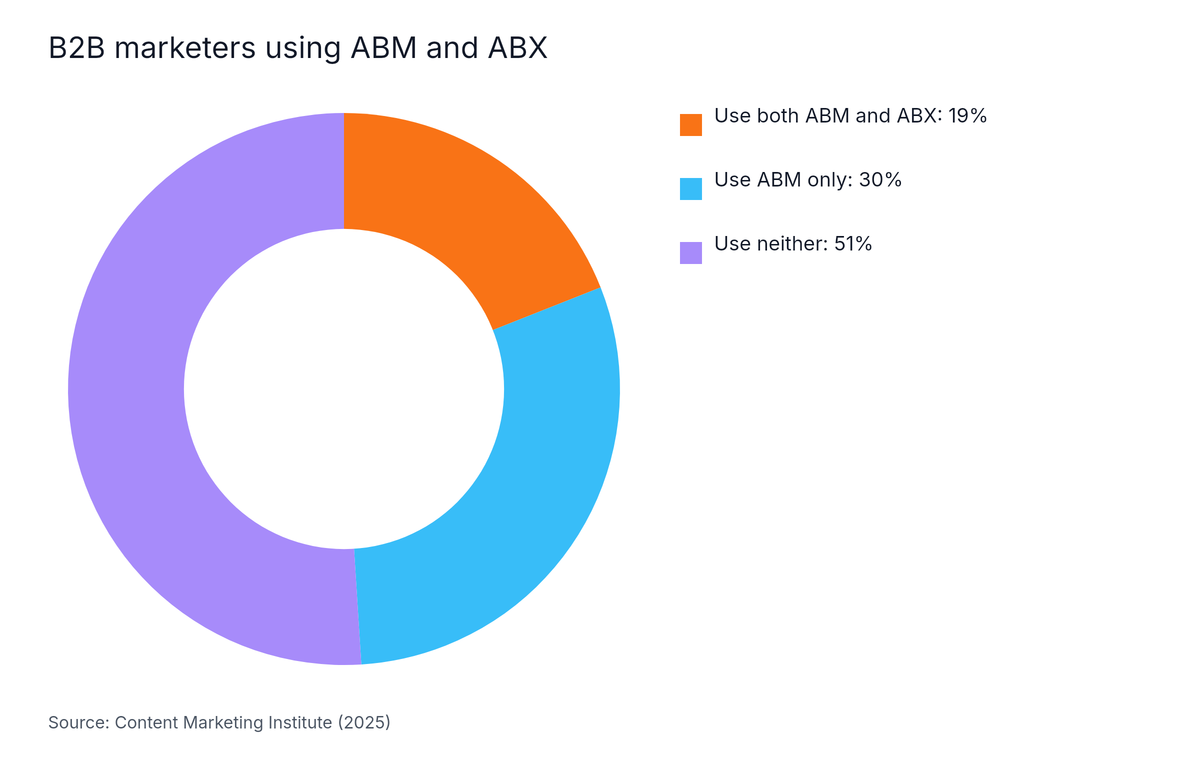
Account-based content marketing is the practice of writing content for a defined list of named target accounts, often for specific buying group roles, and judging it by whether it advances opportunities there rather than by pageviews. That shift changes every part of account based marketing content, from the brief to the KPI. Most B2B teams haven't made it. The Content Marketing Institute's 2026 B2B survey, published in October 2025, found 51% of B2B marketers use neither account-based marketing (ABM) nor ABX (Content Marketing Institute, 2025). Standard, audience-level content is still the default. This guide shows where the two approaches split: briefs, calendars, distribution, ownership and measurement. It also covers how many accounts justify the effort. Teams still defining who belongs on the list can start with firmographic data for target accounts.
Key Takeaways
Account-based content is written for named target accounts and buying group roles, and judged on opportunity progress at those accounts, not on pageviews or organic traffic.
Standard content strategy optimises for reach; account-based content optimises for relevance to a short list, so the brief, calendar, distribution and ownership all change.
Forrester puts the typical business purchase at 13 internal stakeholders and nine external influencers (2026), so one persona per campaign rarely covers the buying group.
Account-based content should be measured on account-to-opportunity rate and pipeline per account, compared with holdout accounts.
Published ranges suggest 100 to 300 target accounts is a workable list for a small team; 500 to 2,000+ is common but hard to sustain.
What is account-based content marketing and how does it differ from standard content strategy?
Account-based content marketing is content produced for a named list of target accounts and their buying group, while standard content strategy is content produced for a broad persona to maximise reach and organic traffic. The difference is the unit of success: standard content is judged on audience size and traffic, account-based content on whether opportunities advance at the listed accounts.
A printed list of company folders fanned out on a desk beside a single highlighted folder
Account-based content is content written for a defined list of named companies, often for a specific buying group role, and judged on whether it advances the opportunity at those accounts. Account-based marketing (ABM) is the wider go-to-market approach that focuses sales and marketing effort on those named target accounts instead of a broad audience. Account-based content is the writing and asset layer inside that approach.
Here is how the two strategies compare on the points that matter.
Dimension
Standard content strategy
Account-based content
Audience
Broad persona or segment
Named target accounts and buying group roles
Goal
Reach, organic traffic, lead volume
Opportunity progress at listed accounts
Topic source
Keyword research and trends
Account research, deal stage and role concerns
Typical volume
Many assets for many readers
Fewer assets, each with a specific reader
Success test
Pageviews, rankings, MQL counts
Account-to-opportunity rate, pipeline per account
The two are not opposites. Many B2B SaaS companies run demand generation alongside ABM, applying account-based content to the accounts with the highest fit and deal-size potential. Adoption is still a minority position: 30% of B2B marketers use ABM only and 19% use both ABM and ABX, against 51% who use neither (Content Marketing Institute, 2025).
Donut chart: B2B marketers using ABM and ABX. Highest: Use neither at 51%.
How does account-based content work differently from standard content at the working level?
Account-based content differs from standard content strategy at the working level in five places: the brief, the editorial calendar, distribution, ownership and the success metric. Standard content starts from a keyword and a persona. Account-based content starts from a named account list and a buying group role, and sales shares ownership of what gets made and where it goes.
Two editorial planning boards side by side, one with many small cards and one with a few labelled account cards
Most guides stop at the definition. The working-level changes are where the strategies actually part ways.
Working element
Standard content strategy
Account-based content
Brief
Keyword, persona, search intent
Account tier, buying group role, deal stage, known objection
Calendar
Publishing cadence by topic cluster
Sequenced to account events and sales cycle timing
Distribution
Organic search, social, email list
Matched-account ads, sales outreach, direct sends, account pages
Owner
Content or SEO lead
Marketing and sales together
Review question
Did it attract readers?
Did a named account move forward?
Personalization depth is the real divider
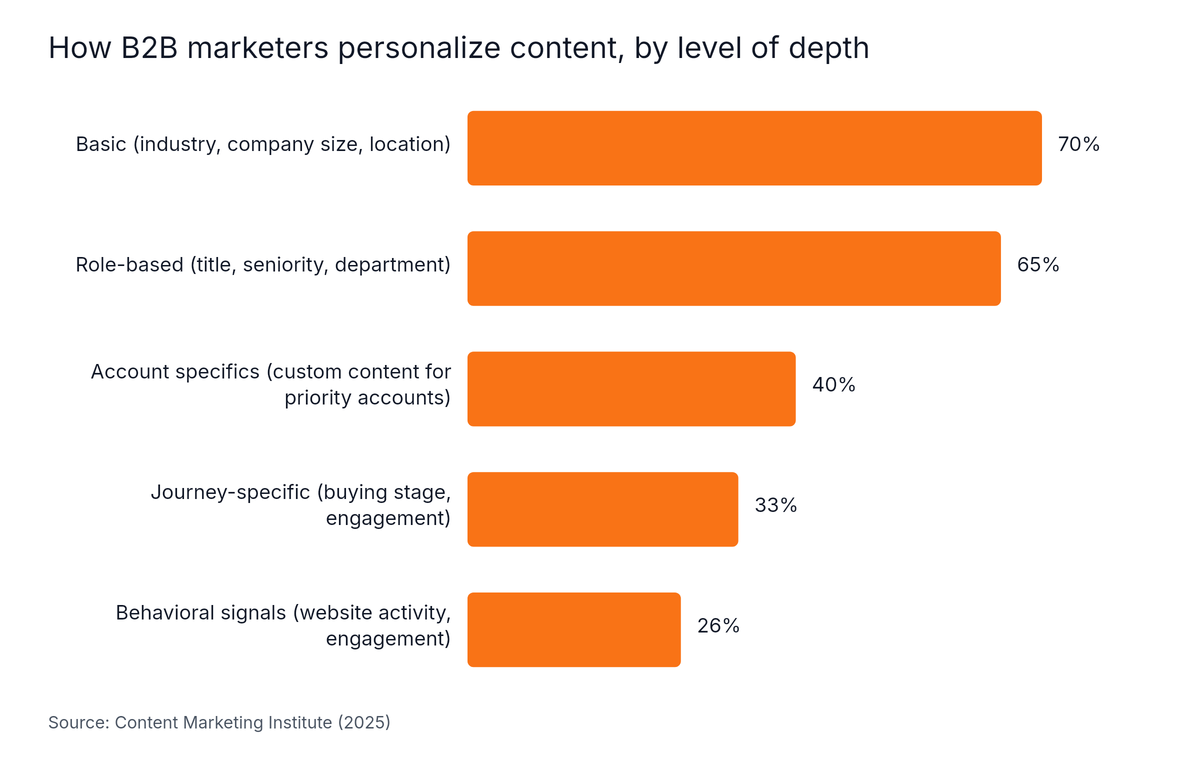
Many teams call industry or name swaps personalization. The same CMI survey shows how thin the deeper levels are: 70% use basic personalization, 65% role-based, 40% account specifics, 33% journey-specific and 26% behavioral signals (Content Marketing Institute, 2025). Only 40% write custom content for priority accounts. That gap separates segmented content from true account based marketing content.
Horizontal Bar chart: How B2B marketers personalize content, by level of depth. Highest: Basic (industry, company size, location) at 70%.
Sales coordination is part of the workflow, not an add-on. Sellers know which account is in a live deal and which objection is stalling it. That knowledge belongs in the brief. ABM best practices for B2B SaaS covers the shared-ownership model in more detail.
How do you create content for each role in a buying group?
Create account-based content for each buying group role by mapping who sits on the buying committee at each account tier, then giving every asset one job: answering that role's specific risk. Forrester's 2026 research puts the typical decision at 13 internal stakeholders and nine external influencers (Forrester, 2026), so one persona per campaign leaves most of the group unreached.
A conference table seen from above with a dozen different notepads placed at each seat
A buying group is the set of stakeholders at one account who take part in a purchase decision. It grows with deal size and with new technology. Forrester's Buyers' Journey Survey of nearly 18,000 global business buyers found buying groups growing sharply for purchases that include genAI features, at 14 members vs. seven (Forrester, 2026).
Published ranges (BC26, GrowthSpree, 2026; no sample stated) show how group size and sales cycle scale together:
Deal size (ACV)
Stakeholders
Sales cycle
$25K to $100K
5 to 8
49 to 84 days
$100K to $250K
7 to 10
84 to 126 days
$250K to $1M
10 to 15
126 to 180 days
Procurement joins most large deals: 62% to 78% of US enterprise deals and 85% to 94% of Indian enterprise deals, per the same published ranges.
What each role needs from a content set
Economic buyer: a short business case with cost, risk and payback in their terms.
Champion: material they can forward without rewriting.
Technical or security reviewer: documentation that answers integration and compliance questions before they ask.
Procurement and finance: clear pricing logic, contract terms and reference points.
Conflict inside the group is common. Gartner found 74% of B2B buyer teams show unhealthy conflict during the decision process, and that content tailored to the buying group lifts consensus while individual-level relevance harms it (Gartner, 2025). Write each asset so it reads well for the whole group, not just its target role.
Distribution must match. In 56 audited LinkedIn accounts, individual contributors and entry-level staff consumed 36% of budget, non-buying job functions caused 30% of wasted spend and 20% of spend reached firms under 50 employees (L26, GrowthSpree, June 2026). Right company, wrong people is a distribution failure, not a content failure.
How do you measure account-based content if not by pageviews?
Measure account-based content at the account level: account-to-opportunity rate, pipeline per account and stage progression at named accounts, compared with holdout accounts that received no treatment. Pageviews, organic traffic and marketing-qualified lead counts describe audience size, not account progress. In 56 audited LinkedIn accounts, decision-makers received 33% of budget against a target of 60% or more (L26, GrowthSpree, June 2026).
A brass balance scale with a small stack of coins on one side and a single key on the other
Three terms anchor the swap. Account-to-opportunity rate is the share of target accounts that open a sales opportunity in a set period. Pipeline per account is the opportunity value created divided by the number of target accounts in a tier. Holdout accounts are a matched set of accounts that receive no ABM treatment and serve as the comparison group.
Standard content metric
Account-based replacement
Why it changes
Pageviews and sessions
Engaged buying group roles per account
Counts people who decide, not any visitor
Organic traffic
Target accounts reaching a defined stage
Traffic from non-target firms adds nothing
MQL count
Account-to-opportunity rate
Measures the account, not the lead
Content downloads
Opportunities and pipeline per account
Ties content to revenue
Campaign ROI overall
Lift versus holdout accounts
Shows what the content added
Time matters. An ABM program shouldn't be judged on pipeline before at least one full sales cycle has passed. For the full method, see ABM measurement from activity to pipeline. When several touches hit one account, ABM attribution explains how to credit them. Teams whose dashboards show hundreds of engaged accounts and no pipeline can start with B2B marketing analytics for pipeline.
How do you scale account-based content with AI without it feeling generic?
Scale account-based content with AI by using it for production and keeping people on the account-specific insight. Userled's 2026 survey of 250+ practitioners found 80% of ABM teams raised content output by 20% or more with AI, yet only 30% can act on a buying signal the day it appears (Userled, 2026). Volume is cheap; relevance is the constraint.
A hand sorting printed paper cards into a small number of labelled trays
Treat the Userled figures with caution: they come from a vendor survey. The direction still matches other 2026 findings. The Demand Gen Report 2026 ABM Benchmark Survey says nearly 80% of surveyed organizations are executing ABM, ranks personalized content as the highest-ROI tactic at 47%, and names AI content personalization as the top AI use case at 29% (Demand Gen Report, 2026).
A reuse model that keeps content specific
One hero asset per tier. Build one strong piece, such as a research-backed point of view, for the tier.
Adapt per role. Rewrite the opening, evidence and call to action for each buying group role.
Add the account layer by hand at 1:1. Put the account's own situation, a named internal risk and a relevant reference into the top accounts only.
Assign every signal an owner. An intent signal that no seller acts on wastes the content built around it.
Gartner's 2026 sales survey reports 67% of B2B buyers prefer a rep-free experience, and says static collateral cannot carry influence on its own (Gartner, 2026). Content has to carry real value for the buyer's role and context. AI drafts help; they don't supply that context.
How many target accounts make account-based content worth it, and who is it not for?
Account-based content is worth the effort when a team can sustain it across a short named list, typically 100 to 300 target accounts, and when annual contract value (ACV) is high enough to justify role-level work. Published ranges put 1:1 at 10 to 50 accounts, 1:few at 50 to 200 and 1:many at 200 to 500 (ABM26, GrowthSpree, June 2026; no stated sample).
Lists of 500 to 2,000+ named accounts are common at companies that should run 100 to 300 (ABM26). A team of three can't write role-level content for 1,500 accounts. The list becomes a market map, not a workable account set.
ABM tier
Account range
Content treatment
1:1
10 to 50 accounts
Bespoke assets per account and per role
1:few
50 to 200 accounts in 5 to 15 clusters
One content set per cluster, adapted by role
1:many
200 to 500 accounts
Programmatic content with light personalization
Who this approach is not for
Low-ACV products. ABM typically pays when ACV exceeds $15K and at least one seller works named accounts. Below that, the cost of reaching several stakeholders per account usually exceeds the return.
Teams with no sales coordination. Without a seller who owns the account, content has no one to carry it into a deal.
Teams that will judge it on MQLs. Dashboards built for volume will make a short, high-fit list look like failure.
Companies with no brand awareness yet. Practitioners argue named accounts need some prior familiarity, so early-stage teams may need broader content first. This is a practitioner view, not a tested rule.
Target cost per sales-qualified lead (SQL) sets a useful ceiling: $1,000 to $3,000 for $15K to $50K ACV contracts, $3,000 to $8,000 for $50K to $150K and $8,000 to $20,000 for $150K+ (B26, GrowthSpree, April 2026). If account-based content can't fit inside those bands, a leaner motion fits better. The comparison of ABM and inbound marketing helps teams choose by stage.
Frequently Asked Questions
What is the difference between 1:1, 1:few and 1:many account-based content?
1:1 account-based content is bespoke work for a single high-value account. 1:few groups accounts with shared traits into clusters of roughly 5 to 15 and writes for each cluster. 1:many applies programmatic content across a named list of 200 to 500 accounts. The tier sets how much custom work each account receives.
Is account-based marketing just targeted demand generation?
No. Demand generation targets audiences defined by persona and interest and optimises for lead volume, while account-based marketing targets a defined list of named companies and measures success per account. Many B2B SaaS companies run both, applying account-based content to the accounts with the highest fit and deal-size potential.
How long does account-based content take to produce pipeline?
Sales cycle length is the floor. Published ranges put cycles at 49 to 84 days for $25K to $100K deals, 84 to 126 days for $100K to $250K deals and 126 to 180 days for $250K to $1M deals, with no stated sample. An ABM program should not be judged on pipeline before one full sales cycle has passed.
Is account-based content worth it for a small B2B SaaS team?
Account-based content typically pays when annual contract value exceeds $15K and at least one seller works named accounts. Below that price point, the cost of reaching several stakeholders per account usually exceeds the return. A small team should start with a list of 100 to 300 accounts or fewer.
Conclusion
Account based marketing content is a different job from standard content strategy, not a smaller version of it. The audience is a short list, the reader is a role, and the test is opportunity progress.
Write for named target accounts and buying group roles, not a broad persona.
Change the brief, calendar, distribution and ownership, with sales in the loop.
Cover the whole buying group: Forrester's 13 internal stakeholders and nine external influencers rarely fit one persona.
Measure account-to-opportunity rate and pipeline per account against holdout accounts.
Keep the list at a size the team can sustain, often 100 to 300 accounts.
A good next step is to bring a draft target account list to someone who has run the motion. A free consultation is available: Meet with an expert. Bring the list and brainstorm the next step with an ABM expert.
Written by
Ishan Manchanda
Ishan Manchanda is co-founder of GrowthSpree, a B2B SaaS marketing consultancy founded in 2017 that has managed $60M+ in ad spend across 300+ B2B SaaS companies. He focuses on demand generation, go-to-market strategy and pipeline growth, and has been featured in Silicon Valley Times, SaaS Mag and the Unbounce podcast.
 Ishan ManchandaNov 8, 2026