Blog
Attribution Models for B2B SaaS: What Each Measures and Where It Fails
Attribution models compared by deal size, sales cycle and buying group. What first-touch, last-touch, U-shaped and W-shaped each measure and where they fail.
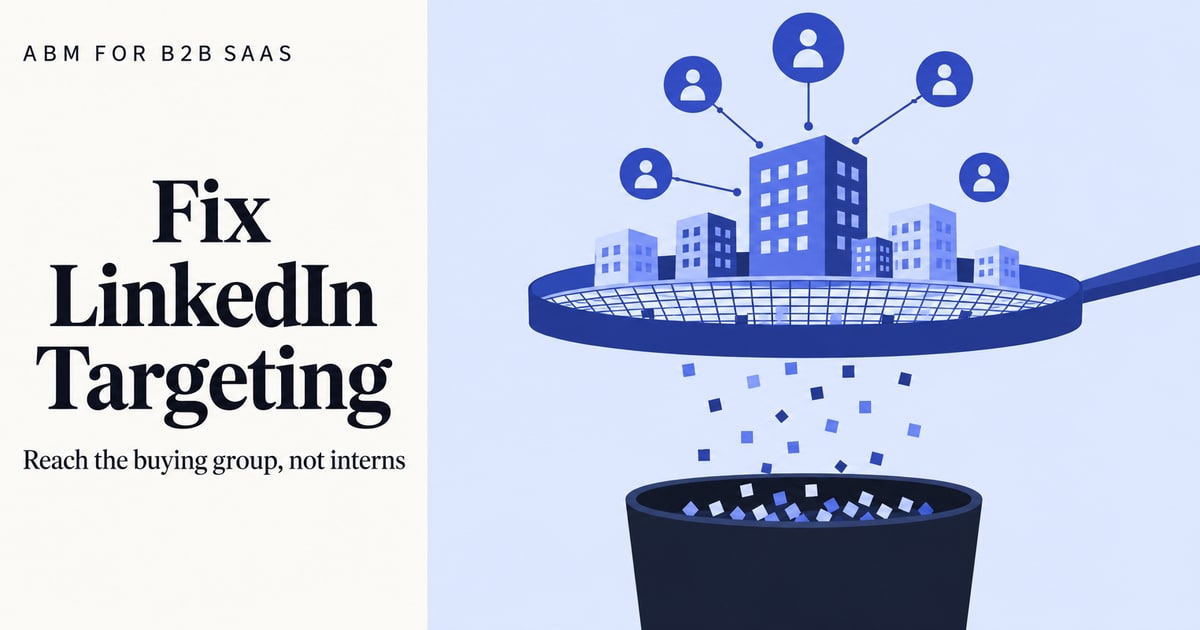
Fix account based marketing LinkedIn targeting: measure waste, exclude non-buyers, cover the buying group and scale from 50 to 200 target accounts.
 Ishan ManchandaNov 7, 2026
Attribution models compared by deal size, sales cycle and buying group. What first-touch, last-touch, U-shaped and W-shaped each measure and where they fail.
Published ranges for splitting B2B SaaS marketing budget across ABM, demand generation, and brand, with sources, sample status, and a tier-first method.
Cut an oversized target account list to team capacity: fit and intent scoring, tier sizes, TAM limits, template fields and post-quarter refinement.
Request a quote and our experts will contact you within 24 hours with tailored solutions and pricing.
abmforb2bsaas.com
Last updated: Nov 7, 2026
By the ABM for B2B SaaS Editorial Team. Last updated October 28, 2026.
Account-based marketing (ABM) on LinkedIn is the practice of restricting ads to a named list of target accounts, then filtering by job function and seniority so budget reaches the whole buying group. Most account based marketing LinkedIn programs get the company list right and the people wrong. In an audit of 56 LinkedIn accounts reviewed by ABM for B2B SaaS, individual contributors and entry-level staff consumed 36% of budget, and 20% of spend reached firms under 50 employees. This guide shows how to measure that leakage, set exclusions that do not over-trim, pick tools, rank accounts by buying signals and keep campaigns under control as the list grows. For the metric framework first, read ABM measurement on pipeline per account.
Key Takeaways
- LinkedIn ABM targeting leaks budget when a company list is used without job-function, seniority and company-size exclusions: in 56 audited accounts, decision-makers received 33% of budget against a target of 60% or more.
- A LinkedIn buying group needs several roles covered per target account, including procurement, because Forrester reports procurement is a decision-maker in 53% of buying cycles (2026).
- LinkedIn's 300-member minimum audience means a 50-account list cannot run alone and must be combined or padded, then measured on the named subset.
- Account tier, not one blended campaign, should set budget, landing page and signal rules, with one action and one owner per intent signal.
Fixing LinkedIn ABM targeting starts with measuring where spend lands, then adding job-function, seniority and company-size exclusions to the matched company list. In an audit of 56 LinkedIn accounts and $9.4M in ad spend, individual contributors and entry-level staff consumed 36% of budget, while Forrester reports 13 internal stakeholders in a typical buying decision (Forrester, 2026).

A matched company list is the LinkedIn method of uploading named companies so ads only serve to members who work there. It answers the "which companies" question and nothing else. Inside each company, LinkedIn still serves ads to anyone who fits the audience, including analysts, interns and job seekers.
The audit is one dataset, so treat it as a benchmark to test against your own account, not a law.
Our results: Across 56 audited LinkedIn accounts and $9.4M in ad spend, decision-makers received 33% of budget against a target of 60% or more. Individual contributors and entry-level staff consumed 36%, non-buying job functions caused 30% of wasted spend, and 20% of spend reached firms under 50 employees.
| Metric (56 audited accounts) | Finding | Benchmark target |
|---|---|---|
| Budget reaching decision-makers | 33% | 60% or more |
| Budget consumed by individual contributors and entry-level staff | 36% | Exclude by default |
| Wasted spend caused by non-buying job functions | 30% | Minimize |
| Spend reaching firms under 50 employees | 20% | Exclude or leave off the list |
The waste is expensive because, in the same audit, LinkedIn clicks for B2B SaaS ran $8 to $25 by vertical. Wrong-person spend also distorts cost per sales-qualified lead (SQL), which is a lead that sales has accepted as a real sales opportunity. Published target ranges, with no stated sample, set cost per SQL by annual contract value (ACV), the yearly revenue a customer contract brings in:
Measure before you exclude, so you know what each exclusion saves.
Verify the fix by repeating the export after two weeks: the decision-maker share should rise and the junior share should fall.
The LinkedIn ABM targeting approach that reaches decision-makers uses a matched company list as the base, layers job function and seniority on top, and covers several roles per account instead of one. Forrester found in 2026 that the typical buying decision includes 13 internal stakeholders and nine external influencers (Forrester, 2026).

A buying group is the set of people inside and around a target account who influence or approve a purchase. Forrester puts the typical size at "The typical buying decision now includes 13 internal stakeholders and nine external influencers" (Forrester, 2026). A campaign aimed at one title misses most of them.
LinkedIn's documentation confirms the mechanism: "you can also apply LinkedIn professional demographic targeting, such as job function or seniority, on top of a list" (Microsoft Learn, LinkedIn Marketing API, 2026). Build the include and exclude logic as a role matrix, not a single title list.
| Role group | Include or exclude | Why | Watch for |
|---|---|---|---|
| Executives and VPs (economic buyers) | Include | Senior leaders hold the most decision weight | Small audiences in some countries |
| Directors and managers in the champion function | Include | They build the business case | Overlap with other tiers |
| Procurement, finance and legal | Include on higher-ACV tiers | Procurement is a decision-maker in 53% of cycles (Forrester, 2026) | Do not exclude as "non-buyers" |
| Security, IT or data owners | Include when the product touches them | They can block late-stage deals | Match the function to the offer |
| Individual contributors and entry-level staff | Exclude | Largest share of leaked budget (36% in the audit) | Some users influence; reach them with organic content |
| Interns, students, job seekers | Exclude | No buying role | Check job-title keywords |
| Your own employees and competitors | Exclude |
Before launch, check settings such as Audience Expansion and the Audience Network against LinkedIn's current documentation, since defaults change.
Exclusion logic can over-trim. Forrester reports "procurement professionals now serve as decision-makers more than half the time (53%) in the average business buying cycle" (Forrester, 2026). It also found that 94% of buyers in groups of six or more mostly see larger groups as beneficial (Forrester, 2026), so wider committees are normal, not friction. A trade-association summary adds that C-suite leaders are the group most likely to identify as decision-makers, at 68% (BIIA, 2026).
Weight the budget, though. In an Influ2 2026 survey of 50 buyers (small and vendor-run, so directional), a senior leader's opinion carried the most weight for 32% of buyers, equal to group decisions at 32%. Day-to-day end users carried it for 16% (Influ2, 2026).
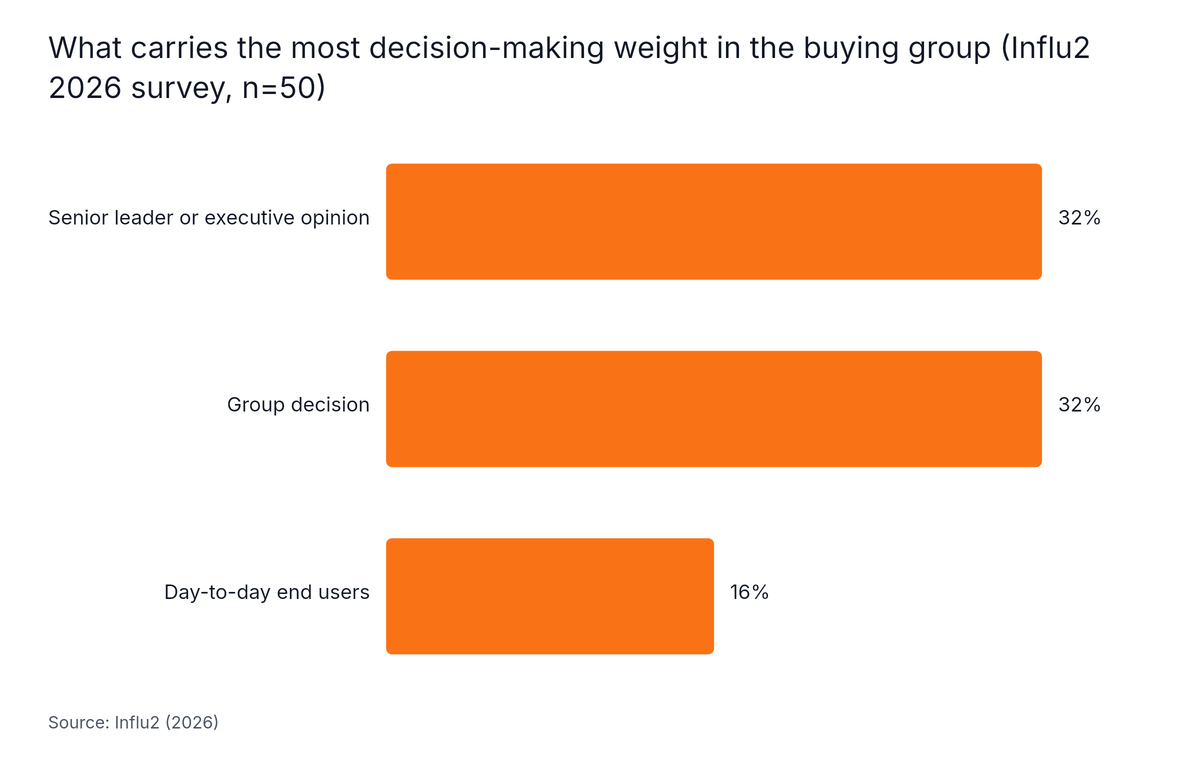
Source: Influ2, 2026
Deal size sets how many roles to cover. Published ranges with no stated sample show 5 to 8 stakeholders in $25K to $100K deals, 7 to 10 in $100K to $250K deals and 10 to 15 in $250K to $1M deals.
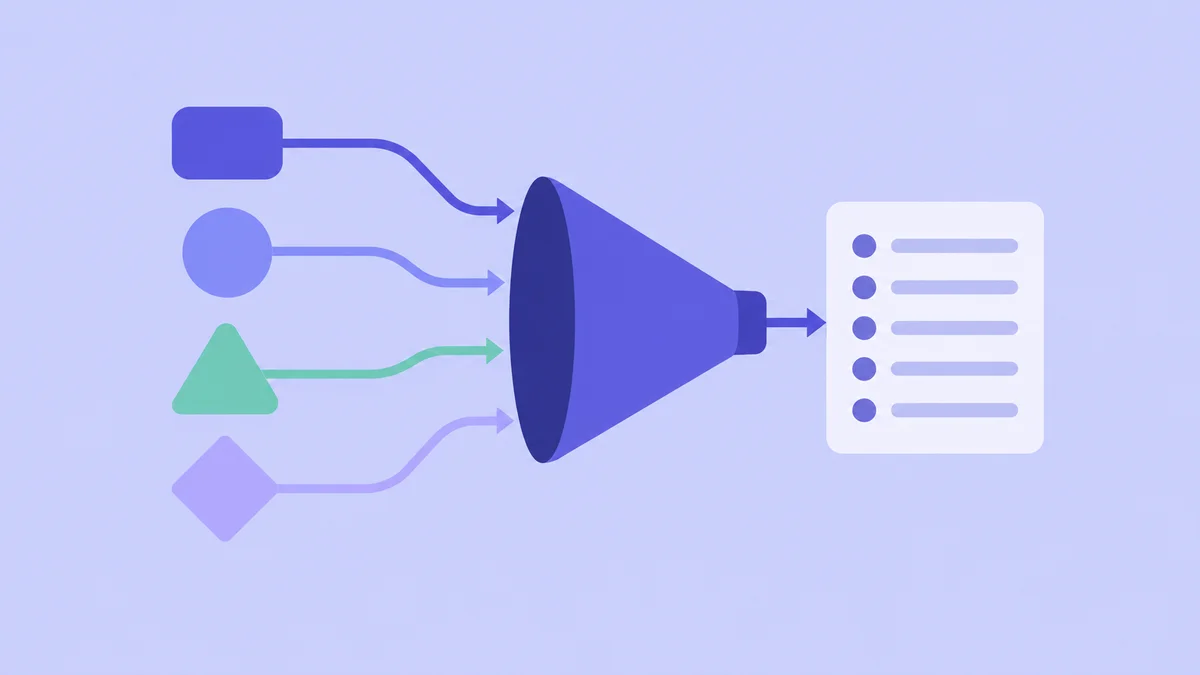
ABM tools that help manage LinkedIn ads fall into four types: LinkedIn Campaign Manager, a customer relationship management (CRM) system, a list-hygiene and enrichment layer, and an ABM platform that syncs accounts to LinkedIn. Each must clear LinkedIn's 300-member minimum audience (LinkedIn Help, 2026), and none keeps interns out of the budget unless exclusions are set.
| Tool type | What it does | Fixes junior-role waste? | Verify before buying |
|---|---|---|---|
| LinkedIn Campaign Manager | Hosts lists, filters, exclusions and demographic reports | Yes, if exclusions are set | Current LinkedIn documentation |
| CRM | Holds the account list and opportunity data | Indirectly, by feeding clean lists | Export or sync method |
| List-hygiene or enrichment layer | Cleans domains, adds firmographics | Partly, by removing small firms | Match rate on your list |
| ABM platform | Syncs lists and reports | Only if it passes exclusions through | Vendor documentation |
A simple decision rule by team size: one or two people running a list inside the published 1:few range of 50 to 200 accounts can use Campaign Manager, a CRM and a spreadsheet. Consider a platform when list changes are frequent enough that manual uploads create errors, or when several tiers must be reported together. LinkedIn's documentation says demographic filters can sit on top of an uploaded list (Microsoft Learn, 2026), so the no-platform setup is a real option. See the software comparison and ABM automation tasks for the trade-offs.
An ABM platform runs LinkedIn ads natively only if it syncs the account list to LinkedIn and also passes job-function, seniority and company-size filters, not just company names. LinkedIn's help documentation requires at least 300 member accounts for a list audience, with location as a required targeting facet (LinkedIn Help, 2025).
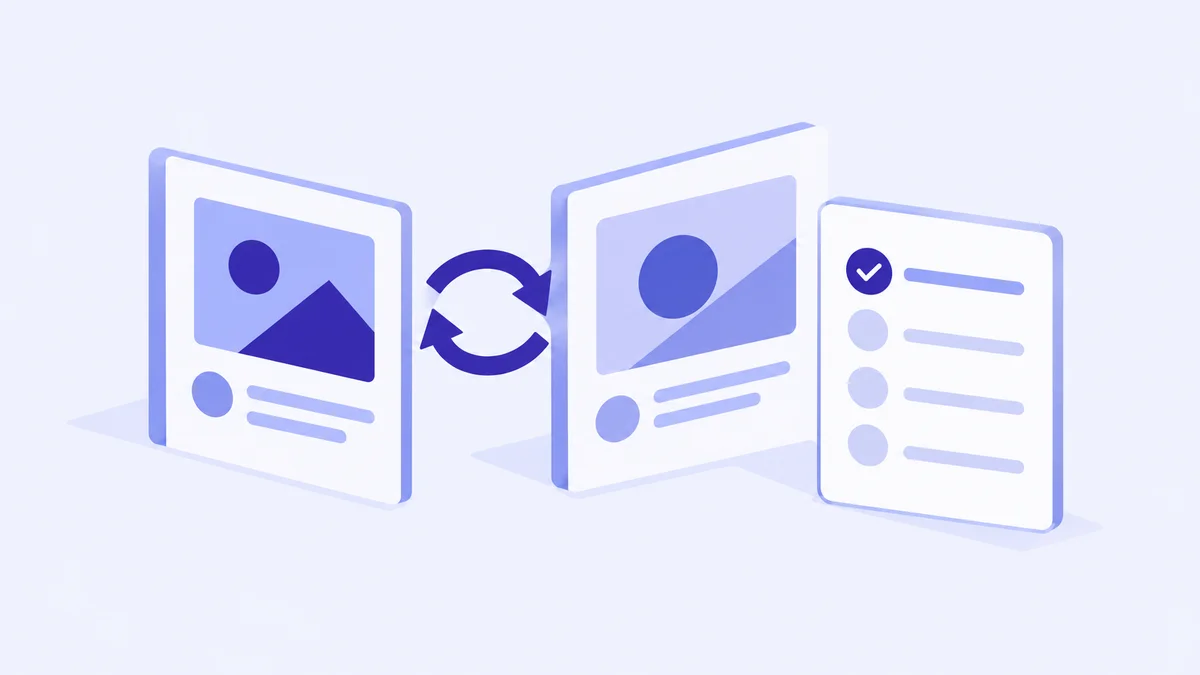
This guide names no platform as a native fit, because every comparison found was written by a vendor and none was neutral or dated. The reliable test is to check each vendor against LinkedIn's own documentation: the list upload rules and the matched audiences documentation. Three rules come from those pages:
Ask each vendor these questions in writing, and get the answers dated:
Decision rule: if a vendor cannot answer questions 2 and 3, a native sync saves upload time but not budget. Keep manual exports until it can.
Scaling LinkedIn ABM from 50 to 200 target accounts changes list mechanics, campaign structure and reporting. LinkedIn requires a minimum audience of 300 member accounts to run an ad set (LinkedIn Help, 2026), so a 50-account list cannot run alone, and a 200-account list needs combining or attribute targeting.
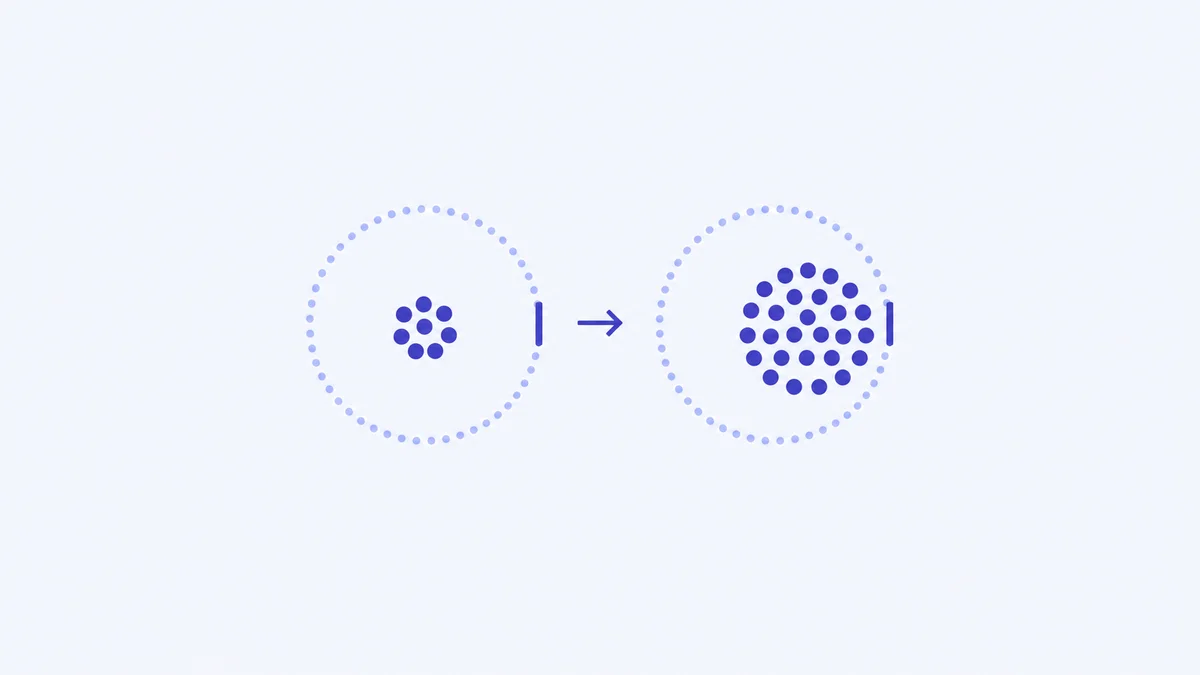
The same minimum applies to uploads: a list campaign needs at least 300 member accounts, and location is required (LinkedIn Help, 2025). In practice:
Practitioner ranges with no stated sample recommend 10 to 50 accounts for 1:1, 50 to 200 in 5 to 15 clusters for 1:few, and 200 to 500 for 1:many. The same source says common lists run 500 to 2,000+ named accounts at companies that should run 100 to 300.
An account tier is a group of target accounts that receives the same level of treatment, budget and content.
| Account tier | Typical size (practitioner ranges) | LinkedIn structure | Landing page |
|---|---|---|---|
| 1:1 | 10 to 50 accounts | Own campaign group, tight role list | Bespoke page per account |
| 1:few | 50 to 200 in 5 to 15 clusters | One campaign per cluster | One page per cluster problem |
| 1:many | 200 to 500 accounts | One campaign per segment | One shared page |
Concentration is the hidden cost of scale. In one B2Linked case, three companies on a list of roughly 400 consumed 96% of impressions (Factors.ai, 2026). It is a single anecdote, so treat it as a warning to check impressions per company, not as a rate.
Send each tier to its own page so the message matches the roles in that tier. A 1:1 page names the account's problem and includes content for finance and procurement. A 1:few page speaks to a shared industry problem. A 1:many page is a clear overview for one segment.
Keep one budget rule: separate campaign groups per tier, one tier per account, so spend does not double. For attribution across multiple touches, tag each page by tier.
Each signal should sort accounts between tiers and carry one action and one owner. An intent signal is an observable behavior, such as a pricing-page visit or a surge in topic research, that suggests an account may be evaluating a purchase. Intent scores that change weekly with no assigned action go unused.
| Signal | Example | Action on LinkedIn | Owner |
|---|---|---|---|
| Site visit from a target account | Pricing or integration page view | Move the account up one tier and raise its budget | Marketing |
| Ad engagement from several roles | Three or more roles click or watch | Add procurement and finance roles to the audience | Marketing |
| Sales activity | Meeting booked or opportunity opened | Switch to supporting content for that account | Sales |
| Research surge | Third-party topic data | Test a short, high-frequency burst | Marketing and sales |
Buying-group size is a signal too. Forrester found purchases with genAI features involve 14 members, against seven for those without them (Forrester, 2026), so accounts evaluating AI-led offers need wider role coverage. For a full workflow, see acting on intent signals before they reset. Judge the signals on meetings and pipeline per account, using holdout accounts, which are target accounts that receive no ads and serve as a comparison group.
LinkedIn ABM targeting is not worth the setup when annual contract value (ACV) sits below roughly $15K, when no seller works named accounts, or when per-country audiences fall under LinkedIn's 300-member minimum after seniority filters. The evidence behind this guide also has limits.
A full ABM program fits when annual contract value is above roughly $15K and at least one seller works named accounts. Standard LinkedIn ads suit broader demand generation by persona. ABM restricts delivery to a matched company list, filters by role and measures pipeline per account, so it needs sales coordination that standard campaigns do not.
LinkedIn ads underperform for enterprise ABM when they reach one persona while the deal involves many. Forrester's 2026 buyer survey reports that a typical buying decision includes 13 internal stakeholders and nine external influencers (Forrester, 2026). Single-persona campaigns, missing exclusions and one generic landing page leave most of the buying group unreached and spend wasted on junior roles.
Decision-makers receiving a third of LinkedIn budget is a targeting problem, not a list problem. In the 56-account audit, decision-makers got 33% against a target of 60% or more. Export spend by seniority and function, exclude individual contributors and interns, and keep procurement, finance and legal in the audience.
Tightening ABM targeting for small-firm spend means filtering the company list before upload and adding a company-size filter in LinkedIn Campaign Manager. In the 56-account audit, 20% of spend reached firms under 50 employees. Remove accounts outside the ideal customer profile, then check the company-size report after two weeks.
Targeting the full buying group on LinkedIn means layering job function and seniority on a matched company list, then excluding interns, students and individual contributors. Forrester reports the typical buying decision includes 13 internal stakeholders and nine external influencers (Forrester, 2026), so build a role matrix covering executives, champions, procurement, finance and technical owners.
Buying signals prioritize LinkedIn target accounts when each signal is tied to one action and one owner. A pricing-page visit might move an account up one account tier and raise its budget, while an opened opportunity switches the account to supporting content. Judge the rules on meetings and pipeline per account, against holdout accounts.
Scaling LinkedIn ABM from 50 to 200 target accounts changes list mechanics first. LinkedIn requires a minimum audience of 300 member accounts to run an ad set (LinkedIn Help, 2026), so small lists must be combined or padded. Then split campaign groups by account tier, give each tier its own landing page and check impressions per company.
One landing page per account tier is the practical minimum for LinkedIn ABM campaigns. 1:1 accounts justify a bespoke page, 1:few clusters share a page built around a common problem, and 1:many accounts can share one page. Separate pages let each tier's content match its roles and make conversion per tier measurable.
Managing LinkedIn ABM campaigns across tiers without doubling spend means one campaign group per tier, a fixed budget for each, and every account assigned to one tier only. Watch impression concentration: in one B2Linked case reported by Factors.ai (2026), three of roughly 400 companies took 96% of impressions.
Positioning a brand on LinkedIn for a named target list means running awareness ads to a matched list of those accounts, filtered to the roles sales is working, and telling sales which accounts are covered. Content should speak to the account's problem, not the product. Measure meetings and pipeline against comparable accounts that received no ads.
LinkedIn ABM budget leaks through people, not companies, and the fix is measurable.
Next step: Meet with an expert for a free consultation, and bring your target account list so you can brainstorm the next step together. For the reporting layer, return to ABM measurement.
Written by
Ishan Manchanda
Ishan Manchanda is co-founder of GrowthSpree, a B2B SaaS marketing consultancy founded in 2017 that has managed $60M+ in ad spend across 300+ B2B SaaS companies. He focuses on demand generation, go-to-market strategy and pipeline growth, and has been featured in Silicon Valley Times, SaaS Mag and the Unbounce podcast.
© 2026 abmforb2bsaas.com All rights reserved.


| Waste and noise |
| Maintain the list |
| Firms under 50 employees | Exclude or keep off the list | 20% of audited spend reached them | Real small targets in 1:1 tiers |