Blog
Attribution Models for B2B SaaS: What Each Measures and Where It Fails
Attribution models compared by deal size, sales cycle and buying group. What first-touch, last-touch, U-shaped and W-shaped each measure and where they fail.
How to build an account based marketing (ABM) program: a realistic list of 100 to 300 accounts, tier rules, and ad structure for small B2B SaaS teams.
 Ishan ManchandaNov 17, 2026
Attribution models compared by deal size, sales cycle and buying group. What first-touch, last-touch, U-shaped and W-shaped each measure and where they fail.
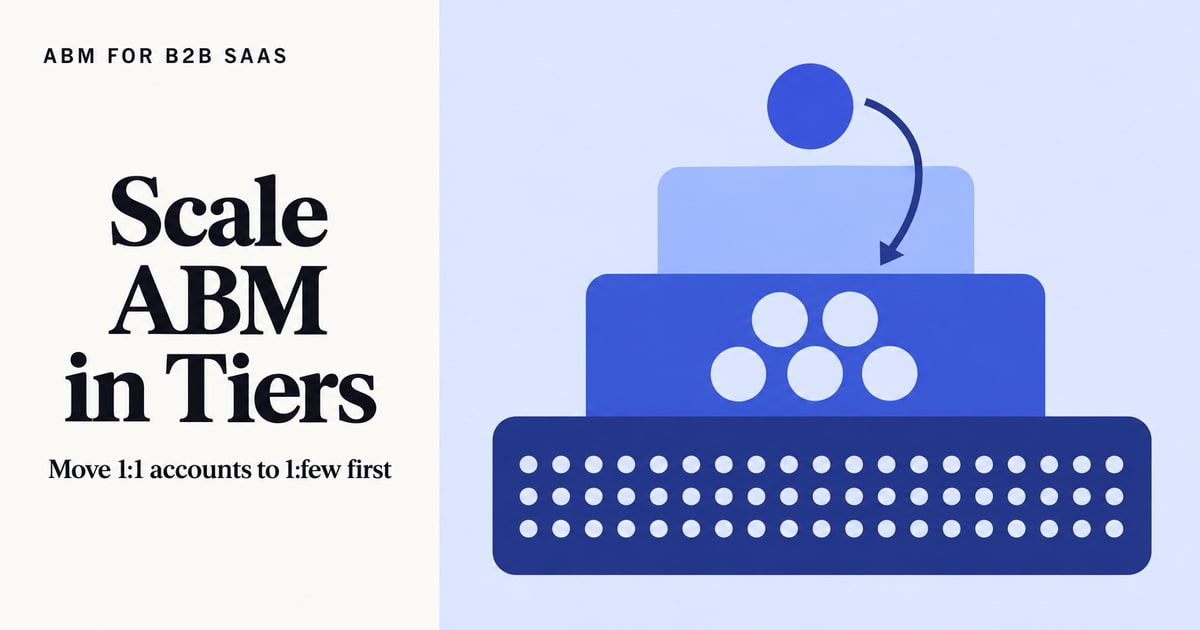
Learn how to scale account based marketing campaigns by migrating accounts from 1:1 to 1:few before 1:many, with triggers, capacity math and metrics.
Build an intent data workflow that ties each signal to a named owner, action and deadline, then judge campaigns on pipeline per account, not clicks.
Request a quote and our experts will contact you within 24 hours with tailored solutions and pricing.
Last updated: Nov 17, 2026
By the ABM for B2B SaaS Editorial Team. Last updated October 28, 2026. Sources and sampling notes are on the Methodology page.
An account-based marketing (ABM) program is a go-to-market plan that focuses sales and marketing effort on a short list of named companies, sized to the team that has to work them and measured on pipeline per account. Most first programs fail at the list. A common starting point is 1,500 accounts, three people and ads aimed at every job function, which makes the program look like ordinary paid media with a new name. This guide covers how big the list should be, how to tier it, how to build it when inbound leads come from companies too small to buy, and how to structure account-based advertising without a dedicated platform. The work sits inside the firmographic data and ICP definition that decides which companies belong on the list.
Key Takeaways
- A first account-based marketing program on a small team should run 100 to 300 target accounts, not the 500 to 2,000+ that a June 2026 practitioner argument says are common.
- Account tiers (1:1, 1:few, 1:many) let a small team give each group of target accounts only the treatment it can sustain.
- Account-based advertising works without a dedicated platform: one audience per tier, buying-group layers inside it, and exclusions set before launch.
- Inbound leads from companies too small to buy are evidence for the exclusion list, not material for the target account list.
A realistic target account list for a first account-based marketing program on a small team is 100 to 300 named accounts. A June 2026 practitioner argument with no stated sample says common lists run 500 to 2,000+ named accounts at companies that should run 100 to 300. The Starr Conspiracy caps its top tier at 25 to 50 accounts (The Starr Conspiracy, 2026).

A target account list is the named set of companies a team has agreed to pursue, sized to the people available to work it. At 1,500 accounts, the list stops being a working set and becomes a market map. Nobody can research, contact and follow up on that many companies, so every account gets the same campaign and the same sequence.
Paid reach adds a cost reason. LinkedIn clicks for B2B SaaS run $8 to $25 by vertical (GrowthSpree, June 2026). Spread a small budget across 1,500 companies and few accounts see enough to matter.
Audit data: In GrowthSpree's June 2026 audit of 56 LinkedIn accounts and $9.4M in ad spend, decision-makers received 33% of budget against a target of 60% or more. Non-buying job functions caused 30% of wasted spend, and 20% of spend reached firms under 50 employees. These are the publisher's own audit figures from a 56-account sample, not a universal benchmark.
The 100 to 300 range is a practitioner view with no stated sample, so treat it as a ceiling to test. Start at the lower end. Add accounts only after the team has finished one full cycle of work on the current set and can show account-to-opportunity conversion on it.
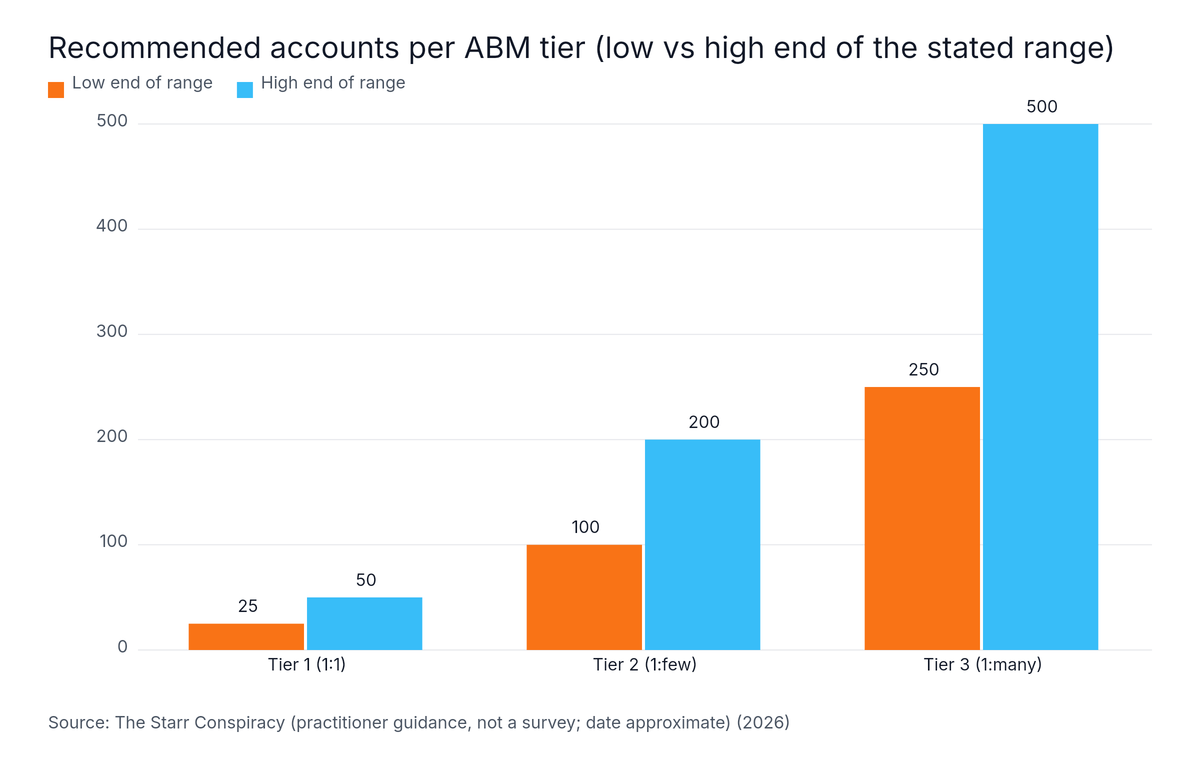
A small team should split target accounts into three account tiers, 1:1, 1:few and 1:many, and size each tier to the effort the team can sustain. Published ranges from a June 2026 practitioner argument, with no stated sample, put 1:1 at 10 to 50 accounts, 1:few at 50 to 200 accounts in 5 to 15 clusters, and 1:many at 200 to 500.
Source: The Starr Conspiracy (practitioner guidance, not a survey; date approximate), 2026
An account tier is a band of target accounts that receive the same level of research, content and outreach. 1:1 means bespoke work for each account, 1:few means shared content for a cluster of similar accounts, and 1:many means programmatic tactics across a wider named list.
Two more practitioner ranges sit close to those figures. The Starr Conspiracy suggests 25 to 50 accounts in the top tier, 100 to 200 in the second and 250 to 500 in the third, and says to adjust by ACV and team capacity (The Starr Conspiracy, 2026). The chart above plots the low end of that guidance: 25, 100 and 250 accounts. Firmable's framework scores accounts on an ideal customer profile scorecard and gives 10 to 30, 50 to 150 and 200 to 500 (Firmable, 2026). All three are practitioner guidance, not survey results.
| Tier | Treatment | The Starr Conspiracy (2026) | Firmable (2026) | Practitioner argument (June 2026, no stated sample) |
|---|---|---|---|---|
| 1:1 | Bespoke research, content and outreach | 25 to 50 accounts | 10 to 30 accounts | 10 to 50 accounts |
| 1:few | Shared content per cluster | 100 to 200 accounts | 50 to 150 accounts | 50 to 200 accounts in 5 to 15 clusters |
| 1:many | Programmatic ads and email | 250 to 500 accounts | 200 to 500 accounts | 200 to 500 accounts |
The ranges disagree at the top, so pick a number from your own capacity, not from any single source.
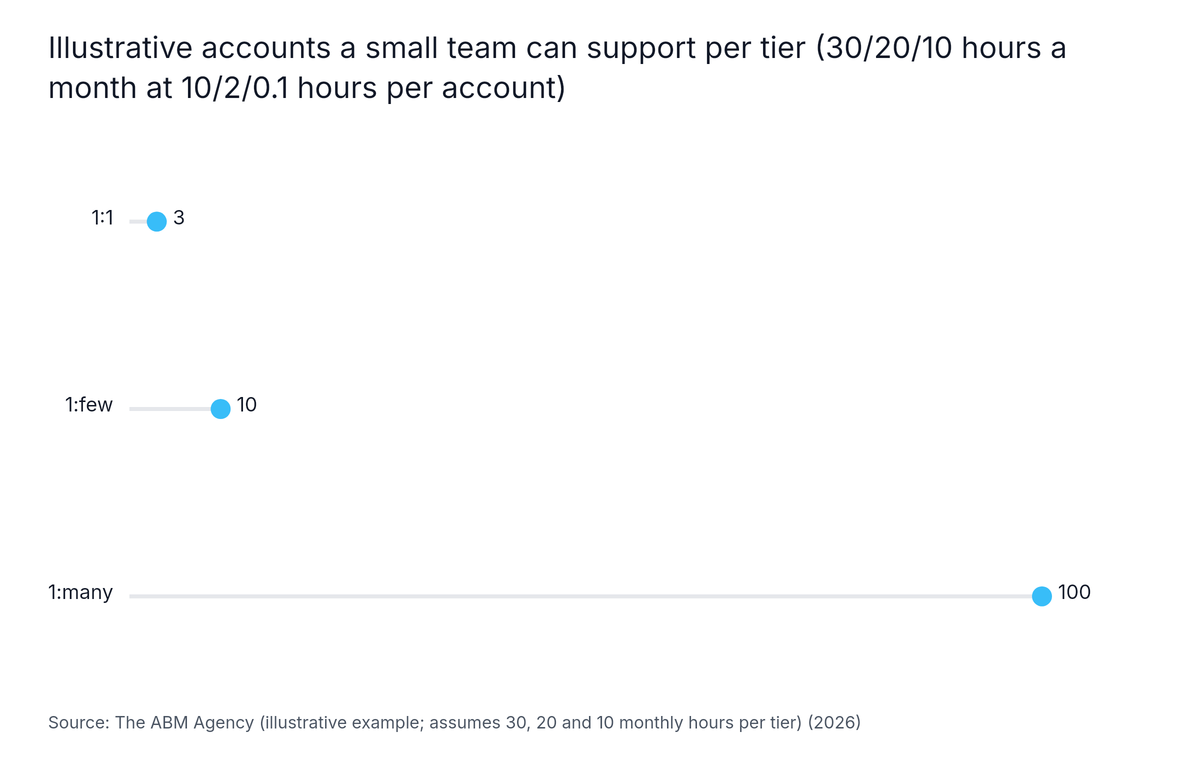
The numbers below are illustrative assumptions, not benchmarks. Say the team gives 30 hours a month to 1:1 work at 10 hours per account, 20 hours to 1:few work at 2 hours per account, and 10 hours to 1:many work at 0.1 hours per account. That supports 3 accounts at 1:1, 10 at 1:few and 100 at 1:many, which is 113 accounts in total. A 1,500-account list is about 13.3 times that capacity (1,500 divided by 113).
Source: The ABM Agency (illustrative example; assumes 30, 20 and 10 monthly hours per tier), 2026
Meet with an expert. A free consultation. Bring your target account list and brainstorm the next step with an ABM expert. Meet with an expert
A named target account list should be built from closed-won and closed-lost deals, with an explicit size and annual contract value (ACV) floor, rather than from inbound lead volume. Inbound leads at companies too small to buy show where the list is wrong, so they become exclusion evidence, not target accounts. Sales must agree to work the final list.

An ideal customer profile (ICP) is a written description of the companies that buy, stay and expand, based on closed deals. Use it as the filter.
The comparison of ABM and inbound marketing explains why inbound volume often stops at the wrong deal size.
Only 31% of organizations agree that marketing and sales collaborate effectively on ABM strategy (N.Rich, 2025). Demand generation teams lead 44% of programs in the same survey of 107 B2B go-to-market leaders (N.Rich, 2025). If demand generation owns the list, ask sellers to strike accounts they will not work before any budget is spent. A list sales has not accepted becomes a list sales ignores. The demand generation overview shows where ABM fits next to broader programs.
Account-based advertising for a small B2B SaaS team works best as one audience per account tier, with job function and seniority layers inside each audience and exclusions set on day one. A dedicated platform is optional: only 22% of 107 surveyed go-to-market leaders run ABM on one (N.Rich, 2025).

The N.Rich report summary says "Most still work from LinkedIn, CRM and spreadsheets." (N.Rich, 2025) The Demand Gen Report 2025 benchmark survey, published 17 October 2025, found 22% with a dedicated ABM platform and only 24% listing account-based advertising tools (Demand Gen Report, 2025).
| Tier | Ad audience | Campaign structure | Measurement |
|---|---|---|---|
| 1:1 | Named buying-group contacts only | Light ads that support direct outreach from sales | Meetings and opportunities per account |
| 1:few | Company list per cluster | One campaign per cluster, one message per cluster | Account-to-opportunity rate per cluster |
| 1:many | One pooled company list | One campaign with function and seniority layers | Account-level engagement in the CRM, then pipeline |
Ad platforms set minimum audience sizes for company-list targeting. LinkedIn's help documentation has described a minimum company count and a minimum match count, and a list of 100 to 300 accounts may fall under it. Check the current wording before building anything. Practical fixes are to pool tiers into one audience, combine several lists, layer attribute targeting on top, or move Tier 1 budget into direct contact.
Cap frequency so small audiences are not exhausted. Exclude non-target companies, and exclude non-buying roles. Holdout accounts are target accounts deliberately left without ABM treatment so their results can be compared with treated accounts. Keep a few from the start. The software comparison covers when a platform earns its cost.
Account-based advertising should reach the whole buying group at each target account, not one persona. Forrester's 2026 State Of Business Buying reports that the typical business buying decision involves 13 internal stakeholders and nine external influencers (Forrester, 2026), so ads aimed at one job function leave most of the decision untouched.
A buying group is the set of people at one company who influence or approve a purchase. Forrester's release states: "The typical buying decision now includes 13 internal stakeholders and nine external influencers, with that number rising for more complex or strategic purchases." (Forrester, 2026)
| Deal size | Stakeholders | Sales cycle |
|---|---|---|
| $25K to $100K | 5 to 8 | 49 to 84 days |
| $100K to $250K | 7 to 10 | 84 to 126 days |
| $250K to $1M | 10 to 15 | 126 to 180 days |
These are published ranges as of 2026, with no stated sample. Treat them as planning ranges, not findings.
Forrester also states: "Procurement professionals are decision-makers in 53% of business buying cycles, engaging from the start of the process." (Forrester, 2026) Map procurement, security and finance into Tier 1 and Tier 2 plans early.
In GrowthSpree's June 2026 audit of 56 LinkedIn accounts, non-buying job functions caused 30% of wasted spend, individual contributors and entry-level staff consumed 36% of LinkedIn budget, and 20% of spend reached firms under 50 employees. Fix this with function and seniority layers, plus company-size exclusions, before launch. The pipeline analytics guide shows why engagement counts can hide this.
An account-based marketing (ABM) program is typically not worth it when annual contract value sits below about $15K, the lowest band in published cost-per-SQL targets, or when no seller works named accounts. Only 26% of 107 surveyed B2B go-to-market leaders call their ABM program successful (N.Rich, 2025).

Published targets for cost per sales-qualified lead (SQL) show how deal size changes the economics. These are published ranges as of 2026, with no stated sample:
| ACV band | Target cost per SQL |
|---|---|
| $15K to $50K | $1,000 to $3,000 |
| $50K to $150K | $3,000 to $8,000 |
| $150K+ | $8,000 to $20,000 |
Below the lowest band, the numbers rarely support named-account work. The best practices guide covers what to do before moving up.
Start from closed-won and closed-lost deals, set an employee-count and contract-value floor, and build a named list of 100 to 300 companies above it. Treat small-company inbound leads as exclusion evidence. Route them to self-serve or low-touch follow-up so they do not consume ABM effort, and get sales to agree to work the final list.
Run one audience per account tier, with job function and seniority layers inside each audience and exclusions set before launch. Pool small tiers into one company list if the ad platform requires a minimum audience, cap frequency, and measure account-level engagement and pipeline per account in the CRM, compared with holdout accounts that receive no ads.
Native options include LinkedIn company-list targeting, Google Ads customer match with contact lists, and Meta custom audiences. Managed services also exist. When evaluating any of them, ask whether they work from your own list, which exclusions they set, how they report pipeline per account rather than reach, and whether they lock you into a platform.
An ABM program should not be judged before one full sales cycle has passed. Published ranges as of 2026 show 49 to 84 days for $25K to $100K deals, 84 to 126 days for $100K to $250K deals, and 126 to 180 days for $250K to $1M deals, with no stated sample.
A first ABM program works when it is small enough to run. Pick fewer accounts, reach the whole buying group, and measure pipeline.
The next step is a one-page capacity check: team hours, tier sizes and the first 100 names.
Written by
Ishan Manchanda
Ishan Manchanda is co-founder of GrowthSpree, a B2B SaaS marketing consultancy founded in 2017 that has managed $60M+ in ad spend across 300+ B2B SaaS companies. He focuses on demand generation, go-to-market strategy and pipeline growth, and has been featured in Silicon Valley Times, SaaS Mag and the Unbounce podcast.