Last updated: Oct 13, 2026
ABM Platform and Software Comparison: What to Evaluate Before You Sign
ABM for B2B SaaS Editorial Team
Account-based marketing (ABM) software is any tool or platform that helps B2B sales and marketing teams identify, reach, and measure a defined list of named target accounts - coordinating outreach across the buying committee and reporting on pipeline created, not impressions generated.
The renewal scenario is where evaluation gets honest. ABM practitioners dedicate 40% of their marketing budget to ABM programs, and 87% planned to increase that spend in 2025 by an average of 9% (Momentum ITSMA, 2024). When renewal arrives, most teams cannot show pipeline contribution by account. This guide skips the feature-checklist demos and leads with the criteria that expose that gap: account-to-opportunity rate, pipeline per target account, and whether the no-platform option serves the program better than a $60K suite.
Key Takeaways
- Fewer than 20% of ABM programs deliver measurable pipeline impact in their first year. The failure is usually measurement design, not the platform (Forrester via Geisheker, 2026).
- The enterprise account-based marketing software tier is led by 6sense and Demandbase. Propensity is the only Gartner Challenger as of November 2025. Terminus no longer exists as a standalone platform.
- The no-platform option - LinkedIn Campaign Manager, a CRM, and a maintained account list - is a credible choice for teams with fewer than 200 target accounts or annual contract value (ACV) below $50K.
- Total cost of ownership for enterprise platforms typically runs two to three times the stated license fee once implementation, data subscriptions, and headcount are included.
- Write year-two price caps and notice windows into the first contract. Documented escalation runs 20-40% at renewal.
Which account-based marketing software actually shows pipeline, not just engagement scores?
Account-based marketing (ABM) software that shows pipeline produces account-to-opportunity rate and pipeline per target account by account tier, compared against holdout accounts that received no ABM treatment. Yet 64% of B2B marketers report running an account-based approach while fewer than a third actually measure account-centric metrics (6sense / Market Intelligence Tools, n=1,332, 2025) - confirming that showing pipeline is the exception. As of 2026, the enterprise tier is led by 6sense and Demandbase.
Account-to-opportunity rate is the percentage of target accounts that convert to a qualified sales opportunity within a defined period - the primary pipeline outcome metric for any ABM program or platform evaluation.
Propensity entered the 2025 Gartner Magic Quadrant as the sole Challenger, priced below the enterprise Leaders and positioned for mid-market teams that cannot justify a $62,000-plus median annual contract. As Turtl's editorial team notes: "ABM software optimizes for account fit, buying-committee engagement, and pipeline impact at the account level" (Turtl, 2026). That definition names three things a demo must prove: fit scoring, committee coverage, and pipeline reporting.
The Renewal Problem: Why Most ABM Programs Cannot Show Pipeline
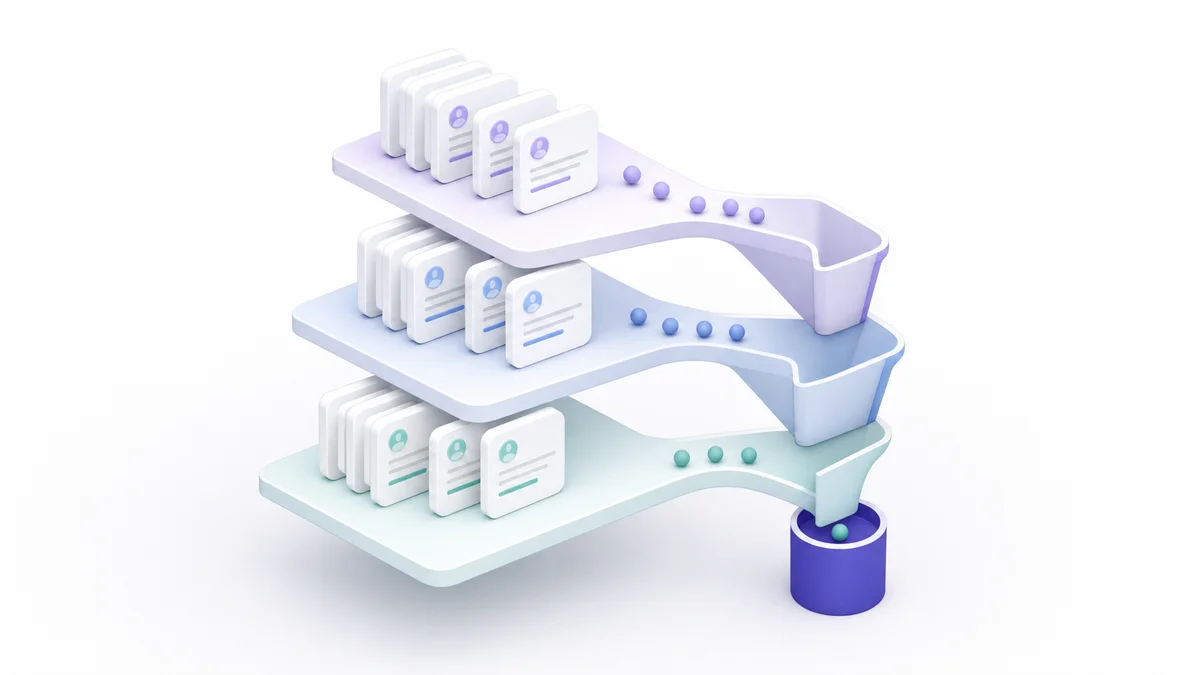
Fewer than 20% of ABM programs deliver measurable pipeline impact within their first year, according to Forrester research cited by Geisheker (2026), and the dominant failure mode is purchasing tooling before the operating model is in place. When a renewal arrives and pipeline attribution is missing, the gap is usually in measurement design, not the platform itself. Pull account-to-opportunity rate by tier and pipeline per target account from the CRM before booking any demos.
The scale of the problem is real. 70% of B2B organizations reported an active ABM program in 2024, up from 49% in 2020 (Demand Metric / The Starr Conspiracy, 2024). Yet 64% of B2B marketers say they run an account-based approach while fewer than a third measure it on pipeline (6sense / Market Intelligence Tools, n=1,332, 2025). That gap - most teams running ABM, fewer than a third measuring it - is the renewal trap.
GrowthSpree data (June 2026, ABM26): Common account-based marketing lists run 500 to 2,000-plus named accounts at companies that should operate 100 to 300. Published ranges suggest 10 to 50 accounts for 1:1 treatment, 50 to 200 in 5 to 15 clusters for 1:few, and 200 to 500 for 1:many. A scoping problem of that scale is not solved by a platform. Published ranges; no sample stated.
The pre-renewal audit checklist
Run this audit against the existing platform's data before any vendor conversation:
- Account-to-opportunity rate by tier. What percentage of 1:1, 1:few, and 1:many accounts converted to a qualified opportunity in the past 12 months?
- Pipeline per target account vs. non-target accounts. Pull a matched set of holdout accounts that received no ABM treatment. Compare pipeline generated.
- Sales acceptance rate. Of the accounts the platform flagged as engaged or in-market, what share did sales follow up on - and how many became opportunities?
- Buying-committee contacts reached. How many contacts per account did the platform surface across the roles a deal depends on?
If the current platform cannot answer questions 1 and 2 from its own reporting, the renewal decision is already clear: the measurement model needs rebuilding before the tool does.
Platform vs. No-Platform: What Are the Realistic Options?
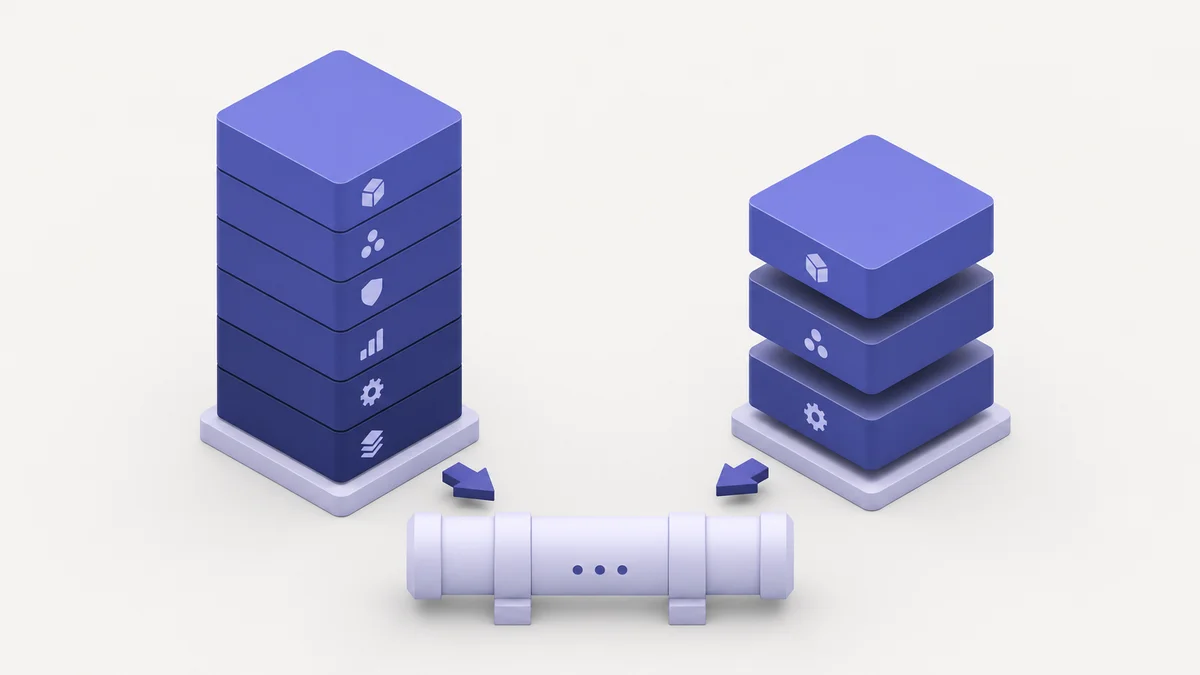
Account-based marketing platforms split into three tiers: enterprise full-stack suites (6sense, Demandbase), mid-market options (RollWorks, Propensity), and the no-platform path using LinkedIn Campaign Manager plus a CRM and a maintained account list. For teams targeting fewer than 200 accounts or operating below a $50K annual contract value (ACV), the no-platform path is a credible starting point - platform total cost of ownership typically runs 2-3x the license fee once implementation, data, and headcount are added (Salesmotion, 2026).
When the program does mature, the performance difference becomes substantial. Mature ABM programs - defined as 24 or more months in market - deliver a 171% qualified-pipeline lift over matched non-ABM controls within 12 months of activation, based on a survey of 167 B2B marketing leaders in North America and EMEA, fielded March-May 2024 (ITSMA / The Starr Conspiracy, 2024). That same survey found 76% of mature ABM practitioners report higher return on investment from ABM than from any other marketing investment. Evaluating a year-one program against those benchmarks produces a false negative.
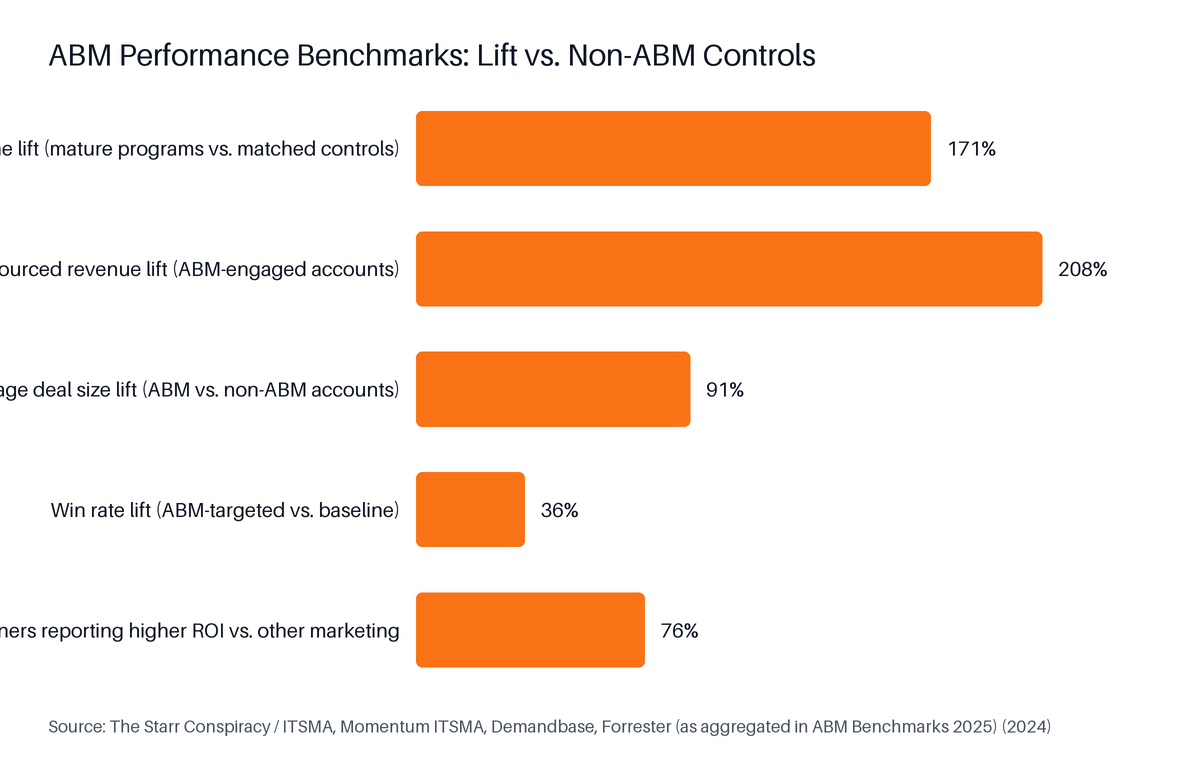
Source: The Starr Conspiracy / ITSMA, Momentum ITSMA, Demandbase, Forrester (as aggregated in ABM Benchmarks 2025), 2024
Option comparison at a glance
| Option | Best for | Typical ACV threshold | Key tradeoff |
|---|---|---|---|
| Enterprise suite (6sense, Demandbase) | 200+ target accounts, $100K+ ACV, 7+ person buying group | $100K and above | Highest TCO; deepest intent data and committee graph |
| Mid-market platform (RollWorks, Propensity) | 50-200 target accounts, $50K-$100K ACV | $50K and above | Lower cost; narrower data coverage |
| No-platform (CRM + LinkedIn + account list) | Under 200 target accounts, below $50K ACV, or early-stage program | Below $50K | Lowest cost; manual orchestration; limited intent signal |
A note on the vendor landscape. Terminus was dropped from the 2025 Gartner Magic Quadrant for ABM Platforms for failing to meet functional inclusion criteria. By September 2026, its domain began redirecting to DemandScience (Piper Rocket, 2026). Buyers mid-contract with Terminus should factor that transition into their renewal timeline.
What Should the Evaluation Criteria Actually Be?
Account-based marketing software evaluation criteria should be anchored to pipeline outcomes: account-to-opportunity rate by tier, pipeline per target account versus holdout accounts, buying-committee coverage per account, intent signal action rate, total cost of ownership, and year-two contract terms. B2B buyers spend only 17% of their total purchase time meeting with potential suppliers (Gartner via Dads Growth Lab, 2024) - so the anonymous self-directed research phase is where intent data either earns its cost or does not. Engagement scores and reach metrics are activity measures, not outcome measures.
Holdout accounts are matched accounts excluded from ABM treatment, used as a non-ABM control group to isolate program impact. Without them, there is no way to separate what the platform contributed from what would have happened anyway.
Buying committee is the full set of stakeholders - economic buyers, technical evaluators, and influencers - involved in a purchase decision. Forrester's January 2026 State of Business Buying report found the average complex B2B purchase involves 13 internal stakeholders and 9 external influencers (Forrester via ivristech, 2026). Those two counts should not be summed, but together they show why buying-committee coverage is a primary evaluation criterion.
Intent signal is a behavioral data point - such as a topic search or review-site visit - suggesting an account may be researching a purchase. Signals not tied to a named action and a named owner consistently go unused.
As Turtl's editorial team states: "Impressions, opens, and clicks are vanity metrics in ABM. Pipeline influenced, deal velocity, and win rate on target accounts versus non-target accounts are what matter" (Turtl, 2026).
GrowthSpree data (June 2026, L26): Across 56 audited LinkedIn accounts with $9.4M in ad spend, decision-makers received only 33% of LinkedIn ad budget against a target of 60% or more. Non-buying job functions caused 30% of wasted spend; individual contributors and entry-level staff consumed 36% of budget. Buying-committee coverage is not a feature to showcase in a demo - it is a measurable outcome to test on live data.
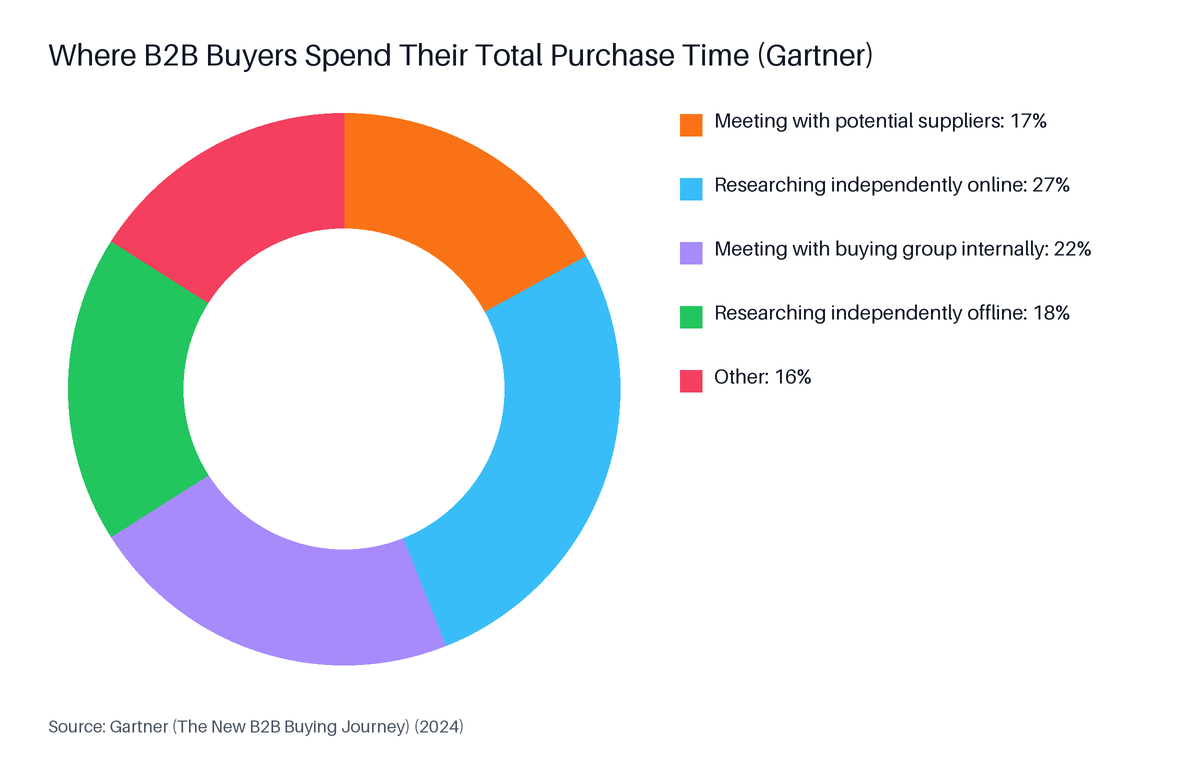
Source: Gartner (The New B2B Buying Journey), 2024
The six criteria that expose the gap
Among account-based marketing programs tracked in 2026, 94% monitor pipeline created and 91% monitor account engagement - but only 63% track cost per account, the metric most directly tied to total cost of ownership (uproas.io, 2026). That distribution reveals which criteria get attention and which get skipped.
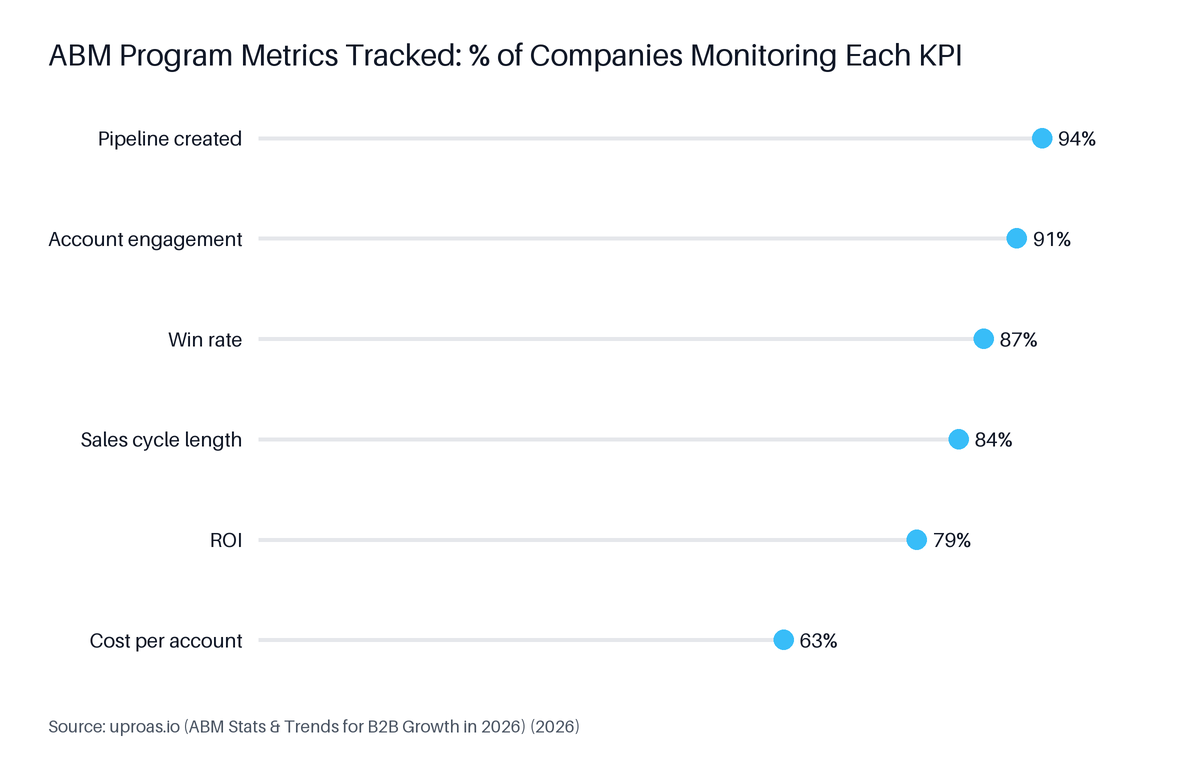
Source: uproas.io (ABM Stats & Trends for B2B Growth in 2026), 2026
| Criterion | What to ask in the demo | Why it matters |
|---|---|---|
| Account-to-opportunity rate | Show this metric for a sample of my accounts by tier | The primary pipeline outcome metric |
| Pipeline per target account vs. holdout | Compare ABM accounts to a non-ABM control set | Isolates the platform's contribution |
| Buying-committee coverage | How many contacts per account across buying roles? | Deals stall when only one contact is tracked |
| Intent signal action rate | What share of flagged accounts receive a named follow-up? | Signals not tied to an owner go unused |
| Total cost of ownership | Platform + implementation + data + headcount | License is rarely the largest line item |
| Year-two contract terms | What is the renewal price cap and notice window? | Documented escalation runs 20-40% |
How to Run a Proof of Concept Before You Sign
A proof of concept (POC) for account-based marketing software is a 30-to-45-day structured test on live account data, with agreed acceptance criteria established before the trial begins. Valasys / Mansi Hake is direct: "No platform should be purchased without a 30-45-day proof of concept on live data with agreed acceptance criteria" (Valasys, 2026). The acceptance criteria are what most teams skip - and the part that makes a POC defensible when a budget owner asks for evidence.
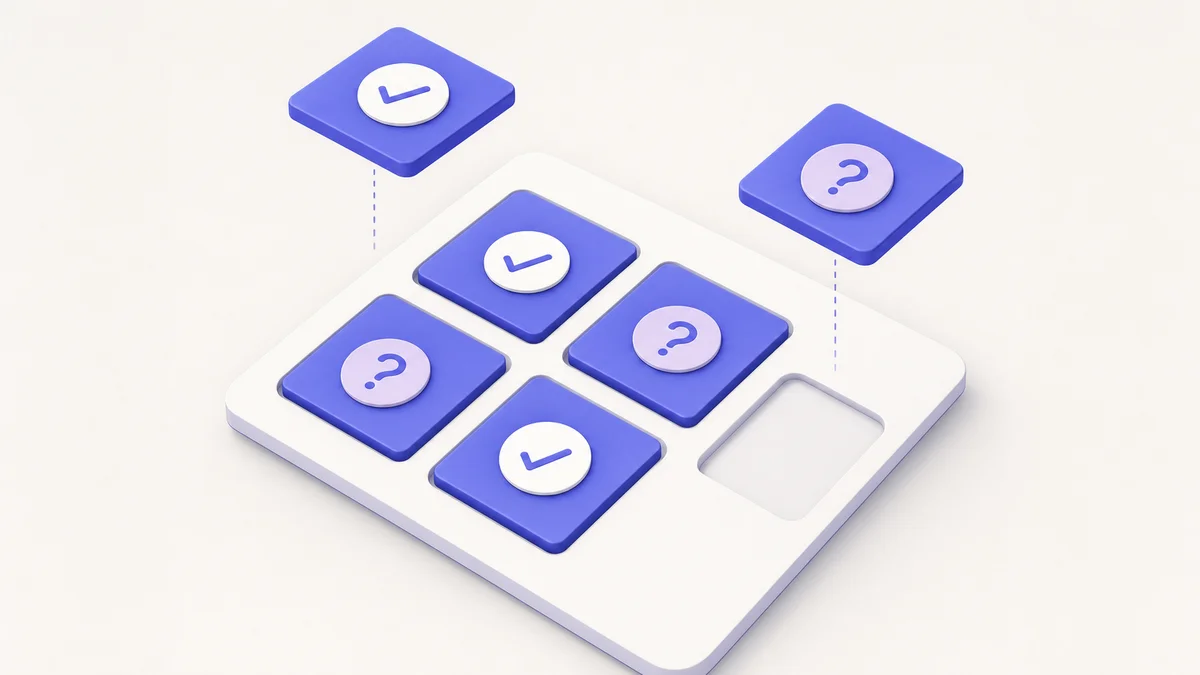
POC acceptance criteria scorecard for account-based marketing software
Set these thresholds before the POC begins. If the platform cannot meet them on live accounts within 30-45 days, it is not ready for the program.
- Account-to-opportunity rate. The platform must surface this metric by account tier within the first two weeks, using CRM data.
- Buying-committee contacts. For each Tier 1 account, the platform must identify at least the economic buyer, technical evaluator, and one additional buying role.
- Intent signal action rate. At least 50% of accounts the platform flags as in-market must receive a named follow-up action by a named owner within five business days.
- CRM sync accuracy. Opportunity and contact data must sync without manual cleanup in under two hours of ops time per week.
- Reporting output. The platform must produce a pipeline-per-account report that a sales leader can read without a marketing translation layer.
Agree on these criteria in writing before the POC begins. A vendor who resists written acceptance criteria signals that demo conditions and production conditions differ materially.
What Does ABM Software Cost and What Should You Negotiate?
Demandbase carries a Vendr median annual contract of $68,591 and 6sense a median of $62,440, with total program costs - including implementation, data subscriptions, ad spend, and headcount - often running two to three times those figures (Salesmotion, 2026). Year-two price escalation is a documented risk. As Autobound's editorial team notes: "Many ABM vendors offer aggressive first-year pricing that increases 20-40% at renewal" (Autobound, 2026). Write price caps and notice windows into the first contract.
Market Intelligence Tools is direct on timing: "Write renewal terms into the first contract, including notice windows and any annual increase, since year two is when a buyer has the least room" (Market Intelligence Tools, 2026).
Total cost of ownership (TCO) for an account-based marketing platform is the full cost of running the program - license fee plus implementation, data subscriptions, ad spend, and headcount. Focusing on the license price alone understates the real budget commitment by 2-3x.

Contract terms to negotiate before signing
- Annual price increase cap. Request a cap of 5-10% per year written into the master service agreement, not left to the renewal conversation.
- Notice window. Clarify how many days before renewal the cancellation notice must be submitted-30, 60, or 90 days.
- Pilot or POC clause. Negotiate the right to exit at month three if the platform does not meet the agreed POC acceptance criteria.
- Implementation fees. Confirm whether onboarding fees are included in the headline price or billed separately. They commonly add 10-20% in year one.
- Data coverage guarantees. For intent data and contact graph coverage, ask for a written statement of coverage for the specific ideal customer profile (ICP) and geography before signing.
When ABM Software Is Not the Right Choice
Account-based marketing software is not the right choice for B2B SaaS teams when the program lacks an operating model. Fewer than 20% of programs deliver measurable pipeline in year one and the failure is structural, not tool-related (Forrester via Geisheker, 2026). A platform purchased to automate a broken list produces a more expensive broken list.
Programs that have not yet reached 24 months in market should not be evaluated against mature-program benchmarks. The 171% qualified-pipeline lift figure - from a survey of 167 B2B marketing leaders, fielded March-May 2024 (ITSMA / The Starr Conspiracy, 2024) - applies to programs at that maturity threshold, not year-one builds.
Consider staying on the no-platform path - or returning to it - when any of the following apply:
- The annual contract value (ACV) of target accounts is below $50K and the total cost of ownership of an enterprise platform exceeds a full year of expected pipeline from those accounts.
- The program has not yet established a pipeline-per-account baseline from existing data, and the team cannot define what improvement would look like.
- Sales has not agreed on which accounts are in scope, which buying roles to reach, or who owns follow-up on platform-triggered signals.
- The target account list has not been tiered and sized to what the team can actually sustain.
"AI meaningfully improves ABM execution, but it does not replace the need for a sound strategy, clean data, and skilled operators," per Autobound's editorial team (Autobound, 2026). The same principle applies to any platform investment.
Frequently Asked Questions
Our ABM program is running but I can't tell which tools are contributing to pipeline - where do I start?
Start with two numbers the CRM already holds: account-to-opportunity rate and pipeline per target account, compared against a matched set of accounts that received no account-based marketing treatment. If the platform cannot surface those two figures by account tier, the gap is in measurement design, not in the tooling - and no new demo solves a measurement gap.
What account-based marketing platforms exist and how do they compare to running ABM without a dedicated tool?
The enterprise tier is dominated by 6sense and Demandbase, both named Leaders in the 2026 Forrester Wave and the 2025 Gartner Magic Quadrant for ABM Platforms. Propensity entered the 2025 Gartner Magic Quadrant as the only Challenger, priced below the enterprise Leaders. The no-platform option - LinkedIn Campaign Manager, a CRM, and a maintained account list - is a legitimate baseline for teams with fewer than 200 target accounts or an annual contract value below $50K.
All the ABM software demos look the same - what should I actually compare before signing a contract?
Ask every vendor to show account-to-opportunity rate and pipeline per target account on a sample of actual accounts, not a curated success story. Then test buying-committee coverage: how many contacts per account does the platform surface across the roles a deal depends on? A platform that cannot answer those two questions on live data in a 30-to-45-day proof of concept is not ready for the program.
Every ABM software vendor claims the same features - what does a useful top-platform comparison actually cover?
A useful account-based marketing software comparison covers six criteria anchored to pipeline outcomes: account-to-opportunity rate by tier, pipeline per target account versus a holdout group, buying-committee coverage per account, intent signal action rate, total cost of ownership including implementation and headcount, and year-two pricing terms. Engagement scores and accounts reached are activity metrics - they do not show platform contribution to revenue.
Our ABM platform renewal is due and we cannot show its pipeline contribution - what should a buyer's guide cover?
An account-based marketing platform buyer's guide for renewal decisions should cover: a pre-demo audit of existing pipeline data, a proof-of-concept scorecard with acceptance criteria, a total-cost-of-ownership calculation including ads, data, and headcount, and contract terms that cap year-two price increases. Fewer than 20% of ABM programs deliver measurable pipeline impact within their first year (Forrester via Geisheker, 2026), so the audit must establish whether the gap is in the platform or the operating model.
Our ABM platform renewal is due - how do I compare tools without getting sold the wrong one?
Run a pre-renewal audit before booking any demos: pull account-to-opportunity rate by tier, pipeline per target account versus non-target accounts, and sales acceptance rate of platform-triggered accounts from the CRM. If those numbers are not in the platform's reporting today, ask each shortlisted vendor to produce them during a 30-to-45-day proof of concept on live data with agreed acceptance criteria before signing.
What is the difference between marketing-sourced and marketing-influenced pipeline, and which one is my ABM platform reporting?
Marketing-sourced pipeline counts only deals where marketing created the first recorded touch. Marketing-influenced pipeline counts any deal where a marketing interaction occurred at any stage - a much larger and easier figure to claim. ABM vendors typically report influenced pipeline in their dashboards. To assess true platform contribution, ask the vendor to filter reporting to sourced pipeline only, then compare that figure against pipeline generated from your holdout accounts.
Verdict: Choose Based on Pipeline Evidence, Not Demo Quality
The evaluation question for any account-based marketing software is not which platform has the most features. It is which platform can demonstrate account-to-opportunity rate and pipeline per target account on live accounts before signing - and which contract terms protect the program if that evidence does not materialise by year two.
- Choose an enterprise suite (6sense, Demandbase) when the target account list runs 200 or more accounts, ACV exceeds $100K, and the buying group spans seven or more stakeholders across multiple functions.
- Choose a mid-market platform (RollWorks, Propensity) when the list is 50-200 accounts, ACV is $50K-$100K, and the team cannot justify the total cost of ownership of an enterprise contract.
- Choose the no-platform path (CRM + LinkedIn + account list) when the list is under 200 accounts, ACV is below $50K, or the program has not yet established a pipeline baseline.
In every case: run the pre-renewal audit first, set written POC acceptance criteria before any trial begins, and negotiate year-two price caps into the first contract.
A free consultation. Bring the target account list and brainstorm the next step with an ABM expert.
Meet with an expert