Request a quote and our experts will contact you within 24 hours with tailored solutions and pricing.
By the ABM for B2B SaaS Editorial Team. Last updated October 28, 2026. See the Methodology page for how sources are handled.
An account based marketing strategy template is a working document that fixes three decisions before any software is bought: how many target accounts sit in each account tier, which buying group roles to reach, and which metrics prove pipeline.
Without it, a first account-based marketing (ABM) program drifts toward a long list and engagement reports. In a 2025 survey of 107 B2B teams, only 26% called their ABM program successful, and 31% called it unsuccessful (N.Rich, 2025). The sample is small and vendor-run, so read it as directional. This page gives the structure for tier sizes, role maps and board reporting. It runs on LinkedIn and a CRM alone. Start with the firmographic data behind your list.
Key Takeaways
An account based marketing strategy template has five parts: tiered list, buying group map, channel and sales plan, measurement sheet, review calendar.
Published ranges size ABM tiers at 10 to 50 accounts (1:1), 50 to 200 (1:few) and 200 to 500 (1:many).
Procurement is a decision-maker in 53% of B2B buying cycles (Forrester, 2026), so ABM coverage should count roles, not contacts.
ABM measurement should lead with pipeline per account against holdout accounts, not engagement scores.
What should an account based marketing strategy template include?
An account based marketing strategy template needs five parts: a tiered target account list, a buying group map per tier, a plan for each tier's channels and sales coordination, a measurement sheet built on pipeline per account, and a review calendar. Account-based marketing (ABM) is a go-to-market approach that focuses sales and marketing effort on named companies and measures success on pipeline, not impressions.
A single printed one-page planning sheet with five blank blocks on a wooden desk
The table below shows each part, what to fill in, and the decision it forces.
Template part
What to fill in
Decision it forces
Target account list
Account name, fit score, tier, owner
Which accounts earn effort
Buying group map
Roles, concerns, content per role
Who must be reached at each account
Channel and sales plan
Channels, SDR and seller tasks per tier
Who does what, and when
Measurement sheet
Leading indicators, pipeline per account, holdout set
What counts as working
Review calendar
Weekly, monthly, quarterly checkpoints
When to promote, demote or stop accounts
Why first ABM programs stall
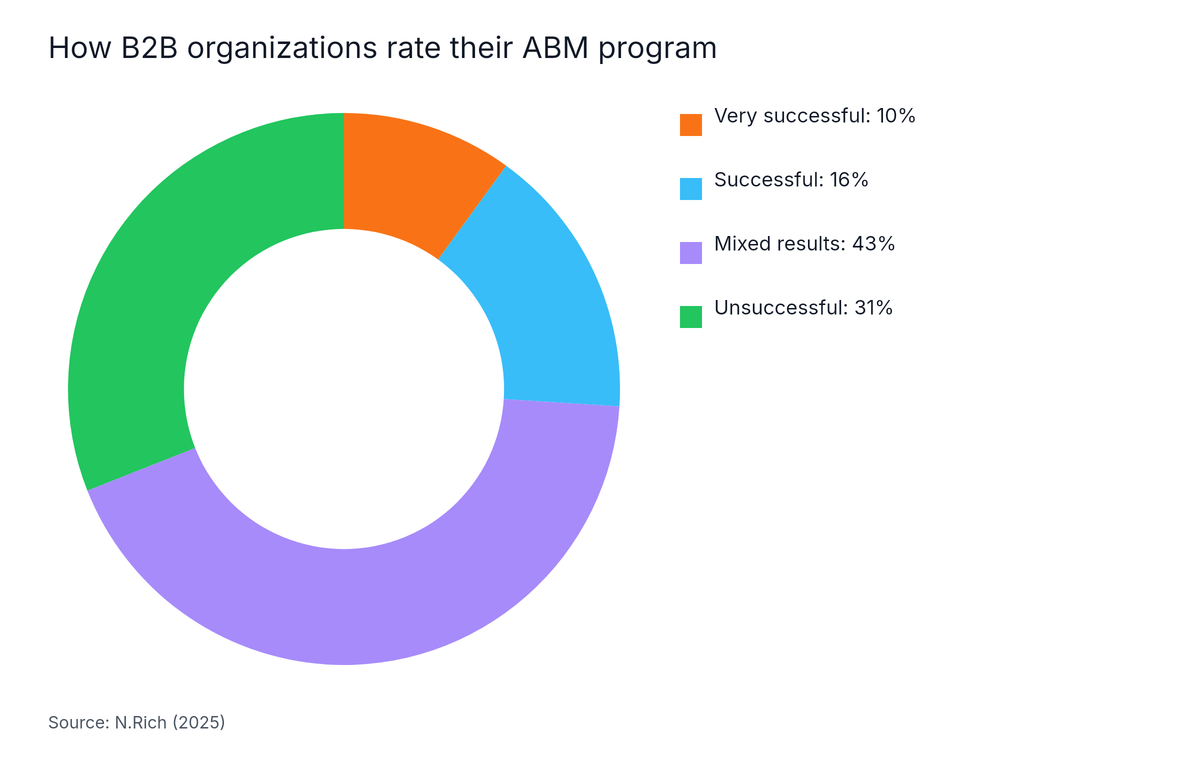
No hard statistic exists for how many first programs are cancelled, so treat the following as proxies. Of 107 B2B teams surveyed, 10% rated their ABM program very successful, 16% successful, 43% mixed and 31% unsuccessful (N.Rich, 2025).
Donut chart: How B2B organizations rate their ABM program. Highest: Mixed results at 43%.
Budget pressure raises the stakes. Marketing budgets sit at 7.8% of company revenue, and 56% of CMOs say they lack the budget for their 2026 strategy (Gartner CMO Spend Survey, via Prompt the Market, 2026). A new ABM program has to show pipeline quickly, so measurement is set before launch.
Adoption is wide. Nearly 80% of organizations were running ABM in 2026, and 47% integrate it with demand generation (Demand Gen Report, 2026). For how the two fit together, see demand generation for B2B SaaS.
How many accounts belong in each ABM tier?
Published ranges put 1:1 ABM at 10 to 50 target accounts, 1:few at 50 to 200 accounts in 5 to 15 clusters, and 1:many at 200 to 500 accounts (GrowthSpree, June 2026; practitioner view, no stated sample). Lists of 500 to 2,000+ named accounts are common at companies that should run 100 to 300.
Three concentric rings of small dots, the smallest ring sparse and the largest ring dense
Use the table to assign each account tier its size, treatment and owner.
Account tier
Published range
Treatment
Typical owner
1:1
10 to 50 accounts
Bespoke content and outreach per account
Named seller plus ABM lead
1:few
50 to 200 accounts in 5 to 15 clusters
Content built for each cluster
ABM lead plus SDR
1:many
200 to 500 accounts
Programmatic ads and sequences
Demand generation plus SDR
Apply a coverage rule before you fill the list
A list is only as large as the number of accounts where the team can reach the buying group. If three people cannot sustain outreach to 1,500 accounts, the program is really a smaller one with a long tail of wasted spend.
Start from fit. An ideal customer profile (ICP) is the set of firmographic and technographic traits shared by the companies that buy and stay. Score accounts against it before assigning a tier. The firmographic data guide covers how.
Tier by fit first, then by deal size and committee complexity. Promote an account to a higher tier only when the team has capacity to match the treatment. A spreadsheet-and-CRM list is a normal starting point.
How do you map the buying group for each tier?
A B2B SaaS buying group is the set of people inside and outside a company who shape one purchase, and it is far larger than one champion: procurement is a decision-maker in 53% of buying cycles (Forrester, 2026). Mapping roles per target account, not contacts, is how an ABM program measures real coverage.
A conference table seen from above with many chairs, some occupied and some empty
A buying group is the set of internal stakeholders and external influencers who take part in one purchase decision. Forrester's 2026 release describes its size this way: "The typical buying decision now includes 13 internal stakeholders and nine external influencers, with that number rising for more complex or strategic purchases" (Forrester, 2026).
Roles to map by deal size
Stakeholder counts rise with deal size, according to published buying committee ranges (GrowthSpree, 2026; published ranges, no stated sample).
Deal size (ACV)
Stakeholders involved
Sales cycle
$25K to $100K
5 to 8
49 to 84 days
$100K to $250K
7 to 10
84 to 126 days
$250K to $1M
10 to 15
126 to 180 days
The same published ranges (GrowthSpree, 2026; no stated sample) show procurement in 62% to 78% of US enterprise deals and 85% to 94% of Indian enterprise deals. For each account in the 1:1 and 1:few tiers, record these fields:
Role (economic buyer, champion, technical reviewer, security, finance, procurement)
Named contact or "unknown"
Main concern and the proof that answers it
Content or touch assigned
Status: unreached, engaged, or in conversation
Coverage then reads as roles engaged per account. The 1:many tier can map roles by function alone.
How do you measure ABM before pipeline shows up?
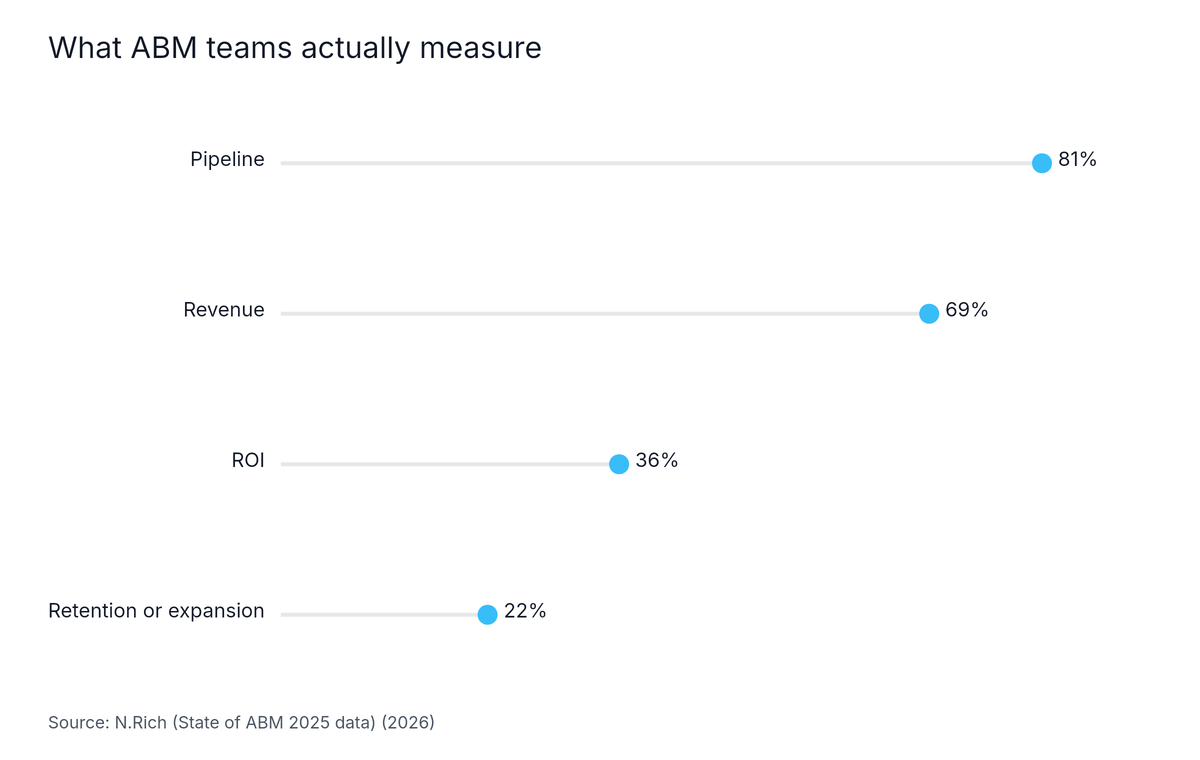
ABM measurement before pipeline appears relies on leading indicators per account tier: buying group roles engaged, meetings held and opportunities created, then pipeline per account against holdout accounts. Among ABM teams, 81% track pipeline but only 36% measure ROI (N.Rich, 2026), so the measurement sheet should fix definitions before launch.
The same 2026 N.Rich analysis found 69% track revenue and 22% track retention or expansion (N.Rich, 2026). Teams report pipeline and revenue often, and ROI and retention rarely. That leaves a program exposed when budgets are reviewed.
Lollipop chart: What ABM teams actually measure. Highest: Pipeline at 81%.
Holdout accounts are matched target accounts that receive no ABM treatment. They let you calculate the account-to-opportunity rate, the share of target accounts that become sales opportunities, for treated and untreated groups side by side. Without them, a rise in pipeline cannot be separated from the market.
Account tier
Primary KPI
Leading indicator
Review cadence
1:1
Pipeline per account
Roles engaged per account
Weekly with sales
1:few
Account-to-opportunity rate per cluster
Meetings held per cluster
Monthly
1:many
Account-to-opportunity rate vs holdout
Coverage of target accounts reached
Quarterly
Set the evaluation date up front
Sales cycle length is the floor. A program selling $100K to $250K deals should not be judged on pipeline before 84 to 126 days have passed (GrowthSpree, 2026; published ranges, no stated sample). Agree that date with finance in writing.
For the board, report four items: pipeline per account, account-to-opportunity rate against holdout accounts, roles engaged per account, and the agreed evaluation date. The ABM measurement guide covers the sheet in detail, and ABM attribution covers crediting multiple touches.
What is a marketing qualified account (MQA) and how is it different from an MQL?
A marketing qualified account (MQA) is a target account whose combined activity across its buying group crosses an agreed threshold, while a marketing qualified lead (MQL) scores one person. Because 74% of buyer teams show unhealthy conflict during a decision (Gartner, 2025), an account-level view of several roles reflects real interest better than one contact's score.
An MQA is judged per account, so three people from one company each reading a pricing page count together. An MQL is judged per person, so the same activity produces three separate low scores. The Gartner survey covered 632 B2B buyers.
The steps below are practitioner guidance, not a sourced standard. To set an MQA threshold in a CRM:
Pick two or three signals from the buying group map, such as roles engaged and meeting requests.
Give each signal an owner and a named action, such as an SDR call within a set number of days.
Mark an account as an MQA when it meets the threshold, and hand it to its seller.
Judge the threshold on meetings and pipeline per account, not on how many accounts qualify.
Can you run this template with only LinkedIn and a CRM?
An ABM program can run on LinkedIn and a customer relationship management (CRM) system alone: upload each account tier as a matched company list, filter by job function and seniority, and track buying group roles in CRM fields. Only 22% of teams ran ABM on a dedicated platform in the 2025 N.Rich survey (N.Rich, 2025).
A laptop showing a plain spreadsheet beside a smartphone on a clean desk
Follow these steps for a no-platform setup:
Add tier, fit score and owner fields to each account record in the CRM.
Upload the 1:few and 1:many tiers to LinkedIn as separate matched company lists.
Set job function and seniority filters on day one, with exclusions for non-buying roles.
Add a role-status field for each 1:1 account and assign a seller to each.
Create a holdout list of matched accounts and leave it untargeted.
Review the sheet on the cadence in the KPI table.
Step 3 matters because of a published audit of 56 LinkedIn accounts and $9.4M in ad spend (GrowthSpree, June 2026). Decision-makers received 33% of budget against a target of 60% or more. Individual contributors and entry-level staff consumed 36%, non-buying job functions caused 30% of wasted spend, and 20% of spend reached firms under 50 employees.
LinkedIn clicks for B2B SaaS run $8 to $25 by vertical (GrowthSpree, June 2026), which leaves little room for waste. If a tool decision comes later, the software comparison guide lists what to evaluate.
Who is this ABM template not for?
The account based marketing strategy template is a poor fit for teams selling below about $15K in annual contract value (ACV) or without at least one seller working named accounts, because the cost of reaching several stakeholders per account usually exceeds the return. In the 2025 N.Rich survey, 43% of B2B teams reported mixed ABM results, so structure is not a guarantee (N.Rich, 2025).
A wall calendar with dated sticky notes and a pencil line marking a long timeline
Annual contract value (ACV) is the yearly revenue a customer contract brings in. Three further limits apply:
Sources are partial. The tier ranges, stakeholder counts and LinkedIn figures are published ranges or practitioner views with no stated sample. The N.Rich survey is vendor-run with 107 respondents. Treat them as starting points, not benchmarks.
Demand generation still matters. The template does not replace it, and many B2B SaaS teams run both.
Capacity is local. No source gives a reliable accounts-per-person ratio, so the coverage rule above is a judgment call for each team.
How many target accounts should a first ABM program start with?
A first ABM program should start with a list sized to the team, usually 100 to 300 target accounts for small teams. Published ranges are 10 to 50 accounts for 1:1, 50 to 200 for 1:few, and 200 to 500 for 1:many. Lists of 500 to 2,000+ named accounts are common but typically exceed what a small team can sustain (GrowthSpree, June 2026, no stated sample).
What is the difference between 1:1, 1:few and 1:many ABM?
1:1 ABM dedicates bespoke content and outreach to each individual account, usually the highest-value targets. 1:few ABM groups accounts with shared traits into clusters of roughly 5 to 15 and builds content for each cluster. 1:many ABM applies programmatic tactics across a broader named list of 200 to 500 accounts.
Do you need an ABM platform before launching an ABM program?
An ABM program does not require a dedicated platform at launch. Tiers, buying group role maps and measurement can run on LinkedIn and a CRM, with matched company lists and CRM fields doing the work. The decision depends on deal size, team size and cost, and a tool decision can wait until the structure is working.
How long does ABM take to produce pipeline?
Sales cycle length is the floor for ABM results. Published ranges are 49 to 84 days for $25K to $100K deals, 84 to 126 days for $100K to $250K deals, and 126 to 180 days for $250K to $1M deals (GrowthSpree, 2026, published ranges, no stated sample). Judge pipeline only after at least one full sales cycle has passed.
Conclusion
A working ABM strategy comes down to structure set before spend. Pick fewer accounts. Reach the whole buying group. Measure pipeline.
Size tiers to the team: 10 to 50, 50 to 200, and 200 to 500 accounts are the published ranges.
Map roles per account, because buying decisions reach well beyond one champion.
Report pipeline per account against holdout accounts, not engagement.
Set exclusions on day one so LinkedIn budget reaches decision-makers.
Agree an evaluation date no earlier than one full sales cycle.
Next step: bring your draft target account list to a free consultation with an ABM expert. Meet with an expert. For wider context, see the ABM best practices guide.
Written by
Ishan Manchanda
Ishan Manchanda is co-founder of GrowthSpree, a B2B SaaS marketing consultancy founded in 2017 that has managed $60M+ in ad spend across 300+ B2B SaaS companies. He focuses on demand generation, go-to-market strategy and pipeline growth, and has been featured in Silicon Valley Times, SaaS Mag and the Unbounce podcast.
 Ishan ManchandaNov 5, 2026