
Blog
Attribution Models for B2B SaaS: What Each Measures and Where It Fails
Attribution models compared by deal size, sales cycle and buying group. What first-touch, last-touch, U-shaped and W-shaped each measure and where they fail.
B2B intent data explained: the three signal types, how each is collected, how reliable they are, and how to give every signal a named owner and action.
 Ishan ManchandaNov 16, 2026
Attribution models compared by deal size, sales cycle and buying group. What first-touch, last-touch, U-shaped and W-shaped each measure and where they fail.
Learn how to scale account based marketing campaigns by migrating accounts from 1:1 to 1:few before 1:many, with triggers, capacity math and metrics.

Build an intent data workflow that ties each signal to a named owner, action and deadline, then judge campaigns on pipeline per account, not clicks.
Request a quote and our experts will contact you within 24 hours with tailored solutions and pricing.
Last updated: Nov 16, 2026
By the ABM for B2B SaaS Editorial Team. Last updated October 28, 2026. Every figure on this page names its source, and ranges with no stated sample are labeled as published ranges.
B2B intent data is behavioral information that shows which companies are actively researching a topic, product or vendor, so sales and marketing teams can decide which target accounts to prioritise and when to act. Most teams can buy it. Fewer know what to do when the weekly score report lands. In an October 2025 DemandScience survey of 750 senior B2B marketing leaders, two-thirds said their dashboards sometimes, often or very often show success that does not turn into revenue (DemandScience, 2025). This page defines what intent data measures and how each signal type is collected. It also explains what reliability means for a B2B SaaS team working an account list built from firmographic data.
Key Takeaways
- B2B intent data is a set of behavioral signals that suggest a company is researching a purchase. It shows interest, not a decision.
- B2B intent data comes in first-party, second-party and third-party types, and reliability generally rises the closer the signal sits to the buyer's own behavior.
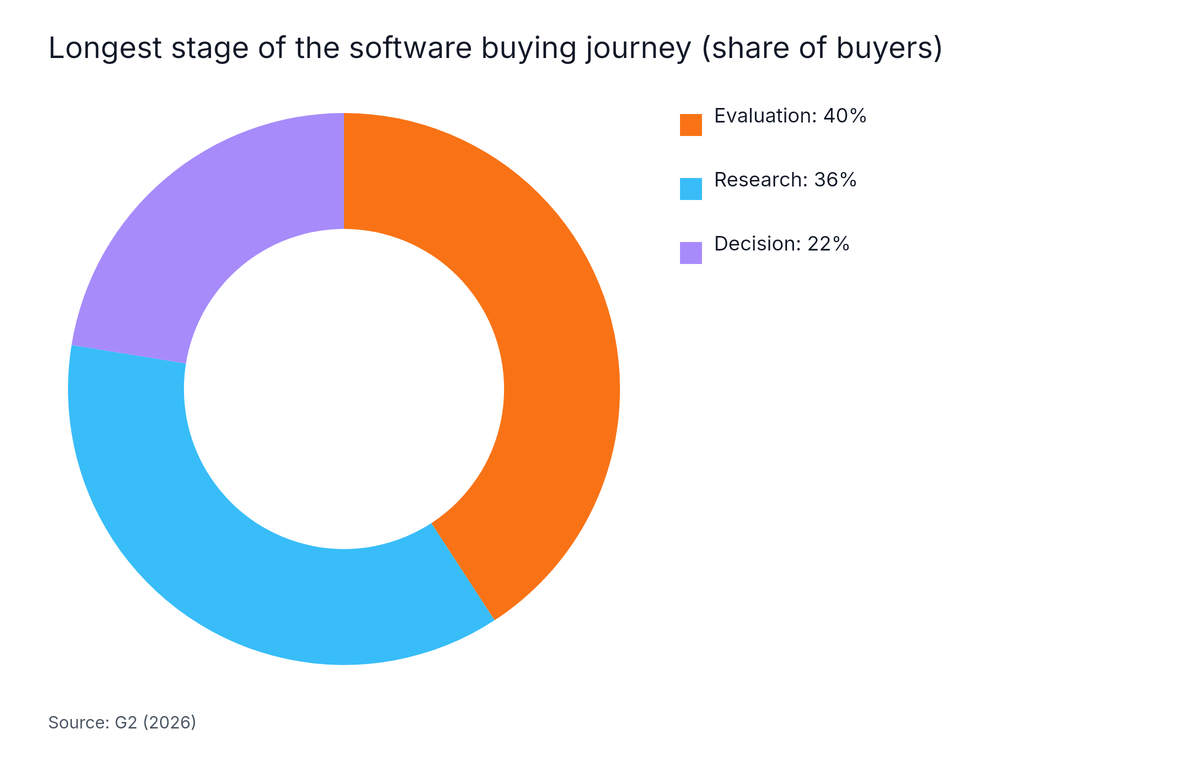
- Evaluation is the longest buying stage for 40% of software buyers (G2, 2026), so pricing and comparison signals outweigh broad topic reads.
- Intent data works best as a prioritisation input for target accounts already chosen on fit, not as a way to find new ones.
- An intent signal only pays off when it has a named owner, an action and a response time.
B2B intent data is a set of behavioral signals, such as topic searches, content reads and review-site visits, that suggest a company is researching a purchase. It works by comparing an account's recent activity with its normal baseline, then flagging a spike for follow-up. Because 73% of purchases involve three or more departments (Forrester, 2025), signals are read per account, not per person.

An intent signal is a single observed action, such as reading a pricing page, searching a category term or comparing vendors on a review site, that is attributed to a company. A signal measures attention, not budget, authority or timing. One analyst reading an article is a weak signal. Several people at the same account reading about the same problem in the same fortnight is a stronger one.
Baseline-versus-spike scoring is a method that scores an account on how far its current topic activity rises above its own normal level. Providers describe it in broadly four steps. Each provider sets its own thresholds, so check their documentation.
The output is a ranking, not a verdict. A ranking is useful only if the accounts being ranked were chosen first, which is why fit comes before intent.
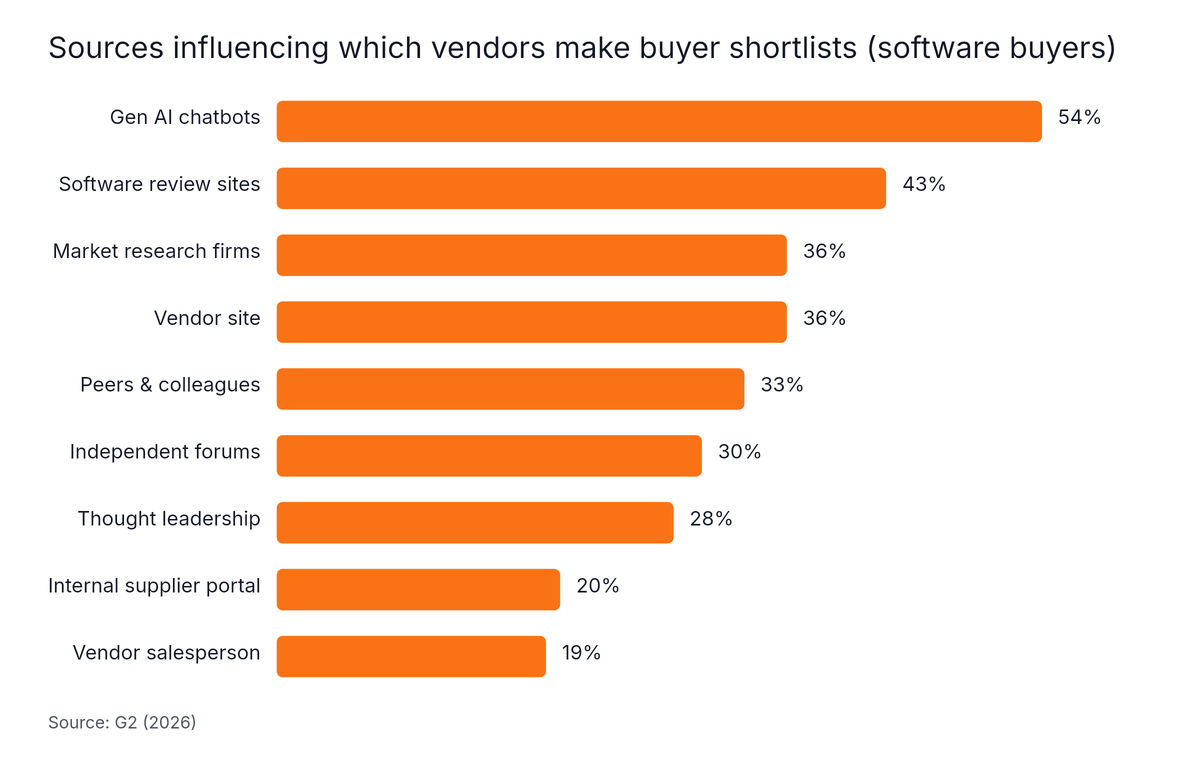
B2B intent data comes in three types: first-party signals from a company's own channels, second-party signals from review sites and partners, and third-party signals from publisher networks and bidstream data. Reliability rises with proximity to the buyer's actual behavior. Software review sites rank second as a shortlist influence, cited by 43% of software buyers (G2, 2026).
Source: G2, 2026
The chart shows what software buyers say shapes their shortlists: AI chatbots at 54%, review sites at 43%, then market research firms and vendor sites at 36% each, peers at 33% and independent forums at 30% (G2, 2026). G2 sells review-site intent data, so treat that ranking as vendor-sponsored.
| Type | Where it comes from | What it shows | Reliability read |
|---|---|---|---|
| First-party | Own website, product, email, CRM | Known accounts engaging with your content | Highest relevance and freshest, but covers only people who already found you |
| Second-party | Review sites and partner properties | Accounts comparing vendors in a category | Strong late-stage signal, limited to the partner's audience |
| Third-party | Publisher co-ops, bidstream, IP matching | Accounts reading about topics across the web | Widest coverage, weakest link to a real buying decision |
First-party intent data is behavior a company observes on its own channels. Second-party intent data is behavior captured on another company's property, such as a review site, and shared under a direct arrangement. Third-party intent data is behavior aggregated across many external sites by a data provider and matched to companies.
Reliability has at least four parts: match rate (how many signals map to a real account), refresh lag (how old the signal is on arrival), identity resolution (account only, or a named person) and validation (whether the account later converts). No independent, cross-industry accuracy benchmark turned up in the sources reviewed for this page. Accuracy percentages that circulate on aggregator pages could not be traced to a primary source and are not repeated here. The practical test is validation against your own closed-won accounts.
Practitioner sources also note a shared-signal problem: several third-party providers license topic data from overlapping sources, so a competitor may see the same alert in the same week.
B2B intent data is collected through five main routes: tracking on a company's own website and CRM, review-site activity, publisher co-ops that pool content consumption, bidstream data from ad auctions, and IP-to-account matching that links anonymous visits to a company. Each route differs in refresh speed, whether it identifies a person or only an account, and how much of the buyer's research it can see.

Privacy rules apply to several of these routes, particularly in Europe. This page describes how collection works and does not give legal advice. Check what each provider documents about consent and data sources.
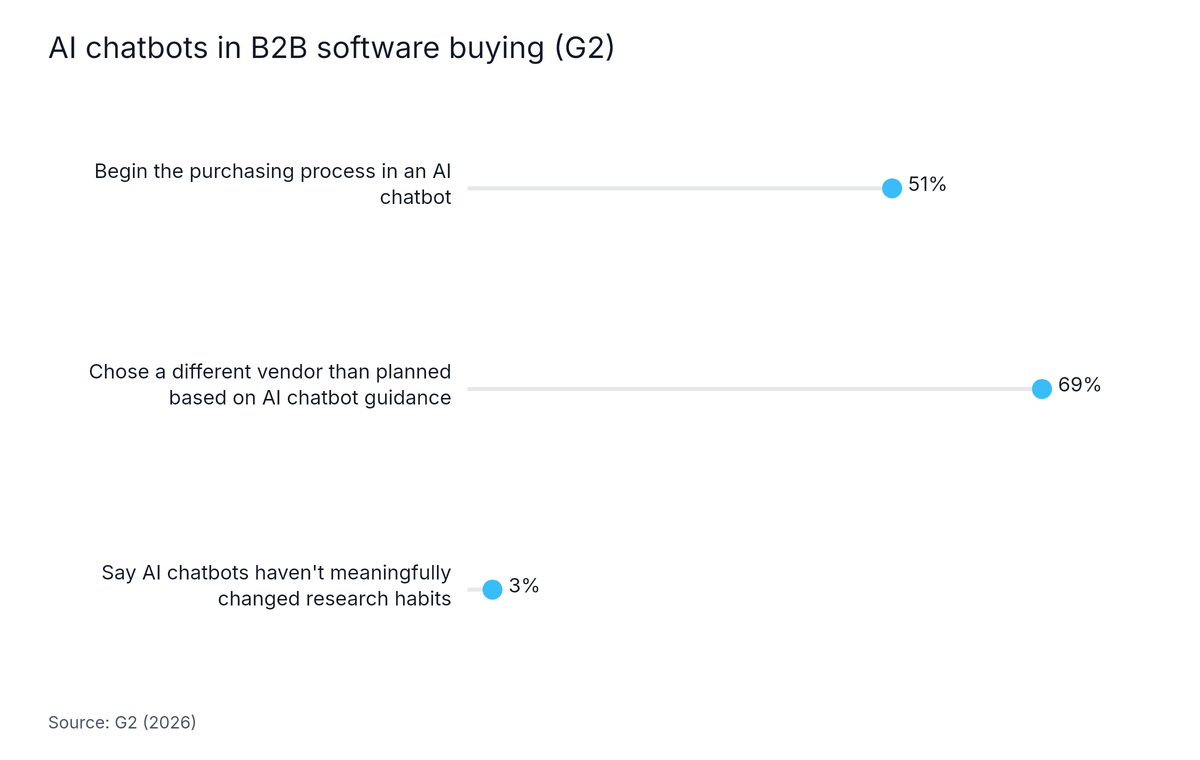
Collection tools see web behavior. Buyers increasingly research somewhere else. As of April 2026, 51% of software buyers begin their purchasing process in an AI chatbot, and 69% chose a different vendor than they first planned based on chatbot guidance (G2, 2026). Forrester states it plainly: "Nearly all business buyers (94%) report using AI during their buying process." (Forrester, 2026)
Source: G2, 2026
Part of the decision is therefore shaped where no co-op or bidstream tool is watching. A quiet account in a third-party report is not proof of a quiet account. This raises the relative value of first-party signals and review-site activity, which sit closer to the point of evaluation.
The main benefit of B2B intent data is prioritisation: it shows which target accounts are researching now, so limited seller and ad time goes to accounts most likely to be in market. Respondents to a 2025 DemandScience survey estimated that 25% of budget leaks away and that better connected data could add 32% in annual revenue (DemandScience, 2025).

Those are self-reported estimates from a vendor survey, so treat them as directional rather than measured results.
| Benefit | What changes | Condition for it to hold |
|---|---|---|
| Account prioritisation | Sellers work accounts researching now, not the whole list | Accounts were chosen on fit first |
| Better timing | Outreach lands during research, not after a decision | Refresh lag is short and the owner responds quickly |
| Stage-matched messaging | Content matches what the account is reading | Signals are tied to a stage, not just a topic |
| Less wasted spend | Ad and sequence effort concentrates on active accounts | Results are checked against holdout accounts |
Stage changes what a signal means. As of mid-2026, evaluation is the longest stage of the software buying journey for the largest share of buyers, at 40%, ahead of research at 36% and decision at 22% (G2, 2026). The report's introduction says: "Evaluation is now where software deals are won and lost." (G2, 2026)
Source: G2, 2026
A pricing-page visit or a vendor comparison therefore carries more weight than a broad topic read. Intent data that cannot tell the two apart will inflate scores early in the journey.
B2B account-based marketing works by choosing named target accounts, mapping the buying group at each, coordinating sales and marketing outreach to those roles, and measuring pipeline per account. Intent data fits as a prioritisation input: fit decides which accounts belong on the list, and intent signals decide which to work first. Forrester's 2025 survey puts the average purchase at 13 internal and nine external people (Forrester, 2025).

Account-based marketing (ABM) is a go-to-market approach that focuses sales and marketing effort on a defined list of named target accounts and measures success on pipeline. An ideal customer profile (ICP) is the description of the companies that buy, stay and expand, built from firmographic and technographic criteria. Building the list from the ICP first means intent only reorders accounts that already belong. Buying intent for the entire market produces a long list of accounts that read a lot and never buy.
Published ranges, with no stated sample, suggest 10 to 50 accounts for 1:1 treatment, 50 to 200 accounts in 5 to 15 clusters for 1:few, and 200 to 500 for 1:many. Intent supports each account tier differently.
| Account tier | Published range of accounts | How an intent signal is used |
|---|---|---|
| 1:1 | 10 to 50 | Triggers a tailored play from the account executive and marketing together |
| 1:few | 50 to 200 in 5 to 15 clusters | A cluster-level topic spike decides which cluster content runs next |
| 1:many | 200 to 500 | Moves an account into or out of a programmatic audience |
Reaching the right account is only half the job. The same intent-flagged account can still be reached through the wrong people.
What we found: In a June 2026 audit of 56 LinkedIn accounts covering $9.4M in ad spend (a study published by GrowthSpree), decision-makers received 33% of LinkedIn ad budget against a target of 60% or more, and non-buying job functions caused 30% of wasted spend. An intent flag on a company only helps if the follow-up reaches the roles that decide.
Because several roles research independently, count how many distinct people or roles at an account show activity, not just the score. For a worked cadence, see acting on intent signals before they reset. Broader practice is covered in the ABM best practices guide.
Intent data improves B2B lead generation only when each signal has a named owner, a defined action and a response time. A signal-to-owner-to-action table turns a weekly score report into a workflow. Marketing leaders estimate about 25% of marketing spend goes to activity that looks successful in dashboards but fails to drive outcomes (DemandScience, 2025).

DemandScience's CMO Bill Hobbib describes the pattern: "Too often, marketers see dashboards glow green, impressions scale, and lead goals exceeded" (DemandScience, 2025). Green dashboards are not meetings. The fix is to cut the signal list down to a few that people will act on.
The rows below are an illustrative starting template, not a benchmark. Adjust the response times to your sales cycle and team size.
| Signal | Owner | Action | Response time | Log |
|---|---|---|---|---|
| Pricing-page visit by a 1:1 account | Account executive | Personal outreach to the visiting role or its sponsor | Same business day | Contact, page, outcome |
| Review-site comparison activity at a 1:few account | SDR | Add to sequence with a comparison asset | Within two business days | Sequence entered, reply |
| Topic spike on a core category term | Marketing | Add account to a matched ad audience and cluster content | Within one week | Audience added, date |
| Several roles active at one account | Sales and marketing together | Map the buying group and fill missing roles | Within one week | Roles covered, gaps |
Keep a set of target accounts that receive no intent-based treatment (holdout accounts). Compare account-to-opportunity rate and pipeline per account against the intent-prioritised set, and run the test for at least one sales cycle. Published ranges, with no stated sample, put cycles at 49 to 84 days for $25K to $100K deals and 84 to 126 days for $100K to $250K deals. Measurement setup is covered in ABM measurement on pipeline per target account. The reasons high engagement can still produce no sales-qualified leads (SQLs) are in B2B marketing analytics. To place intent inside the wider mix, see demand generation for B2B SaaS.
B2B intent data is a poor fit for teams with no seller working named accounts, no agreed ideal customer profile (ICP) and no owner for follow-up. It also misses buyer research that happens outside tracked web behavior, such as AI chatbot use. No independent, cross-industry accuracy benchmark exists in the sources reviewed, so provider claims should be tested against your own closed-won accounts.
Intent data is likely not worth buying yet when:
Smaller teams can start with first-party signals alone: pricing-page visits, demo-page revisits and repeated visits from target accounts, tracked in the CRM. Comparing provider options belongs in a separate evaluation. The ABM software comparison covers what to check before signing, including the no-platform option.
B2B marketing intent data is behavioral information about companies, such as topic searches, content reads and review-site visits, that marketers use to judge which accounts may be researching a purchase. Teams use it to rank target accounts, time outreach and adjust ad targeting. It indicates interest, not a decision to buy, so it needs a named follow-up action.
B2B intent data works by collecting company-level activity on defined topics, setting each account's normal activity level, and flagging accounts whose recent activity rises well above it. The flagged accounts reach sales or marketing as a ranked list. The ranking shows interest only, so a person must decide what action follows.
B2B account-based marketing works by choosing named target accounts, mapping the buying group at each, coordinating sales and marketing outreach to those roles, and measuring pipeline per account. Intent data supports it by ranking which accounts on the list to work first. It does not replace choosing accounts on fit.
Intent data improves B2B lead generation by directing seller and ad effort to accounts already researching a topic, rather than treating every contact equally. The gain comes from timing and prioritisation. It only holds when each signal has an owner, an action and a response time, and is checked against meetings and pipeline.
To use intent data for B2B lead generation, build the target account list on fit first, choose three to five intent signals, assign each an owner, an action and a response time, and log the outcome for every flagged account. Review quarterly which signals led to meetings, and drop those that did not.
Intent data improves B2B performance marketing without adding noise when it narrows who receives spend instead of widening it. Use fit to build the account list, use intent only to rank accounts within it, and judge the result against holdout accounts on pipeline per account, not on engagement scores or intent score changes.
B2B intent data is useful when it ranks accounts already chosen on fit, and wasteful when it becomes a weekly report nobody owns.
Next step: bring your target account list and any intent report you already receive, and map each signal to an owner and an action with an expert. A free consultation is available: Meet with an expert.
Written by
Ishan Manchanda
Ishan Manchanda is co-founder of GrowthSpree, a B2B SaaS marketing consultancy founded in 2017 that has managed $60M+ in ad spend across 300+ B2B SaaS companies. He focuses on demand generation, go-to-market strategy and pipeline growth, and has been featured in Silicon Valley Times, SaaS Mag and the Unbounce podcast.
© 2026 ABM for B2B SaaS All rights reserved.