B2B Intent Data Providers Compared: Signal Types, Coverage, and When Each Is Worth the Cost
b2b intent data providersb2b buyer intent datab2b intent data providers comparison
B2B Intent Data Providers Compared: Signal Types, Coverage, and When Each Is Worth the Cost
Compare B2B intent data providers by signal type, buying-group coverage, CRM follow-up and median cost, with a choose-X-when verdict and a no-platform option.
Request a quote and our experts will contact you within 24 hours with tailored solutions and pricing.
B2B Intent Data Providers Compared: Signal Types, Coverage, and When Each Is Worth the Cost
By the ABM for B2B SaaS Editorial Team. Last updated October 28, 2026. Sources and method are described on the Methodology page.
B2B intent data providers are vendors that sell behavioral signals showing which target accounts are researching a purchase, and the right one depends on signal type, buying-group coverage and CRM follow-up, or on no platform at all. The renewal date usually forces the question. In a survey fielded in October 2025, 87% of marketing leaders reported unreliable or inflated intent signals (DemandScience, 2025). This comparison for account-based marketing (ABM) teams scores each option on signal type, coverage and customer relationship management (CRM) fit, and always includes the no-platform route. It assumes a sound firmographic target account list already exists.
Key Takeaways
Bombora is the lower-cost, account-level intent feed, with a reported median contract of $25,000 a year, while 6sense's reported median is $62,220.
Account-level intent scores miss most of a buying group that averages 13 internal stakeholders and nine external influencers.
An intent data provider is worth renewing only if its signals have named owners and pipeline per account beats a holdout group.
The no-platform option, using first-party signals and sales research, is a legitimate choice for short named account lists.
Which B2B intent data providers should you shortlist, and when does each win?
Choose Bombora when a lower-cost, account-level feed is enough, Intentsify when identity and contact depth matter, 6sense or Demandbase when intent must sit inside a full ABM platform, and no platform when first-party signals already cover the named accounts. Intentsify, 6sense, Bombora, Informa TechTarget and Demandbase are reported as Leaders in The Forrester Wave: Intent Data Providers For B2B, Q1 2025 (Forrester, 2025).
Brass compass with its needle fixed on a single marker on a pale plinth
The table gives the verdict first. Coverage descriptions reflect how each approach works, not a vendor ranking.
Option
Signal type
Buying-group coverage
Choose it when
Bombora
Account-level co-op surge score, updated weekly
Account only
A dedicated, lower-cost feed is needed to rank accounts
Intentsify
Multi-source intent with the Orbit identity graph
Persona and role mapping, per the vendor
Buying-group depth matters more than price
6sense or Demandbase
Intent inside a full ABM platform
Account plus platform contacts
The team will use list building and orchestration too
No platform
First-party signals: site visits, CRM, product usage, review-site activity
Whoever already engaged
Named account lists are short and sellers research accounts by hand
Informa TechTarget is also a reported Forrester Leader. The research behind this page does not support a signal-type description for it, so test it in a pilot if it makes your shortlist. Forrester's Q1 2025 Wave also advised buyers to re-check data coverage outside North America.
What is B2B buyer intent data, and how reliable are the signals?
B2B buyer intent data is behavioral evidence, such as topic research and content consumption, that suggests a company is researching a purchase. Reliability is mixed: 87% of 750 senior marketing leaders say their marketing investments produce unreliable or inflated intent signals (DemandScience, 2025). Treat a score as a prompt to check fit, not proof of a buying decision.
Three translucent glass panes of different sizes stacked on a table, each catching light
The same DemandScience survey puts numbers on the measurement problem. About two-thirds of leaders say dashboards sometimes, often or very often show success that does not translate into revenue (DemandScience, 2025). Respondents also estimate that 25% of marketing budget is wasted on efforts that fail to drive outcomes (DemandScience, 2025). DemandScience sells B2B data, so read these as vendor research with a stated method: 750 leaders at companies with $100M to $5B+ in revenue.
Signals still have a job. Gartner's survey of buyers, fielded in August and September 2025, found 69% of B2B buyers turn to sales reps to validate AI-generated insights (Gartner, 2026). Signals give early visibility. A person still decides the outcome.
How do signal types, buying-group coverage and regional fit differ by provider?
Intent signal types fall into three groups: account-level co-op feeds such as Bombora Company Surge, identity-graph approaches such as Intentsify Orbit, and first-party signals from your own site and CRM. Coverage matters because the typical buying decision involves 13 internal stakeholders and nine external influencers (Forrester, 2026), so an account-level score reaches only part of the buying group.
Account-level co-op feeds
Bombora Company Surge is a weekly, account-level score from 0 to 100 in which 60 or above indicates a surge (ZoomInfo Pipeline, 2026). As of October 2026, Bombora says the score compares the latest three weeks against a 12-week baseline across more than 25,300 topics, built on a consent-driven co-op of B2B sites (Bombora, 2026). Forrester called it "Still the gold standard for account-level intent data feeds" (Forrester, via Bombora, 2025). The limit is plain: Bombora Company Surge is a weekly batch about the account, not a person. Several full platforms also license Bombora data, so check for duplicate signal spend.
Identity-graph approaches
An identity graph links devices, emails and roles to the same person or company, which lets a provider say who inside an account is researching. Intentsify introduced its Orbit graph in 2024, and a vendor-quoted Forrester line credits it for persona-based analysis and improved buying-group prediction (Intentsify, 2025). Intentsify acquired Salutary Data in January 2026 to add contact depth. These are vendor claims. Test them in a pilot.
Why account-only scores fall short
Forrester's State Of Business Buying, 2026 says "The typical buying decision now includes 13 internal stakeholders and nine external influencers, with that number rising for more complex or strategic purchases" (Forrester, 2026). Procurement is a decision-maker in 53% of cycles, and 73% of B2B purchases involve three or more departments (Forrester, 2026).
Benchmark context: Published ranges from GrowthSpree's 2026 buying committee benchmarks (BC26, no sample stated) put 7 to 10 stakeholders in $100K to $250K deals, with 84 to 126 day sales cycles. These are published ranges, not study findings.
Deal size (annual contract value)
Stakeholders
Sales cycle
$25K to $100K
5 to 8
49 to 84 days
$100K to $250K
7 to 10
84 to 126 days
$250K to $1M
10 to 15
126 to 180 days
Row of small brass keys on a hook board with one key lifted and held out
An account score tells sales which company to look at. It does not tell them whether security, finance or procurement has appeared. Reaching the wrong roles is expensive in practice.
Our results: In 56 audited LinkedIn accounts with $9.4M in ad spend analyzed (GrowthSpree, June 2026), decision-makers received 33% of budget against a target of 60% or more. Target cost per sales-qualified lead (SQL) runs $3,000 to $8,000 for $50K to $150K annual contract value deals (GrowthSpree, April 2026). An intent signal that points sales at the wrong role feeds that waste.
Regional and vertical fit
Buying-group size varies by region. Forrester reports that public-sector buying groups average 14 internal stakeholders, rising to 18 in APAC (public-sector only, not all B2B) (Forrester, 2026). Because Forrester also advised re-checking coverage outside North America, ask each provider for match rates on your own target accounts in EMEA and APAC. Vendors claim topic depth for cybersecurity, FinTech and HR Tech, but no independent test was found. Score ten named accounts per vertical before signing.
How much do B2B intent data providers cost before the demo?
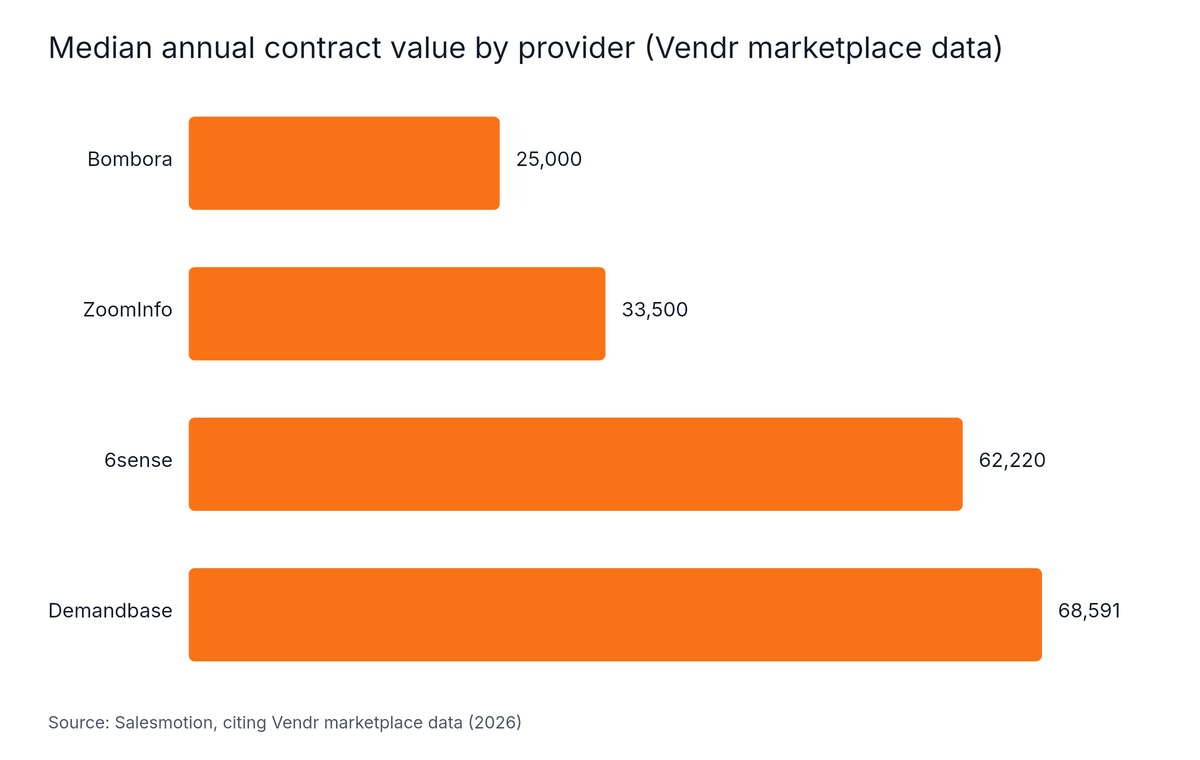
B2B intent data providers differ widely in cost: Bombora's median annual contract is $25,000 across 35 purchases, while 6sense's median is $62,220 across 386 purchases (Salesmotion, citing Vendr data, 2026). Bombora does not publish list pricing, so compare any quote on seats, topics, accounts, regions and term.
Horizontal Bar chart: Median annual contract value by provider (Vendr marketplace data). Highest: Demandbase at 68,591.
The chart also shows ZoomInfo at a $33,500 median and Demandbase at $68,591, with no purchase counts given, so treat those two as indicative.
Provider
Median annual contract
Observed range
Purchases
Bombora
$25,000
$13,000 to $80,450
35
6sense
$62,220
$11,234 to $176,511
386
All figures come from Salesmotion's re-reporting of Vendr marketplace data (2026). Salesmotion is a vendor, so verify the numbers at vendr.com before using them in a budget. Other pages report slightly different 6sense medians from different snapshot dates.
Only the full platforms sit above a $50K line at the median. A dedicated feed costs less, but the money is wasted if no one acts on it. Meanwhile, 79% of organizations report rising martech costs without corresponding ROI gains (DemandScience, 2026). Before the demo, ask for a quote broken into seats, topics, accounts, regions, contract term and data-activation fees. For the wider decision, see the ABM platform comparison.
How do you make intent signals actionable and prove them at renewal?
Intent signals become actionable when each one has a named action, an owner and a deadline. They become defensible at renewal when pipeline per account is compared against holdout accounts that received no intent-triggered treatment. Bombora Company Surge scores update weekly (ZoomInfo Pipeline, 2026), so an unrouted signal is replaced by the next weekly score.
A single empty wooden chair in a large bare room lit by one window beam
Route every signal to an owner
A weekly report emailed to sales with no assigned action is the usual failure. Replace it with routing rules that fire inside the CRM or a chat alert, and check whether each provider integrates natively or through middleware before you sign. The signal-to-action workflow covers the sequence in detail.
Signal
Action
Owner
Surge score of 60 or above on a tier 1 account
Seller reviews the account and contacts the champion
Account executive
Surge plus a pricing-page visit
Outreach to a second role, such as finance or security
SDR
Surge on a tier 3 account
Add to a content or ad audience
Demand generation
Timing matters. About 64% of business buyers are now Millennials or Gen Z (Forrester, 2026), and Forrester notes these buyers "bring B2C expectations into B2B, do far more self-guided research, and have less patience for generic outreach" (Forrester, 2026). A badly timed, generic message costs more than silence.
Run a holdout test before renewing
Holdout accounts are target accounts deliberately left without treatment so their pipeline can be compared with treated accounts. Split matched accounts, route signals to only one group, then compare account-to-opportunity rate, pipeline per account and time to first pipeline. If the treated group does not beat the holdout, the renewal has no basis. ABM measurement explains how to set this up.
Consider the no-platform option
The no-platform option means using first-party signals (site visits, CRM activity, product usage, review-site activity) plus manual research on named accounts. It fits when the list is short. Published ranges from a 2026 practitioner analysis (no sample stated) suggest 10 to 50 accounts for 1:1 treatment and 50 to 200 for 1:few. A seller can research that many accounts without a weekly score. A platform starts to pay when the list outgrows manual research and signals change faster than a person can check.
Who is this comparison not for, and what does it leave out?
The B2B intent data providers comparison is not for teams with a few dozen target accounts and one seller, because the lowest-cost dedicated feed still has a reported median contract of $25,000 a year (Salesmotion, citing Vendr data, 2026). It also leaves out Albacross and Madison Logic, has no vertical testing for cybersecurity or FinTech, and relies on vendor surveys.
Albacross and Madison Logic are out of scope because the research behind this page has no verified, dated feature, pricing or practitioner data for either, and a comparison without that evidence would repeat vendor claims. Three further caveats apply:
Pricing comes from procurement medians re-reported by a vendor, and the Forrester Wave report is paywalled, so Leader placements are vendor-reported.
Privacy rules apply to intent data and visitor identification, particularly in Europe. This page does not give legal advice.
Independent accuracy evidence is thin. Most precision claims come from vendors, and no figure here proves a provider lifts win rates.
Frequently Asked Questions
What is an intent data platform?
An intent data platform collects behavioral signals, such as topic research, content consumption and site visits, and turns them into account-level scores or contact lists. Sales and marketing teams use the scores to decide which target accounts to contact first. A platform is only useful when each signal is tied to a named action and an owner.
Which account based marketing tools show intent?
Full ABM platforms such as 6sense and Demandbase include intent signals alongside account lists and orchestration, and both are reported as Leaders in The Forrester Wave: Intent Data Providers For B2B, Q1 2025. Dedicated feeds such as Bombora and Intentsify supply intent to other tools. Teams without a platform can use first-party signals in the CRM.
How does Bombora intent data work and is it reliable enough to act on?
Bombora Company Surge scores accounts from 0 to 100 based on topic research across a consent-driven co-op of B2B sites, comparing the latest three weeks with a 12-week baseline. A score of 60 or above indicates a surge. Bombora Company Surge is a weekly, account-level signal, so use it to prioritize accounts, not to identify individual buyers.
Which B2B intent data providers cover the buying group, not just the account?
Account-level feeds such as Bombora Company Surge score the company, not the people. Providers that use an identity graph, such as Intentsify with its Orbit graph, aim to map signals to roles. Forrester's credit for Intentsify Orbit is quoted on the vendor's page and the full report is paywalled, so test coverage in a pilot.
Which B2B intent data platforms are worth the $50K-plus annual cost?
A B2B intent data provider is worth $50,000 or more a year only if pipeline per account beats holdout accounts. Among providers with reported medians, 6sense sits above that line at $62,220 across 386 purchases, while Bombora's median is $25,000 across 35 purchases (Salesmotion, citing Vendr data, 2026). Run the holdout test before renewing.
Verdict: Choose X When
The verdict depends on list size, buying-group depth and whether signals have owners:
Choose Bombora when an account-level feed at a median near $25,000 a year is enough.
Choose Intentsify when role-level coverage matters more than price.
Choose 6sense or Demandbase when the team will use the full platform, not only the intent score.
Choose no platform when the named account list is short and sellers can research it.
Renew only after a holdout test shows pipeline per account beating untreated accounts.
Whatever the choice, every signal needs an owner and a measured result. For a decision tied to deal size, start with a pipeline-first measurement plan.
Meet with an expert. A free consultation. Bring your target account list and brainstorm the next step with an ABM expert. Book at ABM for B2B SaaS.
Written by
Ishan Manchanda
Ishan Manchanda is co-founder of GrowthSpree, a B2B SaaS marketing consultancy founded in 2017 that has managed $60M+ in ad spend across 300+ B2B SaaS companies. He focuses on demand generation, go-to-market strategy and pipeline growth, and has been featured in Silicon Valley Times, SaaS Mag and the Unbounce podcast.
 Ishan ManchandaNov 13, 2026