What to Demand from a B2B SaaS Marketing Agency After a Funding Round
b2b saas marketing agencyhow to choose a marketing agency for b2b saascost per SQL by ACV
What to Demand from a B2B SaaS Marketing Agency After a Funding Round
What to require in writing from a B2B SaaS marketing agency after a funding round: pipeline per account, holdout accounts and cost-per-SQL ceilings by ACV.
Request a quote and our experts will contact you within 24 hours with tailored solutions and pricing.
What to Demand from a B2B SaaS Marketing Agency After a Funding Round
By the ABM for B2B SaaS Editorial Team. Last updated October 28, 2026. Sourcing rules are described on the Methodology page.
A B2B SaaS marketing agency should commit in writing to pipeline per target account, a holdout test that proves its work, and cost-per-SQL ceilings set by annual contract value (ACV), before any retainer is signed after a funding round. SQL means sales-qualified lead.
The pressure is real. Once the board sets an enterprise pipeline target, agencies pitch broad retainers and report reach, engagement and marketing-qualified leads, none of which prove revenue. This guide covers what a Series A or later company should require from an agency running account-based marketing (ABM), with benchmarks, a clause table, a holdout design and advice on fees and contract length. It also ties the terms to the ideal customer profile (ICP) work in the firmographic data guide.
Key Takeaways
A B2B SaaS marketing agency contract should name five commitments: pipeline per target account, a holdout test, cost-per-SQL ceilings by ACV, metric definitions and exit rights.
Median B2B SaaS CAC payback was 16 months in 2025, so a post-round agency promise of fast payback needs proof, not a pitch.
Holdout accounts are the only way to show an agency created pipeline that would not have arrived anyway.
Published ranges put cost per SQL at $1,000 to $3,000 for $15K to $50K ACV and $8,000 to $20,000 above $150K ACV.
The checklist fits B2B SaaS companies with ACV above roughly $15K and at least one seller working named accounts.
What should a B2B SaaS marketing agency put in writing before you sign?
A B2B SaaS marketing agency should put five commitments in writing before signing: pipeline created per target account, a holdout test design, cost-per-SQL ceilings by annual contract value (ACV), written definitions for every reported metric, and exit rights tied to missed targets. Anything an agency will not write down is a claim, not a commitment.
A printed agency contract on a desk with five numbered tabs marking clauses beside a pen
Timing matters because payback is slow. "The median B2B SaaS company recovers its customer acquisition cost in 16 months." (Aleph, 2026). An agency promising results in a quarter is promising something most companies do not achieve. The table turns each commitment into contract language and shows what its absence usually signals.
Clause
What to require
Warning sign if missing
Pipeline per account
Pipeline value created per named target account, by tier, from a list frozen at signing
Reports contain only accounts reached or engagement scores
Holdout test
Random split of the target list, suppression of holdouts, test window at least one sales cycle
Results quoted as pipeline totals with no control group
Cost-per-SQL ceiling
A ceiling per ACV band, with SQL acceptance criteria signed by sales
SQL counts that sales does not recognise
Metric definitions
Written definitions of SQL, opportunity and CAC, plus the benchmark year
Definitions shift between monthly reports
Data access
Read access to ad accounts and CRM reports
Reports arrive as screenshots
Exit rights
A review point after one full sales cycle, with termination if agreed targets are missed
Long lock-in with no link to results
Each clause should name an owner. The agency owns delivery, while the client's revenue operations team owns the CRM analysis. That split keeps the agency from grading its own work.
Why does a funding round make agency risk higher?
A funding round raises agency risk because a board-set pipeline target arrives while sales cycles stay the same length, which pushes buyers toward broad retainers and activity reports. Crunchbase News reported $4.23 billion of early-stage fintech funding in Q3 2026, up 11% quarter over quarter, though excluding one $1.2 billion Series A it would have fallen 20.4% (Crunchbase News, 2026).
The same report describes the bar for a Series A rising: "investors now want greater traction and stronger momentum, including revenue that has at least tripled over six months." (Crunchbase News, 2026). That data covers fintech only, but it shows why post-round teams feel pressed to buy volume fast.
CAC payback is the number of months a company needs to recover its customer acquisition cost. The 16-month median comes from 2025 actuals reported by 198 companies (Aleph, 2026).
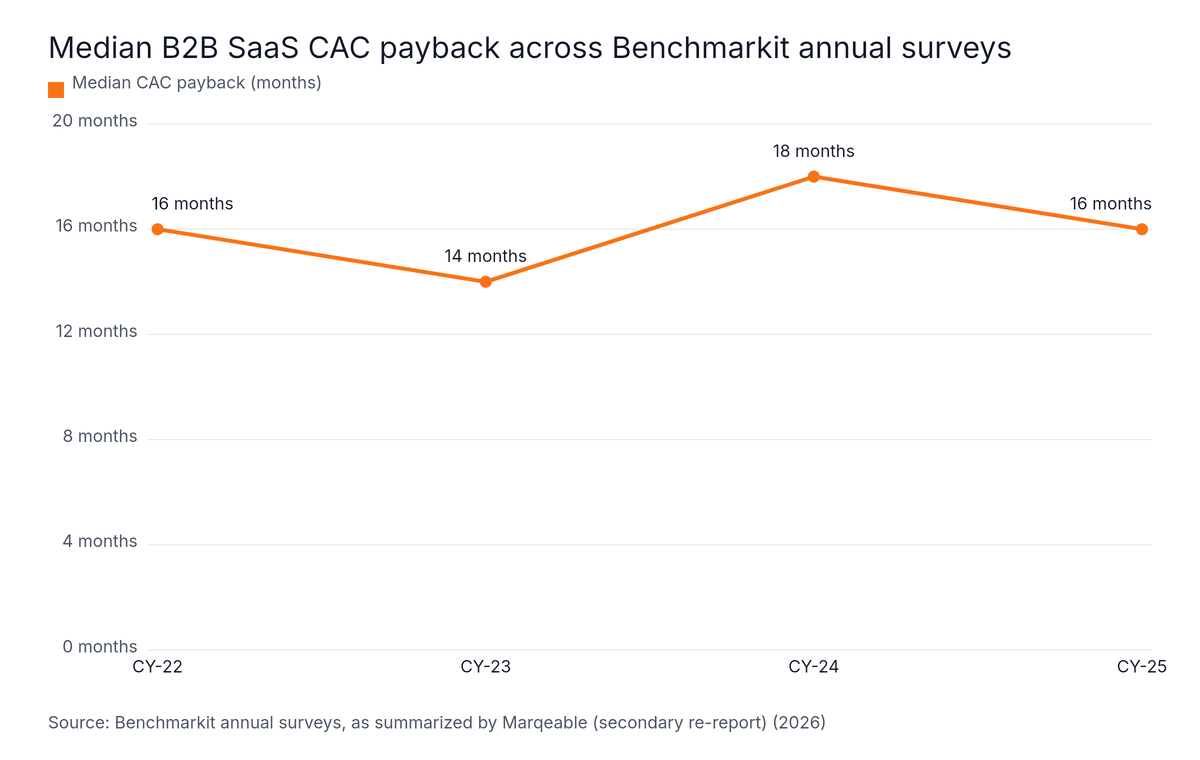
Line chart: Median B2B SaaS CAC payback across Benchmarkit annual surveys. Highest: CY-24 at 18 months.
Payback has also swung year to year. Benchmarkit surveys, summarised by Marqeable (2026), show medians of 16, 14, 18 and then 16 months for CY-22 through CY-25. Any agency payback promise should therefore pin the benchmark year and the CAC definition in the contract.
How do you write pipeline per account into an agency contract?
Pipeline per account is the sales pipeline value created divided by the number of named target accounts in a tier. In a contract, it should be measured in the customer relationship management (CRM) system against a target account list frozen at signing, tier by tier, counting only opportunities created after the engagement start.
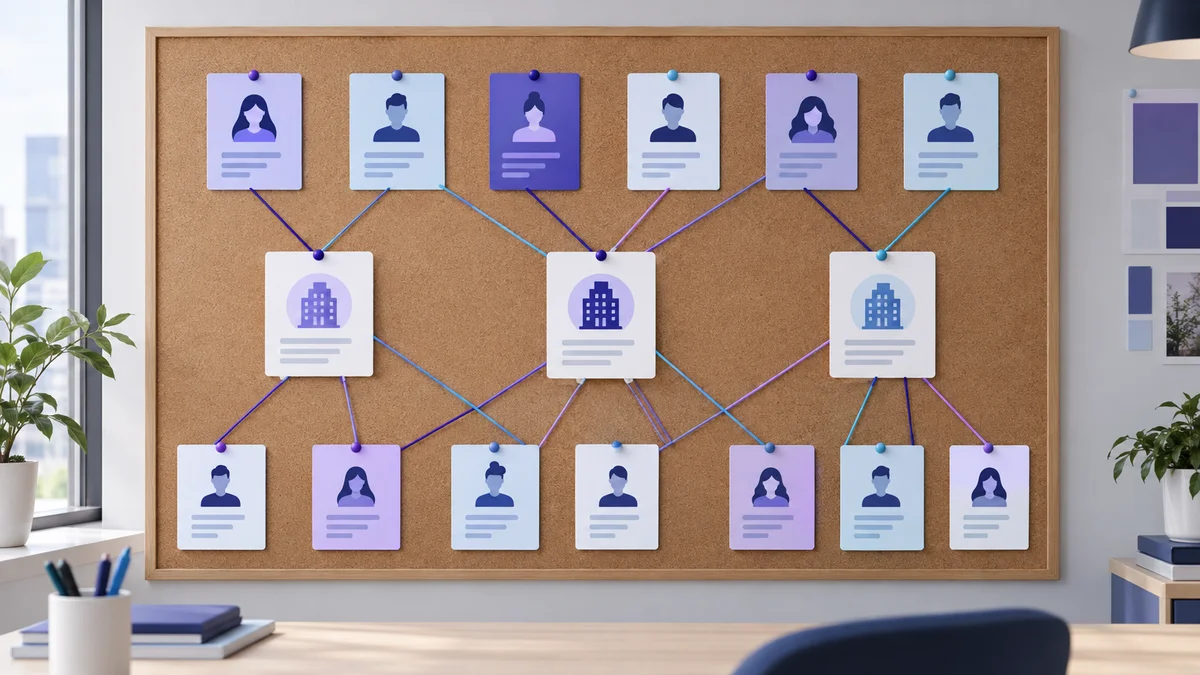
A wall board of named account cards grouped into three tiers with string linking stakeholder roles
Freeze the list and the tiers
List size decides whether any commitment is realistic. Published ranges, with no stated sample, suggest 10 to 50 accounts for 1:1 treatment, 50 to 200 accounts in 5 to 15 clusters for 1:few, and 200 to 500 for 1:many. Common lists run 500 to 2,000+ named accounts at companies that should run 100 to 300. An agency that accepts a 1,500-account list without tiers is accepting a market map, not a program.
Add buying-group coverage
A buying group is the set of stakeholders at one account who take part in a purchase decision. Coverage should be a second KPI next to pipeline: roles reached per account, not just contacts. The published ranges below, with no stated sample, show how fast the group grows with deal size.
Deal size
Stakeholders
Sales cycle
$25K to $100K
5 to 8
49 to 84 days
$100K to $250K
7 to 10
84 to 126 days
$250K to $1M
10 to 15
126 to 180 days
Forrester's State of Business Buying 2026 reports 13 internal stakeholders and nine external influencers per typical decision (Barchart, reporting Forrester, 2026). LinkedIn and Bain research on hidden buyers in finance, legal and procurement, reported in June 2026, points the same way (PPC Land, 2026).
Audit finding: In a June 2026 audit of 56 LinkedIn accounts and $9.4M in ad spend (GrowthSpree), decision-makers received 33% of budget against a target of 60% or more. Individual contributors and entry-level staff consumed 36% of budget, non-buying job functions caused 30% of wasted spend, and 20% of spend reached firms under 50 employees.
Role-level reporting belongs in an agency contract because decision-makers received only 33% of ad budget across those 56 accounts. Require spend and pipeline reported by job function and seniority. For the reporting side, see why 600 engaged accounts can produce zero SQLs.
How do you require a holdout test from a B2B SaaS marketing agency?
Holdout accounts are target accounts randomly withheld from agency campaigns so their pipeline can be compared with treated accounts. A contract should require a random split of the list, suppression in every channel, and client-owned analysis over a window at least as long as the sales cycle, which published ranges put at 49 to 180 days by deal size.
Two matching rows of numbered blocks, one row covered with a pale cloth, on a white table
Geisheker's October 2026 guidance describes the same design: compare pipeline creation between treated and suppressed accounts over a window at least as long as the sales cycle (Geisheker, 2026). For a $250K deal, where published ranges run 126 to 180 days, a holdout window under 126 days cannot show a result. Write the test into the statement of work as numbered steps:
Split the list at random. Divide each account tier into treated and holdout groups before any campaign launches, and record the split in the CRM.
Suppress the holdouts. Exclude them from agency-run ads, email and outreach lists. Sales can still work them as normal.
Fix the window. Run the comparison for at least one full sales cycle for the deal size in question.
Pick the metric first. Name pipeline per account and account-to-opportunity rate as the measures before results arrive.
Give the analysis to the client. The client's revenue operations team runs the comparison, not the agency.
Small lists produce noisy comparisons, so state the minimum number of accounts per group in the contract. A list of 100 to 300 accounts may support a holdout only at the tier level. The wider ABM best practices guide covers tier sizing in more detail.
What cost per SQL and CAC payback targets are reasonable by ACV?
Cost per SQL is total program spend divided by the sales-qualified leads that sales accepts. Published ranges, with no stated sample, put the target at $1,000 to $3,000 for $15K to $50K ACV contracts, $3,000 to $8,000 for $50K to $150K, and $8,000 to $20,000 above $150K. Treat them as sanity checks, then derive your own ceiling.
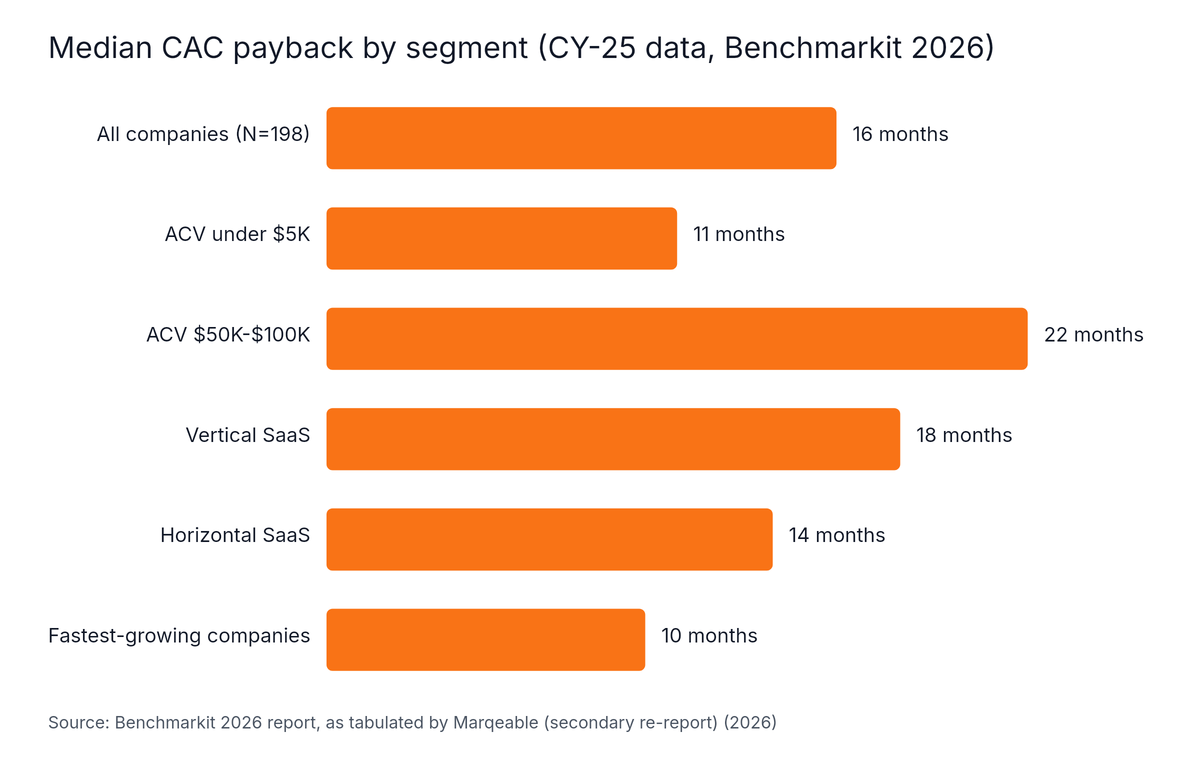
Horizontal Bar chart: Median CAC payback by segment (CY-25 data, Benchmarkit 2026). Highest: ACV $50K-$100K at 22 months.
Payback moves with deal size too. Median CAC payback is 11 months for ACV under $5K versus 22 months for the $50K to $100K band, as tabulated by Marqeable (2026) from Benchmarkit CY-25 data. That is a secondary re-report, so confirm it against the primary report. Vertical SaaS sits at 18 months and horizontal SaaS at 14 in the same tabulation.
Derive the ceiling instead of copying a table
Dispersion matters more than the average. Top-quartile companies pay back in 6 months or fewer, while the bottom quartile takes 24 months or more (Aleph, 2026). Compute the ceiling from your own numbers:
Run the formula for each ACV band and compare the result with the published range for that band. A quote far above both deserves a hard question. Put your own ceiling in the contract by ACV band.
Which retainer structure and contract length should you accept?
A B2B SaaS marketing agency fee should reward pipeline, not activity: a flat retainer rewards delivery, a percentage of ad spend rewards higher spend, and a performance fee rewards measured outcomes. Set the initial term to at least one sales cycle, which published ranges put at 49 to 180 days by deal size, with a written review point.
A wall calendar with a long span of weeks marked in one colour beside a pen and a closed folder
No independent benchmark on retainer structures turned up in the research behind this guide, so treat the points below as negotiating logic, not market data.
Compare the fee models
Flat retainer. Predictable cost, but it pays the same whether pipeline arrives or not. Pair it with the clauses in the first table.
Percentage of ad spend. The agency earns more when you spend more, so require a cost-per-SQL ceiling and a spend cap.
Performance-based fee. Ties pay to accepted SQLs or pipeline per account. Define "accepted" in writing, signed by sales.
A hybrid often works: a modest flat fee plus a bonus tied to pipeline per account measured against holdout accounts.
Match the term to the sales cycle
A term shorter than the sales cycle cannot show pipeline, and a long lock-in removes your leverage. With median CAC payback at 16 months (Aleph, 2026), full economics take longer than any sensible first term. Start with one full cycle, then review against agreed targets and renew only if they are met.
Who is this checklist not for?
A B2B SaaS marketing agency contract checklist does not fit every company. Account-based marketing (ABM) typically pays when ACV exceeds $15K and at least one seller works named accounts, so the account-level terms fit best above that line. Below it, or when the goal is brand reach rather than pipeline, a different agency brief applies.
Four other limits apply:
Sales cycles longer than the contract. A holdout test needs a window of at least one sales cycle, which can reach 180 days for $250K to $1M deals, where published ranges put 10 to 15 stakeholders in the buying group.
Contracts shorter than payback. The median B2B SaaS company needs 16 months to recover acquisition cost (Aleph, 2026), so a short term cannot show full economics.
No CRM discipline. Pipeline per account cannot be audited if opportunities are not tied to accounts.
The published ranges in this guide carry no stated sample, and the payback tables are partly secondary re-reports. They are guardrails for negotiation, not proof that any figure will apply to a given company.
Frequently Asked Questions
What are red flags when hiring a B2B SaaS marketing agency?
The main red flags are refusing to write down pipeline targets, reporting reach or marketing-qualified leads instead of pipeline per account, resisting a holdout test, withholding raw ad and CRM data access, and offering long lock-ins with no exit tied to missed targets. Any one of these means results cannot be verified independently.
How do you hold a B2B SaaS marketing agency accountable for pipeline instead of MQLs?
Write pipeline per target account, account-to-opportunity rate and cost per SQL into the contract, with SQL acceptance criteria signed by sales. Add a holdout test that runs at least one full sales cycle, keep the CRM analysis in-house, and schedule a termination review after that cycle completes.
Should I pay a B2B SaaS agency a flat retainer, a percentage of ad spend, or performance-based fees?
Prefer the structure that ties at least part of the fee to pipeline per account, because a percentage of ad spend rewards higher spend and a flat retainer rewards delivery alone. No independent benchmark on these structures was found, so negotiate it as a contract term and review it after one sales cycle.
How long should I commit to a B2B SaaS marketing agency contract?
Commit initially for at least one full sales cycle, which published ranges put at 49 to 84 days for $25K to $100K deals and 126 to 180 days for $250K to $1M deals, with a written review point. A shorter term cannot show pipeline, and a long lock-in removes your leverage.
What is a good CAC payback period for B2B SaaS?
The median B2B SaaS company recovers its customer acquisition cost in 16 months, based on full-year 2025 actuals from the Aleph and Benchmarkit report. Top-quartile companies pay back in 6 months or fewer and the bottom quartile takes 24 months or more, so a single average is a poor contract target.
Conclusion: what to require before signing
A post-round pipeline target is a reason to tighten a B2B SaaS marketing agency contract, not loosen it. The terms that matter are few:
Commit to pipeline per target account, by tier, from a frozen list.
Require holdout accounts and a test window of at least one sales cycle.
Set cost-per-SQL ceilings by ACV, derived from your own payback target.
Pin metric definitions, the CAC definition and the benchmark year.
Tie fees and exit rights to missed targets after one full cycle, and use intent signal workflows to give sales a clear action per signal.
Next step: bring your target account list to a free consultation and test these terms against it by choosing Meet with an expert.
Written by
Ishan Manchanda
Ishan Manchanda is co-founder of GrowthSpree, a B2B SaaS marketing consultancy founded in 2017 that has managed $60M+ in ad spend across 300+ B2B SaaS companies. He focuses on demand generation, go-to-market strategy and pipeline growth, and has been featured in Silicon Valley Times, SaaS Mag and the Unbounce podcast.
 Ishan ManchandaNov 11, 2026