
Blog
Attribution Models for B2B SaaS: What Each Measures and Where It Fails
Attribution models compared by deal size, sales cycle and buying group. What first-touch, last-touch, U-shaped and W-shaped each measure and where they fail.
How B2B SaaS marketing strategy changes from Series A demand generation to Series B ABM, mapped to deal size, buying group size and cost per SQL.
 Ishan ManchandaNov 8, 2026

Attribution models compared by deal size, sales cycle and buying group. What first-touch, last-touch, U-shaped and W-shaped each measure and where they fail.
Published ranges for splitting B2B SaaS marketing budget across ABM, demand generation, and brand, with sources, sample status, and a tier-first method.
Fix account based marketing LinkedIn targeting: measure waste, exclude non-buyers, cover the buying group and scale from 50 to 200 target accounts.
Request a quote and our experts will contact you within 24 hours with tailored solutions and pricing.
Last updated: Nov 8, 2026
By the ABM for B2B SaaS Editorial Team. Sources and method are described on the Methodology page. Last updated October 28, 2026.
A B2B SaaS marketing strategy is the set of choices about target accounts, channels, content and metrics that fits a company's stage and deal size, and it changes as annual contract value (ACV) and buying group size grow. Median CAC payback for B2B SaaS is 16 months (Aleph x Benchmarkit, 2026), so a wrong stage fit gets expensive fast. Content, paid search and broad LinkedIn that worked at seed tend to stall once the first $50K contracts reach the pipeline. This guide maps strategy to stage and deal size, from demand generation at Series A to a multi-channel account-based marketing (ABM) program at Series B and beyond.
Key Takeaways
- A B2B SaaS marketing strategy at Series A runs on demand generation; at Series B it adds account-based marketing for named target accounts.
- Published ranges (BC26, no sample stated) put 5 to 8 stakeholders in $25K to $100K deals and 10 to 15 in $250K to $1M deals.
- B2B SaaS performance marketing stays in the plan at Series B, but it targets named accounts and is judged on sales-qualified leads and opportunities.
- ABM tiers of 10 to 50 (1:1), 50 to 200 (1:few) and 200 to 500 (1:many) accounts keep a small team's list workable.
- Funding stage is a proxy: deal size and buying group size decide the motion.
A B2B SaaS marketing strategy at Series A centers on demand generation: content, paid search and LinkedIn that win one champion. At Series B, it adds account-based marketing (ABM): named target accounts, content for the whole buying group, and pipeline per account as the metric. Target cost per sales-qualified lead (SQL) climbs from $1,000 to $3,000 at $15K to $50K ACV to $8,000 to $20,000 at $150K+ (published ranges, B26).

The table maps editorial stage labels to deal-size bands. The cost per SQL figures are published ranges (B26, no sample stated). The stage mapping itself is editorial framing, not measured data.
| Stage and situation | Deal size (ACV) | Target cost per SQL | Primary motion |
|---|---|---|---|
| Series A, first repeatable engine | $15K to $50K | $1,000 to $3,000 | Demand generation: content, search, LinkedIn |
| Series A to B, moving upmarket | $50K to $150K | $3,000 to $8,000 | Demand generation plus a small 1:few ABM list |
| Series B and first enterprise deals | $150K+ | $8,000 to $20,000 | Multi-channel ABM with sales coordination |
At Series A, one buyer often drives the decision. Broad targeting is cheap enough to test, and inbound leads supply learning. The goal is a repeatable engine built on a clear ideal customer profile (ICP). A firmographic definition of target accounts keeps spend from drifting to companies too small to buy.
By Series B, a funding round usually brings a board-set enterprise pipeline target. Inbound alone rarely reaches it. The median SaaS magic number is 1.37 (Aleph x Benchmarkit, 2026), so efficiency is read at board level. The strategy now needs a named list, content for each role in the buying group and tight sales coordination. The ABM versus inbound comparison shows how that handoff works.
When annual contract value (ACV) passes $50K, B2B SaaS marketing shifts from winning one champion to reaching a buying group. Published ranges (BC26, no sample stated) put 5 to 8 stakeholders in $25K to $100K deals, 7 to 10 in $100K to $250K deals and 10 to 15 in $250K to $1M deals, with sales cycles stretching from 49 to 180 days.

A buying group is the set of people inside and outside a company who shape a purchase decision, from the champion to finance, security and procurement. The published ranges (BC26) break down as follows:
| Deal size | Stakeholders involved | Sales cycle |
|---|---|---|
| $25K to $100K | 5 to 8 | 49 to 84 days |
| $100K to $250K | 7 to 10 | 84 to 126 days |
| $250K to $1M | 10 to 15 | 126 to 180 days |
Procurement is involved in 62% to 78% of US enterprise deals and 85% to 94% of Indian enterprise deals (BC26, published ranges, no sample stated). Treat these as planning guides, not averages.
An Ivris Tech analysis of published buying-group statistics found sizes ranging from 4.8 to 17 people, because studies count different populations and definitions (Ivris Tech, 2026). That analysis is a secondary synthesis, so check each primary study before relying on it. Build a role map for each account tier instead of quoting one number.
Larger groups want evidence. Forrester's Predictions 2026 report says "B2B buying will be defined by tangible evidence, accountability, and continued buyer empowerment," (Forrester via Digital Commerce 360, 2025). For first enterprise deals, that means references, trial results, ROI evidence and security and procurement answers ready before the late-stage surprise.
Digital marketing for B2B SaaS is the full set of online activities that build awareness, shape evaluation and support sales across the buying group: content and SEO, paid search, LinkedIn, email, review sites, events and retargeting. Forrester's State of Business Buying 2026, covering about 18,000 buyers, reports 94% AI use in buying (Forrester, 2026).

Paid search and LinkedIn are only two parts of that set. Because buyers research with AI, third-party validation on review sites and analyst pages carries more weight at Series B. A Gartner survey of 645 B2B buyers found 69% prefer to validate AI-generated insights with sales reps (Gartner, 2026). Human follow-up is therefore a channel in its own right.
| Channel | Series A role | Series B role |
|---|---|---|
| Content and SEO | Capture problem-aware demand | Role-based content for each stakeholder |
| Paid search | Capture high-intent queries | Support named accounts and branded terms |
| Broad reach to the ICP | Matched account lists with function filters | |
| Email and SDR outreach | Light follow-up on inbound | Coordinated sequences by account tier |
| Review sites and analyst presence | Basic profiles | Third-party validation for committee review |
Small teams can automate parts of this. The ABM automation guide lists which tasks to hand off without a dedicated ops hire.
B2B SaaS performance marketing is paid media managed against measurable outcomes such as sales-qualified leads (SQLs), and it runs beside an ABM program by pointing the same budget at named target accounts with function and seniority filters. ABM tiers decide which accounts also get bespoke content and sales coordination, while the median blended CAC ratio is $1.30 of sales and marketing spend per $1 of new ARR (Aleph x Benchmarkit, 2026).

The two are not rivals. Performance marketing optimizes paid channels toward SQLs or opportunities instead of form fills. ABM decides which accounts get that spend. The blended CAC ratio fell 7% year over year, so efficiency pressure is easing but still real. The software comparison guide covers whether a dedicated platform is needed at all.
First-party data: In 56 audited LinkedIn accounts with $9.4M in ad spend, decision-makers received 33% of budget against a target of 60% or more (L26, GrowthSpree, June 2026). Non-buying job functions caused 30% of wasted spend, individual contributors and entry-level staff consumed 36% of budget, and 20% of spend reached firms under 50 employees.
LinkedIn clicks for B2B SaaS run $8 to $25 by vertical (L26), so each wasted click costs real money. Set function and seniority exclusions on day one.
An ABM strategy is the plan for which target accounts to pick, how to tier them, which channels reach the buying group and how pipeline per account is reported. An account-based marketing strategy means the same thing. Effective plans start with a short list. A practitioner argument (ABM26, no sample stated) says common lists run 500 to 2,000+ named accounts at companies that should run 100 to 300. The recommended tiers are:
Pair each tier with intent signals that each have a named action and owner.
A VP Marketing should measure Series A on efficiency and Series B on pipeline per account. Median CAC payback for B2B SaaS and AI-native software is 16 months, with top-quartile companies at 6 months or fewer and the bottom quartile at 24 months or more (Aleph x Benchmarkit, 2026).

CAC payback is the number of months needed to recover the cost of acquiring a customer. The 2026 report covers 342 B2B SaaS and AI-native software companies, 198 of which reported payback, using full-year 2025 actuals. Median payback improved from 18 months in 2024. These are company-wide figures, not stage-specific ones, because no primary survey in the research breaks payback out by funding round.
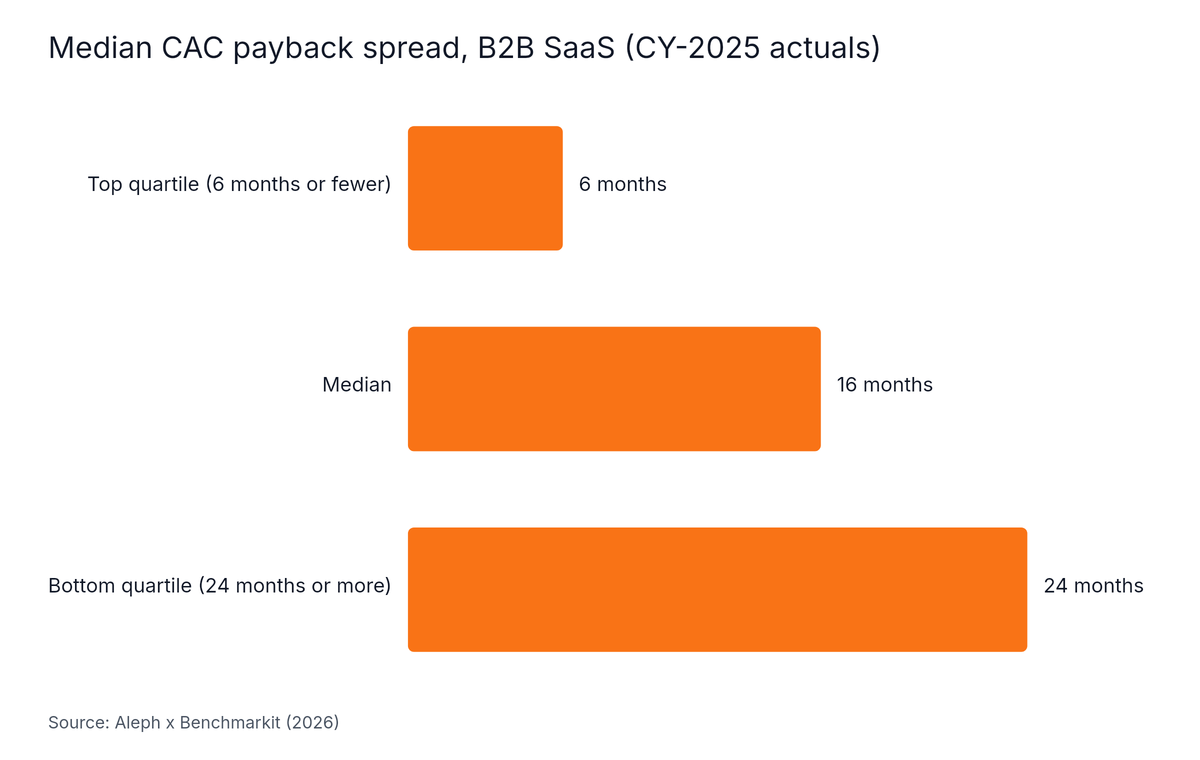
Source: Aleph x Benchmarkit, 2026
The best B2B SaaS marketing campaigns at Series B share a pattern: a tiered list sized to the team, content for each role in the buying group, and a seller who owns the follow-up. They report account-to-opportunity rate, the share of target accounts that become sales opportunities, plus pipeline per target account. The comparison group is holdout accounts, a matched set of target accounts that receive no ABM treatment. Engagement scores and accounts reached describe activity, not outcomes. The ABM measurement guide and the analysis of why engaged accounts produce zero SQLs show how to build that report.
Judge ABM only after one full sales cycle, which runs 49 to 84 days for $25K to $100K deals (BC26, published ranges, no sample stated).
SaaS Capital's 2026 survey of more than 1,000 private B2B SaaS companies, as restated by Livmo (2026), shows a median 8% of ARR on marketing and 15% on selling costs, up from 13% the year before. Livmo is a secondary source, so check SaaS Capital's original survey before quoting it in a board deck.
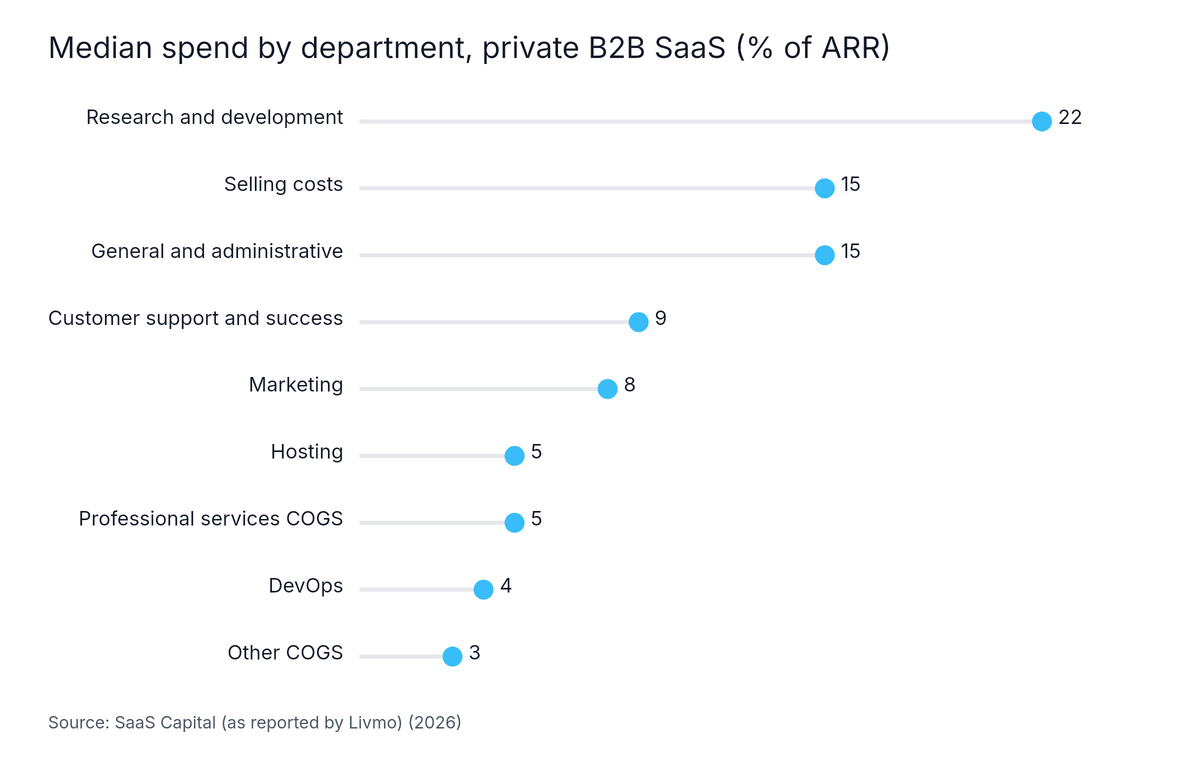
Source: SaaS Capital (as reported by Livmo), 2026
Selling costs now outweigh marketing spend, which supports tight sales coordination at Series B. Attribution gets harder as touches multiply, and the ABM attribution guide explains how to credit channels fairly.
A stage-based B2B SaaS marketing strategy is a poor fit when deal size is low, no seller works named accounts, or the funding label says more than the sales data. ABM typically pays when annual contract value exceeds $15K and at least one seller works named accounts; below that, coordination costs usually exceed the return.
Funding stage is a proxy. Deal size and buying group size decide the motion. Watch for these cases:
The stage-to-ACV mapping above is editorial framing. The cost per SQL, buying group and list-size figures are published ranges, and the buying group and list-size ranges state no sample. Check them against your own pipeline.
Effective B2B SaaS ABM campaigns work a short, tiered list of target accounts with content for each role in the buying group and coordinated sales outreach. Teams measure account-to-opportunity rate and pipeline per account, compared with holdout accounts that received no ABM, rather than accounts reached or engagement scores.
Digital marketing for B2B SaaS also includes content and SEO, email, review-site and analyst presence, website conversion, retargeting, events and sales outreach support. Buyers use AI heavily in research (94% in Forrester's 2026 study), so third-party proof sits alongside paid channels.
Performance marketing for B2B SaaS is paid media managed against measurable outcomes such as sales-qualified leads or opportunities. Beside an ABM program, it runs against the named-account list with function and seniority filters, while ABM tiers decide which accounts get extra content and sales coordination.
An account-based marketing strategy is a plan to focus sales and marketing effort on a defined list of named companies instead of broad audiences. It sets the account list, tiers, channels and content per buying group role, and measures success on pipeline and opportunities created.
An ABM strategy is the account-based marketing plan a team follows: which target accounts to pick, how to tier them as 1:1, 1:few or 1:many, which channels reach the buying group, how sales coordinates, and how pipeline per account is reported against holdout accounts.
Use deal size, not the funding label, to pick the motion.
For the next layer of detail, read the ABM best practices guide.
A free consultation. Bring your target account list and brainstorm the next step with an ABM expert. Meet with an expert.
Written by
Ishan Manchanda
Ishan Manchanda is co-founder of GrowthSpree, a B2B SaaS marketing consultancy founded in 2017 that has managed $60M+ in ad spend across 300+ B2B SaaS companies. He focuses on demand generation, go-to-market strategy and pipeline growth, and has been featured in Silicon Valley Times, SaaS Mag and the Unbounce podcast.
© 2026 abmforb2bsaas.com All rights reserved.