Blog
Attribution Models for B2B SaaS: What Each Measures and Where It Fails
Attribution models compared by deal size, sales cycle and buying group. What first-touch, last-touch, U-shaped and W-shaped each measure and where they fail.
Cut an oversized target account list to team capacity: fit and intent scoring, tier sizes, TAM limits, template fields and post-quarter refinement.
 Ishan ManchandaNov 6, 2026
Attribution models compared by deal size, sales cycle and buying group. What first-touch, last-touch, U-shaped and W-shaped each measure and where they fail.
Published ranges for splitting B2B SaaS marketing budget across ABM, demand generation, and brand, with sources, sample status, and a tier-first method.

Published B2B SaaS sales conversion rates by ACV band: win rates from 12% to 35%, stage-by-stage funnel benchmarks, and how to project pipeline.
Request a quote and our experts will contact you within 24 hours with tailored solutions and pricing.
Last updated: Nov 6, 2026
By the ABM for B2B SaaS Editorial Team. Last updated October 28, 2026.
A target account list is the defined set of named companies that sales and marketing agree to pursue together, sized to the team's capacity and ranked by fit and intent rather than by every company that could buy. Most teams start with the opposite. GrowthSpree's June 2026 practitioner article says common lists run 500 to 2,000+ named accounts at companies that should run 100 to 300 (a view with no stated sample). Three people cannot work 1,500 accounts. This guide shows how to cut an oversized list, size the tiers, let total addressable market set the ceiling, build a working template, and revise the list after one account-based marketing (ABM) quarter. For the wider program, see these ABM best practices.
Key Takeaways
- A list for a three-person team should be capped by capacity, not by how many companies fit the market.
- Fit works as the gate and intent works as the sort: cut on fit first, then rank survivors by intent signals.
- Published ranges give 10 to 50 accounts for 1:1, 50 to 200 for 1:few and 200 to 500 for 1:many, but they are practitioner guidance, not survey data.
- A useful template separates fixed fit fields from volatile signal fields and adds owner, tier, buying-group coverage and exit criteria.
- After one ABM quarter, the list should promote accounts with meetings, demote silent ones and be re-scored against closed-won and closed-lost history.
A target account list of 1,500 accounts is cut by working backward from capacity: set a hard cap near 150 to 300 accounts for three people, remove accounts that fail a fit gate, rank the survivors by intent, and move the rest to a nurture pool instead of deleting them. The cap is a planning method, not a published benchmark.

| Cut step | Rule | Where cut accounts go |
|---|---|---|
| Hard exclusions | Region, size floor, excluded segments | Removed from ABM, kept in CRM |
| Fit floor | Minimum ICP fit score | Nurture pool |
| Intent sort | Rank by signal strength | Below the cap: nurture pool |
| Sales veto | Written reason required | Nurture pool or promoted |
Our results: GrowthSpree's June 2026 audit of 56 LinkedIn accounts, covering $9.4M in ad spend, found decision-makers received 33% of LinkedIn budget against a target of 60% or more. Non-buying job functions caused 30% of wasted spend.
Smaller lists allow deeper coverage of each buying group. Gartner reports that 74% of B2B buyer teams show unhealthy internal conflict (BizTechReports, Gartner release, 2025), which argues for reaching several people at fewer accounts. The same method works for a list of 800 names: only the starting count changes, not the cap.
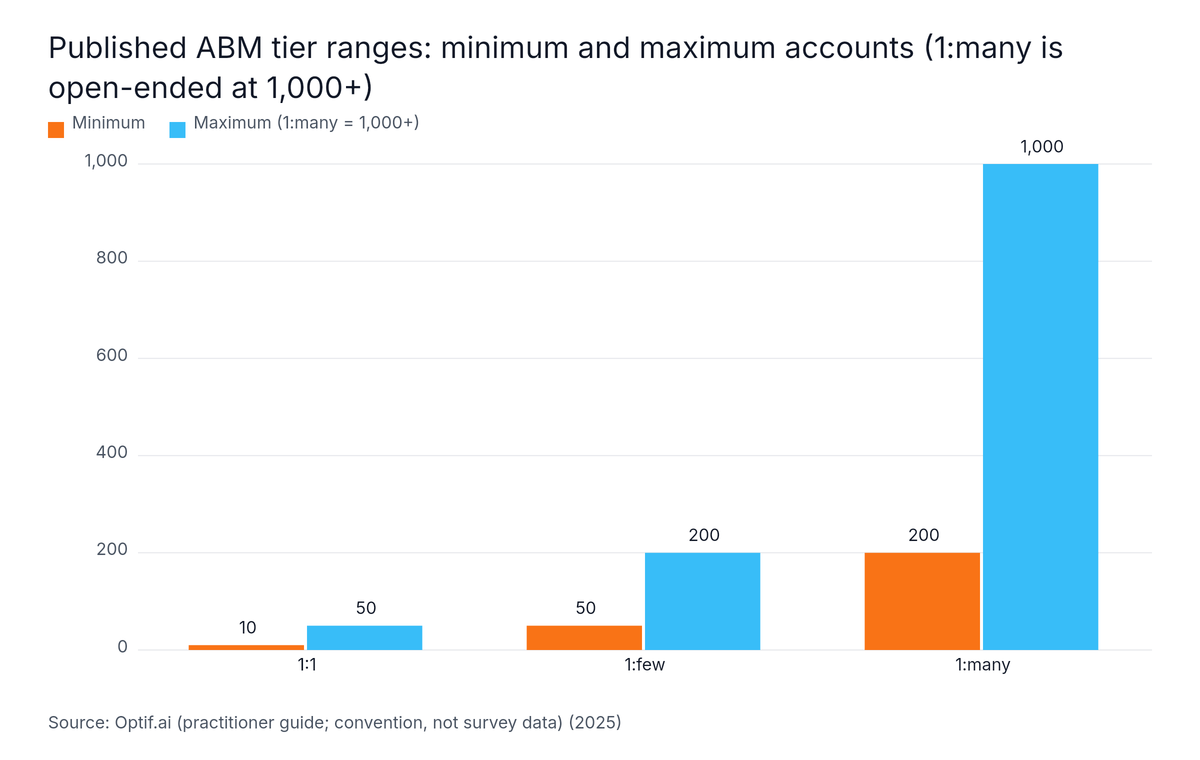
Published ranges for a B2B SaaS account list place 10 to 50 accounts in 1:1, 50 to 200 in 1:few (grouped into 5 to 15 clusters), and 200 to 500 in 1:many, according to GrowthSpree's June 2026 practitioner article, which states no sample. These are practitioner guidance, not survey findings. Team size and total addressable market (TAM) then decide where in each range a list should land.

1:few is an ABM tier that groups accounts with shared traits into clusters of roughly 5 to 15 accounts and builds one set of content per cluster. The table pairs each published range with an illustrative allocation for three people. The allocation numbers are assumptions chosen to sit inside the ranges, not a benchmark.
| Tier | Published range | Treatment | Illustrative allocation (3 people) |
|---|---|---|---|
| 1:1 | 10 to 50 accounts | Bespoke content and outreach per account | 15 accounts |
| 1:few | 50 to 200 accounts in 5 to 15 clusters | One content set per cluster | 90 accounts (9 clusters of 10) |
| 1:many | 200 to 500 accounts | Programmatic, shared tactics | 150 accounts |
| Total | 255 accounts |
The result, 255 accounts, lands inside the 150 to 300 range used for the cap and well below 1,500. The chart shows the lower bound of each published tier: 10 accounts for 1:1, 50 for 1:few and 200 for 1:many, drawn from a 2025 Optif.ai practitioner guide that presents them as convention, not survey data.
Source: Optif.ai (practitioner guide; convention, not survey data), 2025
Total addressable market (TAM) is the full set of companies that could plausibly buy the product. TAM sets the ceiling on how many accounts exist to choose from. Capacity sets the working list. If the TAM is smaller than the cap, no cut is needed. If it is far larger, fit scoring decides who enters the list, not the size of the market.
Two uncited rules of thumb circulate: ABM suits a TAM under about 5,000 accounts, and 1:many suits a TAM of 1,000 to 50,000. Treat both as unverified. Gartner's Delainey Kirkwood gives a reason to keep coverage deep: "Buying groups are more diverse than ever, ranging from five to 16 people across as many as four functions" (IT-Online, Gartner, 2025).
A target account selection plan that combines fit and intent scores uses fit as a gate and intent as a sort: an ideal customer profile (ICP) fit score decides which accounts are eligible, and intent signals decide which get worked first and when. Intent can amplify a good fit but cannot compensate for a poor one.

An ideal customer profile (ICP) is the description of company traits that predict a good customer, such as industry, headcount, region and technology in use. A fit score turns those traits into a number. Set a floor and treat anything below it as ineligible, however active the account looks.
Fit also protects against waste. Gartner's 2025 survey of 632 buyers found that 73% of B2B buyers actively avoid suppliers who send irrelevant outreach (Gartner, 2025). A broad list makes irrelevant outreach likely.
An intent signal is a behavior, such as a pricing-page visit, a topic search or an email reply, that suggests an account may be researching a purchase. Timing matters because 67% of B2B buyers prefer a rep-free experience (Digital Commerce 360, reporting Gartner, 2026), so sellers often need a signal to know when to step in.
To use intent data, start with first-party signals, which are generally treated as more reliable than third-party ones. Then give each signal an action and an owner, as below. The workflow for acting on intent signals covers timing in more detail.
| Intent signal | Example | Named action | Owner |
|---|---|---|---|
| Pricing-page visit | Two visits in one week | Seller sends a relevant note | Account owner |
| Content engagement | Reads a tier-specific guide | Move account up the call sheet | SDR |
| Reply or meeting request | Email reply | Book meeting, update stage | Seller |
| No activity | Silent after agreed touches | Demote to nurture pool | ABM manager |
A working target account list template needs fixed fit fields (name, domain, industry, headcount, region), volatile signal fields (intent score, last-touch date), and operating fields (tier, owner, play assigned, buying-group coverage, stage, exit criteria). Splitting fixed from volatile fields tells the team what to refresh monthly and what to verify once.

| Field group | Fields | Refresh cadence |
|---|---|---|
| Fixed fit | Account name, domain, industry, headcount, region, revenue band | Verify once, recheck yearly |
| Fit result | ICP fit score, source of selection | Re-score each quarter |
| Volatile signals | Intent score, last-touch date, engagement | Weekly or monthly |
| Operating | Tier, owner, play assigned, stage, exit criteria | Update at each stage change |
| Buying group | Contacts by role, procurement involved, coverage gaps | Update after each touch |
Forrester's 2026 State Of Business Buying report says "The typical buying decision now includes 13 internal stakeholders and nine external influencers, with that number rising for more complex or strategic purchases" (Forrester, 2026). The internal and external counts are reported separately and should not be added together. The same Forrester research (Forrester, 2026) finds procurement professionals are decision-makers in 53% of business buying cycles, which is why a procurement field belongs in the template.
GrowthSpree's 2026 buying committee benchmarks (published ranges, no stated sample) give a rough coverage target by deal size: 5 to 8 stakeholders at $25K to $100K deals, 7 to 10 at $100K to $250K, and 10 to 15 at $250K to $1M. Record how many contacts exist per account against that range.
After one ABM quarter, refine the account list by promoting accounts that earned meetings or opportunities, demoting accounts with no engagement after the agreed number of touches, and re-scoring fit against closed-won and closed-lost history. Pipeline should be judged only after a full sales cycle has passed.

Proof matters because it is the weak point for most programs: in Demand Gen Report's 2025 ABM Benchmark Survey, practitioners ranked proving ROI (47%) as their top challenge (Demand Gen Report, 2025).
GrowthSpree's 2026 benchmarks (published ranges, no stated sample) put sales cycles at 49 to 84 days for $25K to $100K deals, 84 to 126 days for $100K to $250K deals, and 126 to 180 days for $250K to $1M deals. A quarter is often shorter than the cycle, so early judgments should use meetings and account-to-opportunity rate, not closed revenue.
Compare results with holdout accounts, a matched set that receives no ABM treatment. The guide to ABM measurement explains pipeline per account, and the article on engaged accounts that produce no SQLs shows why engagement alone misleads.
Cutting an account list to team capacity is not for teams without a seller working named accounts, teams selling below about $15K in annual contract value (ACV), or teams whose total addressable market is already small enough that no cut is needed. In those cases, broader demand generation usually fits better. The $15K threshold is ABM for B2B SaaS editorial guidance, not survey data.
Honest limits apply to the method itself:
Three-person teams can right-size and tier a list with a customer relationship management (CRM) system and a spreadsheet, adding enrichment for fit fields and intent tooling only when a named owner will act on the signals. A dedicated ABM platform is optional, not required. Match the tool to the job: CRM for tiers and owners, enrichment for fit data, intent tooling for timing.
AI defines a target account list as a ranked set of companies that a model scores against ideal customer profile traits and buying signals, then sorts by likelihood to convert. AI scoring speeds up the sort, but it inherits the quality of the fit criteria it receives, and intent signals amplify a good fit without compensating for a poor one.
To build an account list with intent data, start from accounts that already pass the fit gate, attach a short set of intent signals, give each signal a named action and owner, and re-sort on a fixed cadence. Intent should rank accounts inside the ideal customer profile, not add accounts that fail fit.
A list of 800 names is cut and tiered with the same sequence as any oversized list: set a capacity cap from team size, remove accounts that fail the fit gate, rank the survivors by intent, then assign each survivor to a tier. Accounts below the cap move to a nurture pool rather than being deleted.
The right number of target accounts is the sum, across tiers, of the people assigned to each tier multiplied by the accounts one person can serve at that tier's treatment depth. No benchmark for cost per account or list size is published, so treat the result as a planning estimate and adjust after one quarter.
A list works when its size matches the people who will work it. The steps to take away:
For the broader program around the list, read the guide to demand generation and where ABM fits.
Meet with an expert. A free consultation. Bring your target account list and brainstorm the next step with an ABM expert.
Written by
Ishan Manchanda
Ishan Manchanda is co-founder of GrowthSpree, a B2B SaaS marketing consultancy founded in 2017 that has managed $60M+ in ad spend across 300+ B2B SaaS companies. He focuses on demand generation, go-to-market strategy and pipeline growth, and has been featured in Silicon Valley Times, SaaS Mag and the Unbounce podcast.
© 2026 abmforb2bsaas.com All rights reserved.