Enterprise Account Based Marketing: Buying Group Coverage and Pricing
How enterprise account based marketing covers 10 to 15 stakeholders per deal, what ABM software costs by pricing model, and how to cap renewal increases.
Request a quote and our experts will contact you within 24 hours with tailored solutions and pricing.
Enterprise Account Based Marketing: Buying Group Coverage and Pricing
By the ABM for B2B SaaS Editorial Team. Last updated October 28, 2026. Sources and method are described on the site's Methodology page.
Enterprise account-based marketing is a go-to-market approach that coordinates marketing and sales effort across every member of a named account's buying group, not only the champion, on deals large enough to involve procurement, security, and finance.
The usual story goes like this: the champion loved the product, then procurement, security, and finance appeared. Published ranges put $250K to $1M deals at 10 to 15 stakeholders (BC26, 2026, no sample stated). Software that reaches only one of them leaves most of the committee untouched. This guide covers how enterprise account-based marketing (ABM) works at that scale, which roles software tends to miss, what the pricing models cost, and how to avoid a surprise at renewal. It builds on firmographic data for defining target accounts.
Key Takeaways
Enterprise account-based marketing treats the buying group, not the champion, as the unit to cover. Deals of $250K to $1M involve 10 to 15 stakeholders (published ranges, BC26, 2026).
Procurement is a decision-maker in 53% of business buying cycles and engages from the start (Forrester, 2026).
Vendr's purchase data puts median annual contracts at $63,199 for 6sense (Cleanlist, 2026) and $68,591 for Demandbase (Userled, 2026).
6sense contracts can carry 5-10% annual escalation (RevSpire, 2026), so renewal caps belong in the first agreement.
A proof of concept that counts procurement, security, and finance contacts per account is the most direct coverage test a buyer can run.
How does enterprise account-based marketing handle buying groups of ten to fifteen stakeholders?
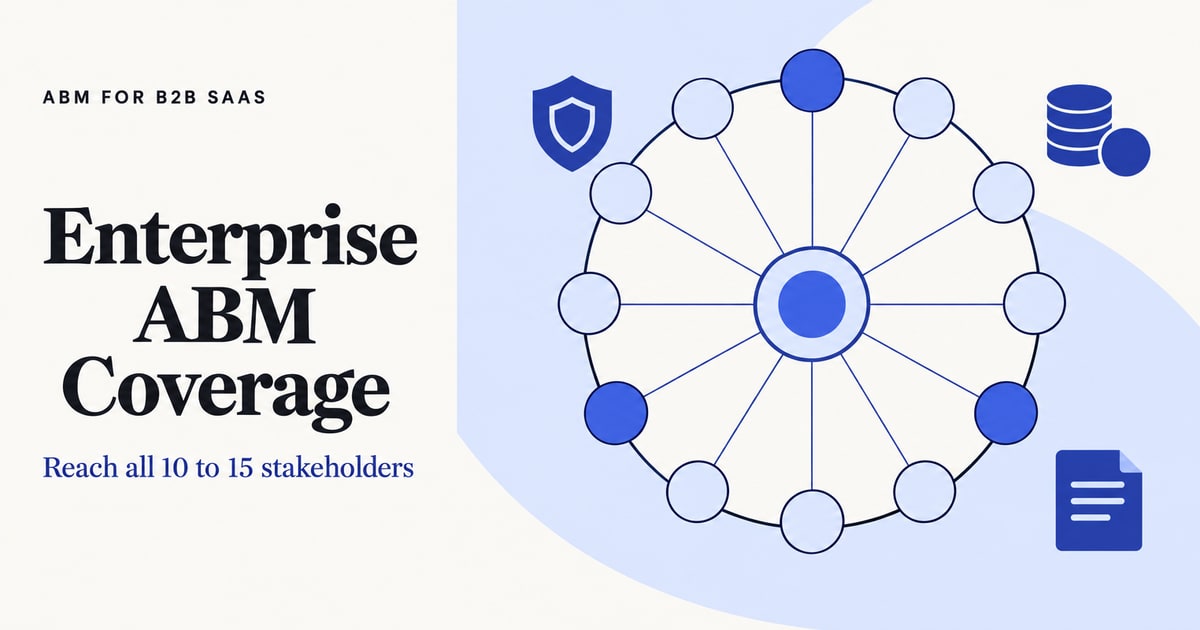
Enterprise account-based marketing handles a buying group of ten to fifteen stakeholders by mapping every role in each target account, assigning content and an owner to each role, and coordinating sales and marketing touches across the group. Published ranges put $250K to $1M deals at 10 to 15 stakeholders and 126 to 180 day sales cycles (BC26, 2026, no sample stated).
Flat illustration of a round table with twelve seats around a central target ring
A buying group is the set of internal stakeholders and external influencers who take part in a single purchase decision. Its size grows with deal size, as these published ranges show.
Deal size (ACV)
Stakeholders involved
Sales cycle
$25K to $100K
5 to 8
49 to 84 days
$100K to $250K
7 to 10
84 to 126 days
$250K to $1M
10 to 15
126 to 180 days
Source: published ranges (BC26, 2026), no sample stated. ACV means annual contract value.
Why the champion is not enough
Independent research points the same way. Forrester's survey of nearly 18,000 global business buyers reports that "On average, 13 internal stakeholders and nine external participants influence buying decisions" (Forrester, 2026). Forrester counts the two groups separately, and the count rises for complex or strategic purchases.
Buyers also want the committee large. Of buyers in groups of six or more, 94% say the larger group helps them (Forrester, 2026). A big committee protects a decision they must defend, so vendors should expect it to stay big.
Consensus is the harder problem. A Gartner survey of 632 buyers found 74% of buyer teams show unhealthy conflict, and group-relevant messaging makes a high-quality deal three times more likely (Gartner, 2025). Role-specific content and sales coordination matter more than a single-persona campaign.
Which buying group roles does ABM software miss, and how can a buyer test coverage?
The buying group roles most at risk of being missed by ABM software are procurement, security, and finance, because they rarely appear as the champion. A buyer can test coverage with a proof of concept that counts these contacts per target account. Forrester found procurement is a decision-maker in 53% of business buying cycles (Forrester, 2026).
Flat illustration of five role badges with three left outside a dotted circle
Forrester's own wording is blunt: "Procurement professionals are decision-makers in 53% of business buying cycles, engaging from the start of the process." (Forrester, 2026). Procurement is not a late-stage contact. No independent study measures how accurately ABM platforms identify procurement, security, and finance contacts.
Regional figures run higher. Published ranges show procurement involved in 62% to 78% of US enterprise deals and 85% to 94% of Indian enterprise deals (BC26, 2026, no sample stated).
What a coverage check should include
Role
What the role decides
What to test in a platform
Champion
Whether the evaluation starts
Contact found, with accurate title
Economic buyer or finance
Budget approval
Named contact, not just a company logo
Technical evaluator or security
Risk and architecture review
Contact found by function and seniority
Procurement
Terms and vendor approval
Contact found early, not at contract stage
Executive sponsor
Final sign-off
Senior contact mapped to the account
Ad targeting shows the same gap between the right company and the right people.
Published audit data: A June 2026 audit of 56 LinkedIn accounts covering $9.4M in ad spend found decision-makers received 33% of budget against a target of 60% or more, and non-buying job functions caused 30% of wasted spend (GrowthSpree, L26, June 2026; third-party study, not original research by this site).
In the same audit, individual contributors and entry-level staff consumed 36% of budget, and 20% of spend reached firms under 50 employees (GrowthSpree, L26, June 2026).
A five-step proof of concept
Reconcile the benchmarks first. Forrester's 13 internal plus nine external counts every participant in a typical decision, while the published range of 10 to 15 applies to $250K to $1M deals specifically. Test against the range that matches the deal size, and expect fewer contacts than the full count, since external influencers are hard to identify.
Pick accounts sales already knows. Choose a small set where sellers can list the real committee from past or live deals.
Run the platform on those accounts. Record every contact it returns, with title and function.
Count coverage by role. For each account, tally procurement, security, finance, technical, and executive contacts separately from the champion.
Have sales verify accuracy. Ask sellers to mark each contact as correct, outdated, or wrong.
Set up holdout accounts.Holdout accounts are target accounts that receive no ABM treatment and serve as the comparison set. Compare account-to-opportunity rate between treated and holdout accounts after at least one full sales cycle.
The last step matters most. Intent scores and engagement dashboards show activity, not outcome. A signal needs a named action and an owner, as in this intent signal workflow, and ABM attribution should credit the account.
How much does enterprise ABM software cost, and how do the pricing models compare?
Enterprise ABM software costs a median of $63,199 a year for 6sense and $68,591 for Demandbase in Vendr purchase data (Cleanlist, 2026; Userled, 2026). Vendors quote either a platform fee plus a flat per-user fee, or modules and data credits. Most publish no list price, so contract benchmarks are the best available guide.
Flat illustration of stacked price blocks with coin and credit tokens beside them
Vendr is a SaaS purchasing platform whose anonymized contract data serves as a pricing benchmark. As Vendr states in its 6sense guide, quoted by Cleanlist in 2026, "6sense does not publish transparent list pricing."
Vendor
Median annual contract
Observed range
Pricing structure
Purchases in sample
6sense
$63,199
$11,753 to $177,404
Modules and data credits
383
Demandbase
$68,591
$24,000 to $164,265
Platform fee plus flat per-user fee
185
Terminus
$24,840
Not reported
Not reported
Not reported
Sources: Vendr data via Cleanlist (2026) and Userled (2026); Terminus median from Vendr data as reported by Market Intelligence Tools (2026).
How the two main models differ
Platform fee plus per-user pricing is a structure where the buyer pays a base platform fee and a flat fee for each licensed user, with onboarding reported separately. Demandbase's Vendr benchmark follows this pattern (Userled, 2026).
Credit-based pricing is a structure where the buyer pays for modules plus a pool of data credits that meter contact unlocks and exports. 6sense replaced its Team, Growth, and Enterprise tier names with modular configurations and credits in May 2025 (Salesmotion, 2025). Credits make overage a renewal-cost risk, and they tie spend to contact volume, which matters when each account has 10 to 15 people to reach.
Snapshots also move. An earlier Vendr snapshot showed a 6sense median of $62,220 across 386 purchases in February 2026, against $63,199 across 383 in the later one (Cleanlist, 2026).
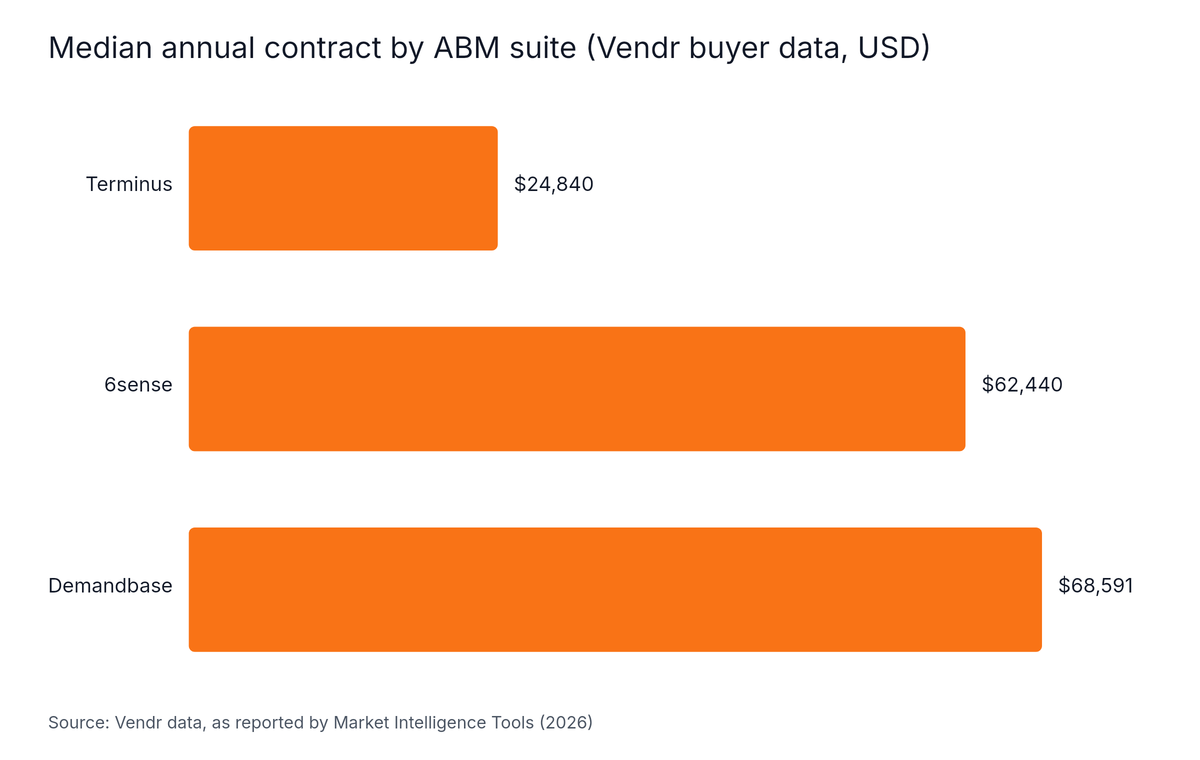
Horizontal Bar chart: Median annual contract by ABM suite (Vendr buyer data, USD). Highest: Demandbase at $68,591.
Vendr data as reported by Market Intelligence Tools (2026) puts the median annual contract at $24,840 for Terminus, $62,440 for 6sense, and $68,591 for Demandbase. The 6sense figure of $62,440 differs from the $63,199 in the table because the two come from different Vendr snapshots, reported by different sources on different dates.
Which ABM platforms are cheapest at enterprise scale, and what do they leave out?
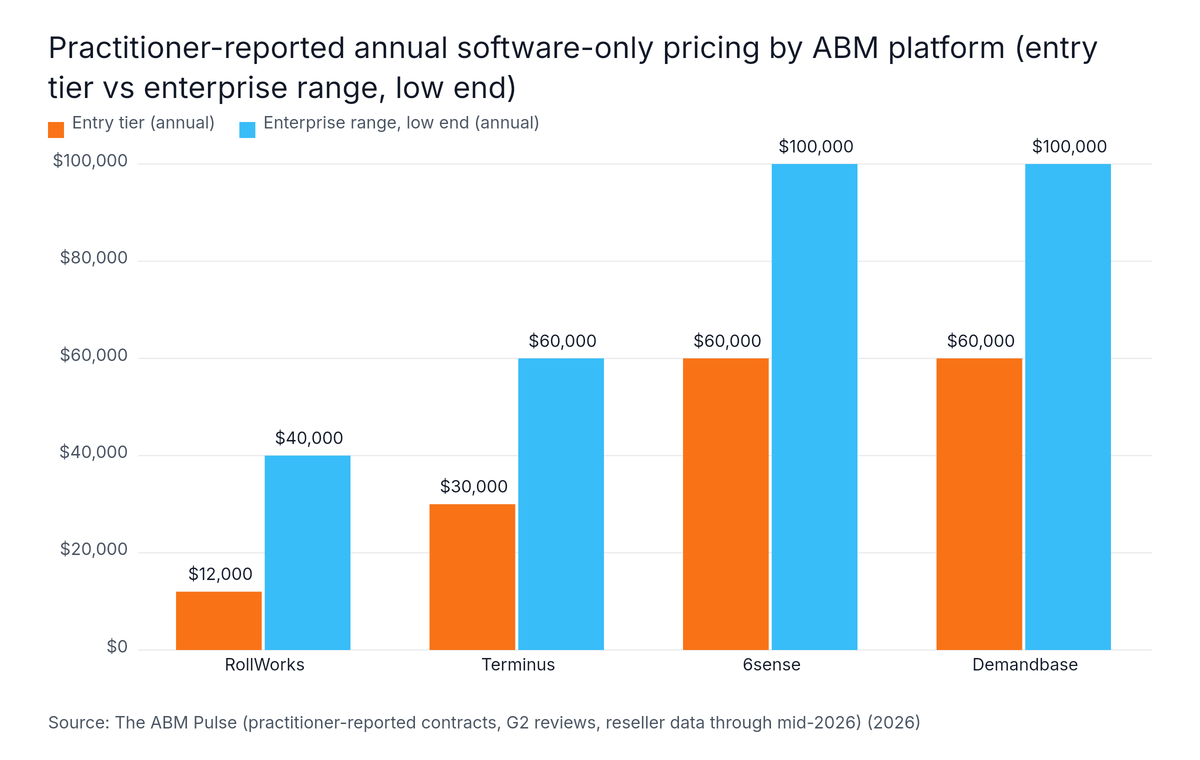
On practitioner-reported 2026 pricing, RollWorks ($12,000) and Terminus ($30,000) have the lowest entry-level annual software costs, against $60,000 for both 6sense and Demandbase (The ABM Pulse, 2026). Lower prices can leave out contact depth for procurement, security, and finance, credit allowances, and renewal terms, and software-only figures exclude ad spend, data, onboarding, and staff.
Flat illustration of two price bars of different height beside a small tag and a shield
Grouped Bar chart: Practitioner-reported annual software-only pricing by ABM platform (entry tier vs enterprise range, low end). Highest: 6sense at $60,000.
The ABM Pulse figures are the low end of practitioner-reported annual ranges, drawn from reviews and reseller data through mid-2026, not audited contracts. They measure a different thing from the Vendr medians, which is why Terminus shows $30,000 here and $24,840 in the Vendr-based chart.
What the Vendr and ABM Pulse figures leave out
The Vendr and ABM Pulse pricing figures cover software only. Ad spend, data enrichment, onboarding, and the headcount to run the program sit on top, so a median contract is a floor for budgeting, not a total cost. Three questions separate a cheap quote from a cheap program:
Contact coverage: does the entry tier return named procurement, security, and finance contacts, or only company-level signals?
Credits and users: what happens when contact unlocks or licensed users exceed the quoted allowance?
Renewal terms: is the year-two price capped, or is the first quote an introductory rate?
How much do ABM contracts rise at renewal, and how can the increase be capped?
Vendr says 6sense contracts often include annual price escalation of typically 5-10% a year, while multi-year terms of two to three years commonly lower annual pricing by 15-30% (RevSpire, 2026). Buyers also negotiated an average of 16.77% off the first 6sense quote (Cleanlist, 2026), and that room closes at renewal.
Flat illustration of a calendar page with a capped upward staircase and a padlock
The same source reports average Demandbase savings of 13.27% (Cleanlist, 2026). These figures are specific to 6sense and Demandbase. No published benchmark covers enterprise-scale renewal uplift across all ABM vendors, so treat them as negotiating context, not a forecast.
Contract terms to negotiate before signing
Renewal cap: write the maximum annual increase into the first contract, not the renewal.
Notice window: set a clear date by which either side must give notice, so auto-renewal cannot lock in a higher price.
Credit overage: confirm what happens when contact unlocks and exports exceed the credit pool.
True-down rights: ask whether users or modules can be reduced at renewal if the program shrinks.
Multi-year trade-off: weigh the 15-30% lower annual pricing against the lock-in and the escalation clause.
The pain is sharpest when a renewal arrives and nobody can show pipeline contribution. Measuring pipeline per target account before the renewal date gives the negotiation a factual footing.
When is enterprise ABM software not worth it?
Enterprise ABM software is not worth it when deal size is low, the target account list exceeds what the team can work, or no seller owns named accounts. ABM typically pays when annual contract value (ACV) exceeds $15K and a seller works named accounts, and median contracts near $63,199 a year (Cleanlist, 2026) make software a high bar for small programs.
Four limits apply to the figures in this article:
Pricing is secondhand. Every price here comes from third-party purchase data, not vendor pages, and vendor quotes vary by account universe, modules, and negotiation. Check current terms with each vendor.
Medians are not totals. A median software contract excludes ad spend, data, onboarding, and staff.
Committee counts vary. Forrester's 13 plus nine and the published 10 to 15 measure different things, and the published range states no sample.
Data coverage is uneven. Contact data outside the US can be thinner, and privacy rules such as GDPR limit what platforms can supply. This article does not give legal advice.
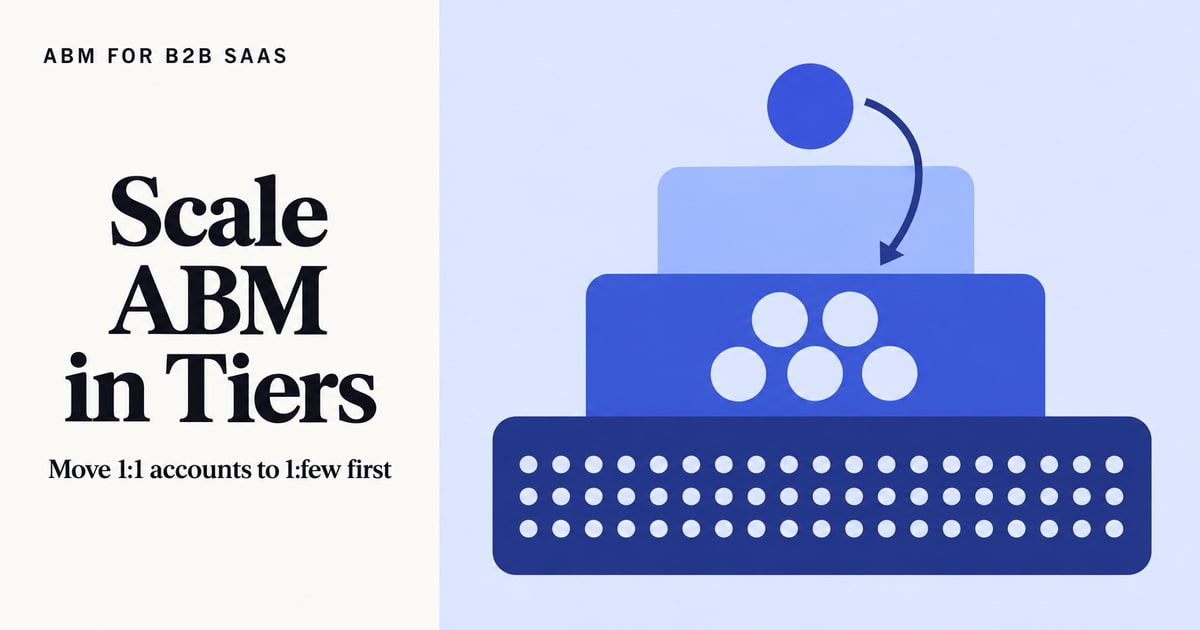
List size is a common failure point. Published practitioner views describe lists of 500 to 2,000+ named accounts at companies that should run 100 to 300 (ABM26, June 2026; practitioner argument, no sample). Recommended tiers are 10 to 50 accounts for 1:1, 50 to 200 in 5 to 15 clusters for 1:few, and 200 to 500 for 1:many (ABM26, June 2026). Target cost per sales-qualified lead (SQL) also rises with deal size, from $3,000 to $8,000 at $50K to $150K ACV to $8,000 to $20,000 at $150K+ ACV (published ranges, B26, 2026). Teams earlier in the journey can compare ABM against inbound marketing or read how demand generation and ABM fit together.
Frequently Asked Questions
What does enterprise ABM software actually cost and how do the pricing models compare?
Enterprise ABM software typically costs about $63,199 a year for 6sense and $68,591 a year for Demandbase at the median, based on Vendr purchase data reported in 2026 (Cleanlist; Userled). Demandbase prices as a platform fee plus a flat per-user fee, while 6sense uses modules and data credits. Neither publishes list prices, and the medians cover software only.
Which ABM platforms are cheapest to run at enterprise scale and what do they leave out?
On practitioner-reported 2026 low-end annual pricing, RollWorks ($12,000) and Terminus ($30,000) cost less than 6sense and Demandbase (both $60,000), per The ABM Pulse. Price alone does not show what each includes. Buyers should confirm contact coverage for procurement, security, and finance, credit limits, and renewal terms before treating a lower entry price as a lower total cost.
Do you need an ABM platform to cover a large buying group?
An ABM platform is not always required to cover a large buying group. Running account-based marketing with LinkedIn and a customer relationship management (CRM) system is a valid option. The decision depends on deal size, team size, and whether a platform's data and orchestration justify its cost. Coverage of procurement, security, and finance contacts should be tested either way.
Is a multi-year ABM contract worth the discount?
A multi-year ABM contract can be worth it if the price protections are written in. Vendr reports that terms of two to three years commonly lower annual 6sense pricing by 15-30% (RevSpire, 2026), but contracts often carry 5-10% annual escalation. The discount only pays off if renewal caps, credit overage terms, and true-down rights are in the agreement.
Next steps for enterprise ABM buyers
Enterprise account-based marketing succeeds or fails on committee coverage, and the price of the software is only one part of that.
Plan for 10 to 15 stakeholders at $250K to $1M deals, and cover procurement, security, and finance from the start.
Treat Vendr medians of $63,199 (6sense) and $68,591 (Demandbase) as a software floor, not a total budget.
Negotiate renewal caps, notice windows, and credit overage terms before the first signature.
Run a proof of concept with holdout accounts and judge it on account-to-opportunity rate.
Bring the target account list and the current committee map to a free consultation before choosing a vendor. Meet with an expert to brainstorm the next step.
Written by
Ishan Manchanda
Ishan Manchanda is co-founder of GrowthSpree, a B2B SaaS marketing consultancy founded in 2017 that has managed $60M+ in ad spend across 300+ B2B SaaS companies. He focuses on demand generation, go-to-market strategy and pipeline growth, and has been featured in Silicon Valley Times, SaaS Mag and the Unbounce podcast.
 Ishan ManchandaNov 15, 2026