Request a quote and our experts will contact you within 24 hours with tailored solutions and pricing.
Intent Data in ABM Campaigns: Building a Workflow That Assigns Owners and Triggers Action
By ABM for B2B SaaS Editorial Team (see the Methodology page for how figures are sourced). Last updated October 28, 2026.
An intent data workflow for account-based marketing (ABM) is a documented rule set that ties each intent signal to one named action, one owner and a response deadline, so weekly scores produce campaigns instead of reports. Most teams have the data but not the workflow. 87% use intent signals in some form, yet under half of those teams use them to trigger or tailor outreach (Sopro via SME Today, 2026). This guide shows how to build a platform intent data workflow for campaign execution: who owns each signal, which fit-and-intent thresholds pick the target accounts, and how to judge results on pipeline per account. It builds on the real-time signals workflow and the wider ABM measurement guide.
Key Takeaways
An intent signal only counts once it has a named action, a named owner and a deadline; a score on a dashboard is not a workflow.
Fit should gate intent: high-intent accounts that fail the ideal customer profile (ICP) check are reviewed or suppressed, not sold to.
An ABM platform is useful for intent only if it creates tasks, changes audiences or enrolls sequences; reporting alone does not make a campaign.
Campaign ROI for B2B SaaS is best judged as pipeline per account against holdout accounts, not cost-per-click.
Why do intent scores update every week and nobody acts on them?
Intent scores go unactioned because most teams collect signals without tying them to an action or an owner. In Sopro's 2026 survey of 442 senior B2B decision-makers, 87% use intent signals in some form, but under half of them trigger or tailor outreach (Sopro via SME Today, 2026). The signal is reported, not routed.
Macro view of an unanswered weekly report printout with a paper clip on a desk
An intent signal is any observed behaviour, such as topic research, content consumption or a pricing page visit, that suggests an account may be researching a purchase. A score is a summary of many such signals. Nobody can act on a summary without knowing which signal moved it.
Three reasons signals stall
No trust in the data. In a survey of 750 senior marketing leaders, 87% said their marketing investments produce unreliable or inflated intent signals (DemandScience, 2025). The same survey found only 26% of "intent" signals convert to qualified opportunities. Sales learns to ignore alerts that rarely pay off.
No owner. The weekly report goes to sales by email and nobody is assigned a follow-up. A DemandScience report found 85% of teams spend more time fixing problems than building programs (DemandScience, 2025), which is the kind of drag that leaves alerts unowned.
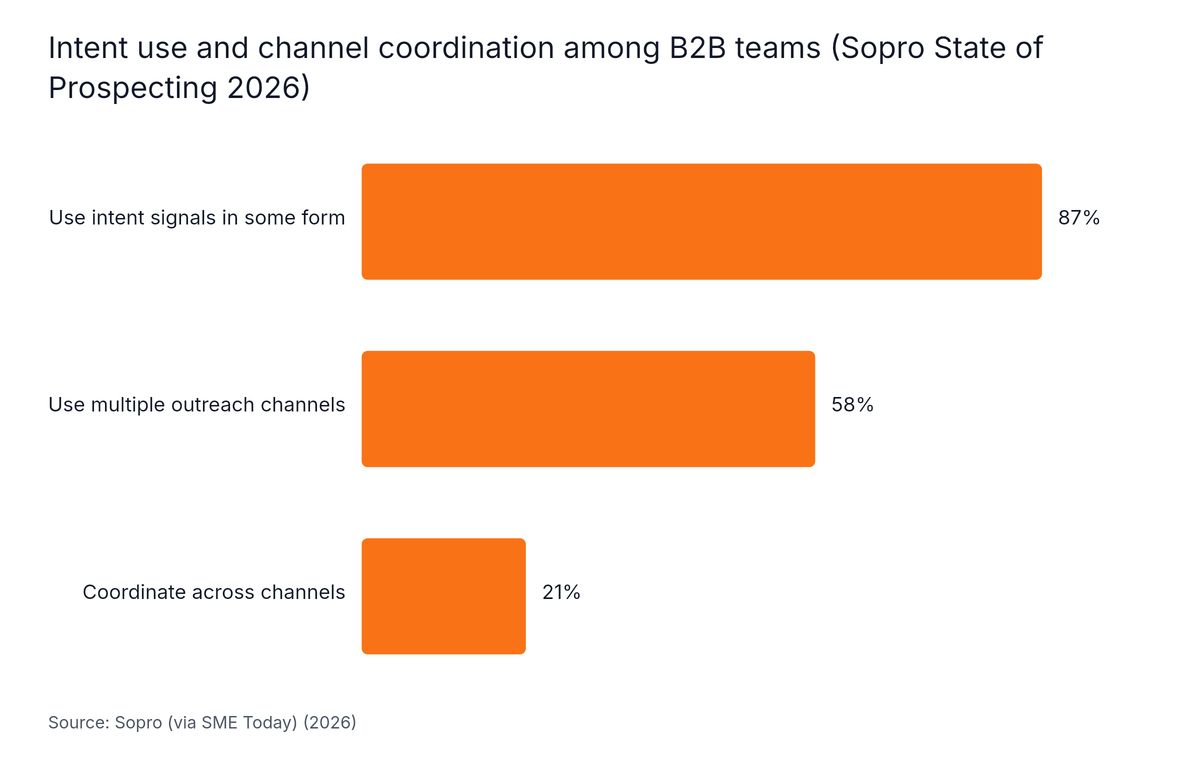
No coordination. In the same Sopro survey, 58% of teams use multiple outreach channels, but only 21% coordinate across them (Sopro via SME Today, 2026). One signal can trigger three uncoordinated touches, or none.
The chart below shows the gap between using intent and coordinating on it: 87% use intent signals, 58% use multiple channels and 21% coordinate across channels (Sopro via SME Today, 2026).
Horizontal Bar chart: Intent use and channel coordination among B2B teams (Sopro State of Prospecting 2026). Highest: Use intent signals in some form at 87%.
Refresh frequency adds a second problem. A weekly score can lag the behaviour that created it. No neutral study sets a decay window, so the practical step is to measure how quickly your own signals lose value, then set response deadlines to match. Sopro puts the principle plainly: "Prospecting must align with how buyers already behave." (Sopro via SME Today, 2026)
How do you assign an owner to each intent signal?
Assign each intent signal to one accountable role, one named action and one response deadline, then record all three in a table the team can audit. Marketing owns signal quality, SDRs own first contact, account executives own accounts with open opportunities. Deadlines matter: companies with a defined response SLA reached inbound leads within 15 minutes at 54.9% versus 29.5% without one (Blazeo, via LeanData, 2026).
Close-up of labelled cable tags in different colours on a patch panel
That speed figure covers inbound leads, not account intent, and comes from a vendor benchmark cited on a vendor blog. Treat it as a reason to set a deadline, not as a target for intent alerts.
A signal-to-action-to-owner table
The rows below are practitioner starting points, not study findings. Adjust the triggers and deadlines to your sales cycle and team size.
Signal
Trigger rule
Named action
Owner
Response deadline
Escalation
Pricing or comparison page visit
Account passes fit gate and two or more visits in a week
Personal outreach task in the CRM
SDR
1 business day
SDR manager, then account executive
Category topic surge
High-fit account crosses the intent threshold
Add to ad audience and send SDR alert
ABM manager
2 business days
Head of demand generation
Several contacts engage with ads
Three or more contacts at one account
Coordinated email and ad play across roles
ABM manager with SDR
3 business days
SDR manager
Any signal at an account with an open opportunity
Open opportunity exists
Notify the deal owner; pause cold outreach
Account executive
1 business day
Head of Sales
High intent, low fit
Intent above threshold, fit below
Review the fit score; suppress or reclassify
Marketing operations
Weekly review
How to build the owner table
List the five or six signals your team can observe today. Drop any signal no one has acted on in the last quarter.
Write one trigger rule per signal, with a fit condition first.
Name one action and one role. If two roles share a signal, the action is not specific enough.
Set a response deadline and a named fallback owner for when it is missed.
Review the table weekly. Retire signals that do not convert.
Name a person, not a team, for signal quality and routing rules. Someone must be accountable when an alert fires and nothing happens.
The signal-to-action rate is the share of alerts that receive their assigned action within the deadline. Influ2 sets 35% or higher as an effective hand-off rate (Influ2, via MarketScale, 2025). That means the share of ad-clicking prospects that sales also contacted, and many teams fall short. It is vendor research with no stated sample, so use it as a reference point, not an industry average. For tasks that can run without a dedicated operations hire, see ABM automation tasks.
How do fit and intent thresholds decide which target accounts get a campaign?
Fit and intent thresholds sort target accounts into four groups: high fit with high intent get a sales play, high fit with low intent get nurture or ads, low fit with high intent are reviewed or suppressed, and low fit with low intent get nothing. Fit gates intent because 73% of B2B buyers avoid suppliers that send irrelevant outreach (Gartner via BizTech Reports, 2025).
Four-quadrant sorting tray with small coloured tokens placed in separate sections
A fit score is a rating of how closely an account matches the ideal customer profile (ICP), usually built from firmographic data. Intent measures timing. Fit measures whether the account should ever be a customer. Acting on intent without fit is how teams chase accounts that are researching but will never buy.
What we found: A June 2026 study of 56 audited LinkedIn accounts, covering $9.4M in ad spend and published by GrowthSpree, found decision-makers received only 33% of budget against a target of 60% or more. Individual contributors and entry-level staff took 36%, and 20% of spend reached firms under 50 employees. Right accounts, wrong people: fit has to be checked at the role level too.
The fit-by-intent matrix
Quadrant
Fit
Intent
Action
Owner
1
High
High
Sales play: SDR alert, coordinated outreach, ads to the buying group
SDR and account executive
2
High
Low
Nurture: low-cost ads and content for the account tier
ABM manager
3
Low
High
Review the fit score; suppress or reclassify, no outreach
Marketing operations
4
Low
Low
No action; revisit at the next list refresh
None
The numeric cutoffs are yours to set. The DemandScience survey found only 26% of intent signals convert to qualified opportunities (DemandScience, 2025). Require more than one signal before an account moves into quadrant 1.
Size the threshold to capacity
Set the intent threshold so that quadrant 1 produces only as many alerts as the team can work inside its deadline. Here is an illustration with made-up numbers. Two SDRs can each work about 10 alerts a week, so capacity is 20. If the threshold fires 60 alerts, 40 go unworked and the team learns to ignore the rest. Raise the threshold, or add a second-signal rule, until weekly alerts sit near 20. Review the cutoff on a fixed schedule.
List size matters too. Published ranges (practitioner view, no stated sample) say common ABM lists run 500 to 2,000+ named accounts at companies that should run 100 to 300. Tighter lists make thresholds easier to staff.
Check coverage of the buying group
An account-level trigger should lead to coverage of the group, not one contact. Forrester's 2026 research states: "The typical buying decision now includes 13 internal stakeholders and nine external influencers" (Forrester, 2026). Procurement is a decision-maker in 53% of buying cycles (Forrester, 2026). For purchases with genAI features, Forrester found 14 members versus seven for those without (Forrester, 2026). Before an SDR works a quadrant 1 account, the owner should check which roles have engaged and which have not.
What should an ABM platform do with an intent signal besides report it?
An ABM platform that acts on intent signals can create a task, change an ad audience or enroll a sequence when a rule fires, rather than only displaying a score. ZoomInfo's October 2026 comparison reports that Influ2 launched contact-level orchestration in May 2026 and that 6sense is moving Orchestrations to Intelligent Workflows, though each claim needs checking on the vendor's page (ZoomInfo, 2026).
Macro of a metal toggle switch flipped on a circuit board
The same ZoomInfo page reports that Demandbase launched the Mojo marketing agent in September 2026. It is a third-party comparison, so confirm each capability in vendor documentation before relying on it. Many ABM platforms also resell or embed Bombora's Company Surge data, and Bombora was named a Leader in The Forrester Wave: Intent Data Providers for B2B, Q1 2025 (Bombora, 2025). Knowing where the data comes from helps explain why two platforms may show similar surges.
A capability checklist
Capability
What to test in a trial
Pass condition
Task creation
Does a rule create a CRM task for a named owner?
Task appears with the signal attached
Audience change
Does crossing a threshold add the account to an ad audience?
Audience updates without a manual export
Sequence enrollment
Can a rule enroll the right contact in a cadence?
Enrollment respects open-opportunity suppression
Reporting of actions
Can you see alerts fired versus alerts acted on?
Signal-to-action rate is visible
Test before you wire workflows
Independent testing of intent accuracy is scarce. Before building routing rules on any vendor's data, check it against your own closed-won accounts: did those accounts show the signal before they bought? A platform is also not required. A CRM with intent fields, a shared weekly list and LinkedIn matched audiences can run the same table. See the ABM platform comparison for what to evaluate before signing.
How do you measure campaign ROI as pipeline per account?
Pipeline per account is the total pipeline created by a group of target accounts divided by the number of accounts addressed, compared against holdout accounts that received no campaign. This replaces cost-per-click as the ROI test. Two-thirds of marketing leaders say their dashboards at least sometimes show success that fails to translate into revenue (DemandScience, 2025).
Two matching stacks of index cards, one taller than the other, beside a brass ruler
Holdout accounts are matched target accounts that receive no campaign and serve as the control group. DemandScience's CMO, Bill Hobbib, described the problem this way: "dashboards glow green, impressions scale, and lead goals exceeded, yet these “qualified” leads convert to customers at a low rate" (DemandScience via GlobeNewswire, 2025). Marketers also estimate that 25% of marketing spend goes to campaigns that look productive but never drive outcomes (DemandScience, 2025).
The calculation, step by step
Metric
Formula
Question it answers
Accounts addressed
Count of accounts that crossed the threshold and received the play
How large was the program?
Account-to-opportunity rate
Accounts with a new opportunity divided by accounts addressed
Did the play move accounts?
Pipeline per account
Pipeline created divided by accounts addressed
What was each account worth?
Lift versus holdout
Pipeline per account addressed minus pipeline per holdout account
Did the campaign cause it?
Pipeline per account by quadrant
Same formula, split by fit-and-intent group
Which threshold earns its keep?
Wait for a full sales cycle before judging. Published ranges (no stated sample) put cycles at 49 to 84 days for $25K to $100K deals, 84 to 126 days for $100K to $250K, and 126 to 180 days for $250K to $1M. Cost per sales-qualified lead (SQL) is a useful secondary check. Published target ranges (no stated sample) run $1,000 to $3,000 for $15K to $50K annual contract value (ACV) contracts, $3,000 to $8,000 for $50K to $150K, and $8,000 to $20,000 for $150K and above.
Split the result by quadrant. If quadrant 1 shows strong pipeline per account and quadrant 2 shows little, move budget toward sales plays and away from broad nurture. For attribution questions on accounts touched by several channels, see ABM attribution, and for the case against activity dashboards see B2B marketing analytics.
Who is this intent data workflow not for?
An intent data workflow for ABM is not suited to teams without a seller working named accounts, teams that have never checked their intent data against closed-won accounts, or teams expecting it to replace sales judgement. Even among adopters, fewer than half trigger outreach from signals, per Sopro's 2026 survey of 442 senior B2B decision-makers (Sopro via SME Today, 2026).
Honest limits
Small or unstaffed teams. If nobody can work an alert within a day, a lower-effort option is a weekly named-account list reviewed by one seller.
Low deal size. Coordinating across a buying group costs more than it returns at low ACV.
Unverified data. Most third-party intent reflects research behaviour, which produces false positives. Independent testing of accuracy is scarce.
Practitioner conventions. The response windows in this guide are starting points, not measured results.
Privacy rules. Rules on intent data, email outreach and visitor identification vary by region, particularly in Europe. This guide does not give legal advice.
Frequently Asked Questions
Which ABM platforms use intent signals to trigger campaigns rather than just report them?
ZoomInfo's October 2026 comparison reports that Influ2 launched contact-level orchestration in May 2026, able to trigger next-best actions across ads, sales cadences, CRM and marketing automation (ZoomInfo, 2026). It also says 6sense is moving Orchestrations to Intelligent Workflows in 2026 and Demandbase launched its Mojo marketing agent in September 2026. Verify each claim in vendor documentation.
How to improve b2b campaign roi with intent data?
Improving B2B campaign ROI with intent data means acting only on accounts that pass a fit gate and show more than one signal, then measuring pipeline per account against holdout accounts. Only 26% of intent signals convert to qualified opportunities, according to the survey in DemandScience, 2025, so raw signal volume is a weak trigger on its own.
How to analyze marketing campaign roi b2b saas?
Analyze B2B SaaS campaign ROI by dividing the pipeline created by addressed target accounts by the number of accounts addressed, then comparing that figure with holdout accounts that received no campaign. Wait at least one full sales cycle first. Published ranges put cycles at 49 to 84 days for $25K to $100K deals, with no sample stated.
Conclusion
An intent workflow works when every signal has an action, an owner and a deadline, and when results are judged on pipeline rather than clicks. Five points to carry forward:
Write a signal-to-action-to-owner table and review it weekly.
Gate intent with fit, and require more than one signal before a sales play.
Size thresholds to the alerts your team can work within the deadline.
Check any platform's rules against your own closed-won accounts.
Report pipeline per account against holdout accounts after a full sales cycle.
For the broader approach, see the ABM best practices guide. A free consultation is the next step: bring your target account list and brainstorm the signal table with an ABM expert. Meet with an expert
Written by
Ishan Manchanda
Ishan Manchanda is co-founder of GrowthSpree, a B2B SaaS marketing consultancy founded in 2017 that has managed $60M+ in ad spend across 300+ B2B SaaS companies. He focuses on demand generation, go-to-market strategy and pipeline growth, and has been featured in Silicon Valley Times, SaaS Mag and the Unbounce podcast.
 Ishan ManchandaNov 20, 2026