Blog
ABM Measurement: From Activity Metrics to Pipeline per Target Account
Stop tracking engaged accounts. Rebuild ABM measurement around account-to-opportunity rate and pipeline per target account, tiered by 1:1, 1:few, and 1:many.
Intent scores reset weekly and most ABM teams have no owner or action tied to them. Here is the workflow to act on real-time buying signals before the window closes.
Stop tracking engaged accounts. Rebuild ABM measurement around account-to-opportunity rate and pipeline per target account, tiered by 1:1, 1:few, and 1:many.

ABM optimises for pipeline per named account; inbound optimises for lead volume. Get a clear verdict by ACV and sales cycle length for B2B SaaS teams.

Define where B2B SaaS demand generation ends and ABM begins, by deal size and channel. Includes thresholds, channel mix, and pipeline metrics.
Request a quote and our experts will contact you within 24 hours with tailored solutions and pricing.
abmforb2bsaas.com
Last updated: Oct 22, 2026
ABM for B2B SaaS Editorial Team
To act on real-time buying signals before they reset, assign a named owner to each signal class in the CRM, set a maximum response SLA per signal type, and ship a handoff brief to sales the same day the signal fires. Account-based marketing (ABM) teams that skip this step will find the signal has expired before anyone moves.
That expiry is faster than most teams assume. According to Forrester's 2025 Buyers' Journey Survey, B2B buyers complete approximately 70 to 80% of their purchase research before ever contacting a vendor sales team (Forrester, cited January 2026), leaving real-time buying signals as the only visible trail of an active evaluation. Yet as of the DemandScience October 2025 survey of 750 senior B2B marketing leaders, 91% use intent data and only 24% report exceptional return (DemandScience / Autobound, 2026). The gap is not the data. It is the workflow.
This article maps each signal class to a named owner, a maximum action window, and a handoff brief so the account is reached while it is still in-market.
Key Takeaways
- Real-time buying signals expire fast: 70% of accounts active in a B2B segment in one quarter are inactive the next (Informa TechTarget, cited in Omnibound, 2026), making a weekly review cadence structurally too slow.
- First-party signals (pricing page, demo request) decay within hours. Third-party signals (topic surge, review-site visit) decay over days to weeks. They need different SLAs and different owners.
- The average B2B company takes 47 hours to respond to a buying signal. Lead qualification odds drop 21-fold when follow-up stretches from 5 minutes to 30 minutes (MIT/InsideSales.com, cited in DataMagnet, 2026).
- Every signal class needs a named owner encoded in the CRM before the signal fires, not assigned after it arrives.
- 91% of B2B marketers use intent data, but only 24% report exceptional ROI (DemandScience / Autobound, 2026). The activation workflow is the missing piece.
Real-time buying signals expire before most account-based marketing (ABM) teams act on them because no named owner and no service-level agreement are attached to the signal when it arrives. According to Informa TechTarget benchmark data, 70% of accounts active in a B2B target segment in one quarter are inactive the next (Omnibound 2026 stats compilation) - making a weekly review cadence structurally too slow for B2B SaaS ABM teams. The signal is visible. The workflow to act on it is missing.

Three structural failures compound the problem:
According to Gartner's 2025 buyer behavior research, buyers using generative AI tools are 2.3 times more likely to finalize a vendor shortlist before contacting any sales representative (The Starr Conspiracy, citing Gartner, 2025), compressing the already-narrow window further. Gartner's Future of Sales research also shows that B2B buyers spend only 17% of their total buying journey in direct contact with potential vendors (Omnibound, citing Gartner, 2025). Real-time buying signals may be the last observable data point before the account closes internally.
"Most B2B teams are spending five and six figures on intent data platforms, then letting those signals decay in a CRM queue for 47 hours." (Koka Sexton, 2026)
A first-party intent signal is any behavior recorded on properties the selling company controls: a pricing page visit, a demo request, a return to a product comparison page, or a webinar registration. A third-party intent signal is inferred from activity across external publisher networks, review sites, or data co-ops such as Bombora, a B2B intent data provider that aggregates topic-level research behavior across publisher networks. For B2B SaaS ABM teams, first-party signals decay within hours and third-party signals decay over days to weeks, requiring different SLAs and different named owners.
As of the DemandScience October 2025 survey, 91% of B2B marketers use intent data (Omnibound, 2026), yet the distinction between signal types is rarely built into the response workflow. That is why most teams treat a high-confidence pricing page visit and a low-confidence topic surge with the same Monday-morning email.
| Signal | Confidence | Estimated half-life | Recommended first touch |
|---|---|---|---|
| Demo request | Very high | 2 to 4 hours | SDR call same business day |
| Pricing page (2+ visits) | High | 4 to 12 hours | SDR email within 4 hours |
| Product comparison page | High | 12 to 24 hours | SDR email within 8 hours |
| Case study download | Medium | 24 to 48 hours | Demand gen nurture sequence |
| Webinar registration | Medium | 24 to 48 hours | AE alert if account is in active cycle |
| Signal | Confidence | Estimated half-life | Recommended first touch |
|---|---|---|---|
| Topic surge (e.g., Bombora) | Medium | 7 to 14 days | Ad sequence + SDR if 3+ weeks of surge |
| Review site visit (G2, Gartner Peer Insights) | Medium-high | 3 to 7 days | SDR outreach within 48 hours |
| Competitor content consumption | Low-medium | 7 to 14 days | Ad retargeting, not cold SDR call |
| Funding event (firmographic trigger) | Medium | 14 to 30 days | AE strategic outreach |
| Job change (champion leaves or joins) | Variable | 7 to 21 days | AE relationship check-in |
"Intent signals get stale fast. Daily updates are the minimum, with real-time alerts for high-value accounts being ideal." (UserGems editorial team, 2026)
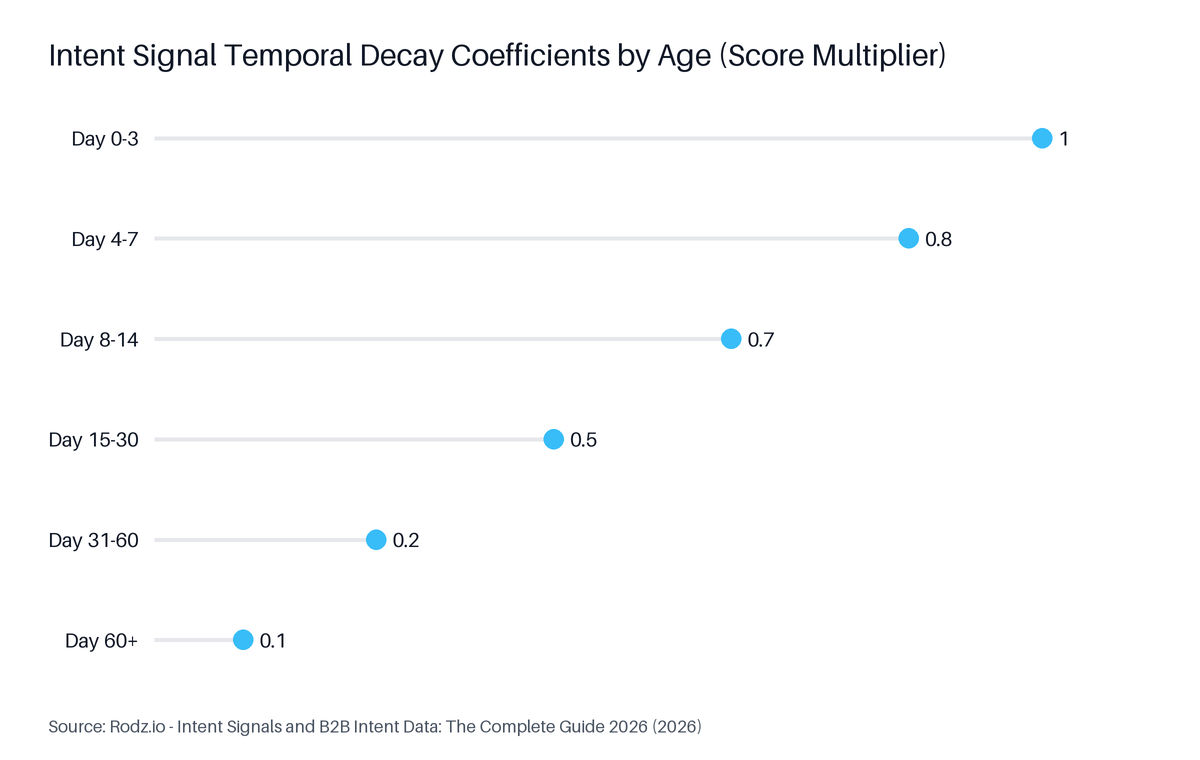
Intent signal decay is the reduction in predictive value of an intent signal over time, following an exponential curve with the sharpest drop in the first week. For B2B SaaS ABM teams, Forrester research on intent data providers shows signals lose roughly 50% of predictive value within 30 to 45 days (cited in Saber intent decay glossary, 2025). The average B2B company takes 47 hours to respond - a gap that erases most predictive value before anyone acts.
Source: Rodz.io — Intent Signals and B2B Intent Data: The Complete Guide 2026, 2026
The decay curve (Rodz.io, 2026) shows a coefficient of 1.0 at days 0 to 3, dropping to 0.85 by day 7, 0.65 by day 14, 0.45 by day 30, and 0.10 after day 60. A signal four weeks old carries less than half its original predictive weight. For high-confidence first-party signals, a pricing page visit not followed up within a day carries a fraction of its conversion potential by day three.
The response-time data makes the operational cost concrete. The average B2B lead response time is 47 hours, and 77% of companies take longer than 5 minutes to respond to an intent signal (Optifai 2026 B2B Lead Response Benchmark of 939 B2B companies). A MIT-designed lead response study analyzing over 100,000 call attempts found that lead qualification odds drop 21-fold when follow-up stretches from 5 minutes to 30 minutes (DataMagnet, citing MIT/InsideSales.com research, 2026).
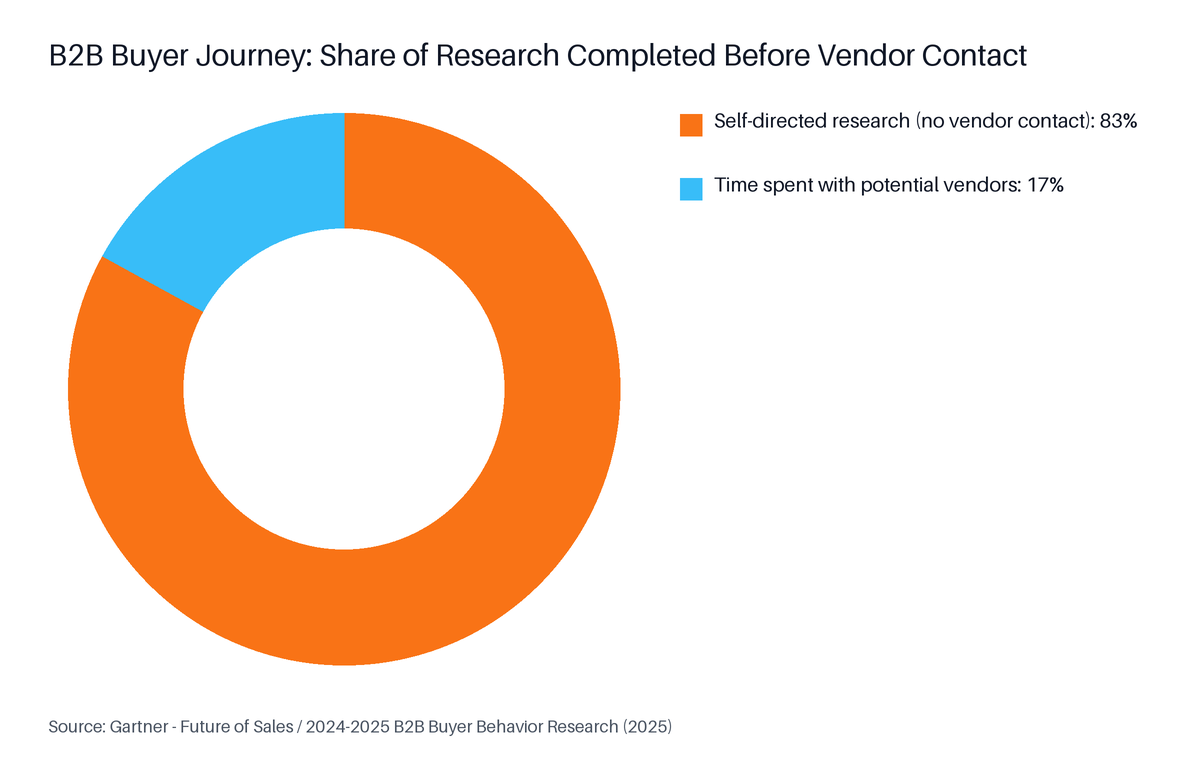
Source: Gartner — Future of Sales / 2024–2025 B2B Buyer Behavior Research, 2025
Gartner's research shows buyers spend only 17% of their total buying journey in direct contact with potential vendors (Omnibound, citing Gartner, 2025) - the chart above illustrates how little of that journey is visible to sellers. Practical SLA targets by signal confidence:
| Signal confidence | Tier 1 accounts (top 10 to 50) | Tier 2 accounts (50 to 200) | Tier 3 accounts (200 to 500) |
|---|---|---|---|
| Very high (demo request) | Same business day, within 4 hours | Same business day | Within 24 hours |
| High (pricing page 2+) | Within 4 hours | Within 8 hours | Within 24 hours |
| Medium (topic surge 3+ weeks) | Within 24 hours | Within 48 hours | Ad sequence only |
| Low (single blog read) | Ad sequence only | Ad sequence only | No SDR action |
The ideal customer profile (ICP) filter applies before any SLA: a high-confidence signal from an account outside the ICP does not trigger an SDR action regardless of the decay window.

Mapping real-time buying signals to named owners means assigning a specific role - demand gen manager, sales development representative (SDR), or account executive (AE) - to each signal class before the signal fires, not after. As of the DemandScience October 2025 survey of 750 senior B2B marketing leaders, 91% use intent data but only 24% report exceptional ROI (DemandScience / Autobound, 2026), confirming that activation ownership is the gap. A pricing page visit routes to the SDR on the named account. A funding event routes to the AE. The assignment lives in the CRM.
"Someone has to own the signal, and ownership needs to be encoded in the workflow, not discussed in Slack every morning." (SalesMotion.io editorial team, 2026)
GrowthSpree data (June 2026, 56 LinkedIn accounts audited): In 56 audited LinkedIn accounts, decision-makers received only 33% of ad budget against a target of 60% or more. The same role-routing failure that wastes paid budget occurs when intent signals reach the wrong contact at the right company - the signal fires on the correct account but the wrong person receives the outreach.
RACI is a responsibility assignment matrix: Responsible (does the work), Accountable (owns the outcome), Consulted (input needed), Informed (kept in the loop).
| Signal class | Responsible | Accountable | Consulted | Informed | Max action window |
|---|---|---|---|---|---|
| Demo request | SDR on account | SDR Manager | AE if in cycle | Demand Gen | 4 hours |
| Pricing page (2+ visits) | SDR on account | SDR Manager | AE | Demand Gen | 8 hours |
| Review site visit | SDR on account | SDR Manager | Demand Gen | AE | 48 hours |
| Topic surge (3+ weeks) | Demand Gen | ABM Manager | SDR | AE | 14 days |
| Funding event | AE on account | AE | SDR | Demand Gen | 30 days |
| Job change (champion) | AE on account | AE | SDR, Demand Gen | ABM Manager |
The RACI has no operational effect unless the CRM enforces it. The minimum required fields per signal event:
A signal-to-action table maps each real-time buying signal class to its estimated half-life, the maximum action window before predictive value falls, the recommended first touch, and the fallback when the window closes. For B2B SaaS ABM teams, the table eliminates the judgment call that causes signals to go unactioned when the assigned owner is unavailable or the weekly review arrives too late.
| Signal type | Signal source | Estimated half-life | Max action window | First touch | Window-closed fallback |
|---|---|---|---|---|---|
| Demo request | First-party | 2 to 4 hours | Same day | SDR call | AE escalation |
| Pricing page (2+ visits) | First-party | 4 to 12 hours | 8 hours | SDR email | SDR call next day |
| Product comparison page | First-party | 12 to 24 hours | 24 hours | SDR email | Nurture sequence |
| Review site visit | Third-party | 3 to 7 days | 48 hours | SDR email | Ad retargeting |
| Topic surge (3+ weeks) | Third-party | 7 to 14 days | 14 days | Ad sequence | Archive + monitor |
| Funding event | Firmographic | 14 to 30 days | 30 days |
The weekly review is not a passive inbox check. A structured triage takes 20 to 30 minutes and answers four questions for each active signal:
For B2B SaaS ABM teams, the signal-stacking threshold before promoting an account to Tier 1 treatment depends on the annual contract value (ACV) of the deal. For $15K to $50K ACV contracts (published ranges, no sample stated [B26]), a single high-confidence first-party signal is sufficient to trigger an SDR action. For $150K or above ACV contracts, two or more corroborating signals across different signal classes are a reasonable threshold before committing AE time. A single topic surge on a $250K deal is not a promotion trigger; a pricing page visit plus a review site visit on the same account in the same week is.
A marketing-to-sales handoff for a signal-triggered account requires a brief that travels with the account record: signal type, date fired, age at handoff, known buying committee contacts, and a recommended first-touch angle. According to GetBoomerang.ai's 2026 ABM playbook, cold outreach on a raw intent signal converts under 2%, while the same signal routed with context converts 15 to 30% to a meeting (GetBoomerang.ai editorial team, 2026). A raw score with no context produces the same result as no handoff.
"Cold outreach on a raw intent signal converts under 2%. The same signal, routed through a warm connector, converts 15-30% to meeting." (GetBoomerang.ai editorial team, 2026)

A handoff brief does not need to be a long document. It needs five pieces of information:
The handoff completes when the disposition (contacted, no response, meeting booked, not in market, bad fit) is recorded in the CRM and fed back to the intent scoring threshold. Without this step, marketing cannot recalibrate which signals actually produce meetings. This is the step most ABM programs skip, and it is why SDR trust in intent data erodes over time.
The signal-to-owner workflow requires at least one SDR or AE working named accounts and a CRM that can hold custom fields and route tasks. Published ranges (no sample stated) show common ABM lists run 500 to 2,000+ named accounts at companies that should run 100 to 300 (ABM26: GrowthSpree, June 2026). Signal triage on an oversized list is a list-size problem, not a workflow problem. B2B SaaS ABM teams under 50 accounts with no dedicated sales role will find a formal RACI structure disproportionate.
GrowthSpree data (June 2026, 56 LinkedIn accounts audited): Non-buying job functions caused 30% of wasted LinkedIn spend in the 56-account audit. When signals are not filtered by ICP and role before outreach, the same mismatch occurs: the workflow fires on a legitimate signal but routes to a contact who has no buying authority, producing a false positive that erodes SDR confidence in the whole system.
False positives erode SDR trust when signals consistently route to contacts outside the ICP or with no purchasing role. The fix is calibration, not abandonment. Run a 30-day retrospective: track which signal types at which confidence levels produced meetings versus dead ends. Reset action thresholds based on actual outcomes - if single-week topic surges on Tier 3 accounts never produce meetings, remove the SDR action from that signal class and replace it with an ad sequence. Feeding SDR disposition data back to the scoring model is the mechanism that makes this calibration possible.
The workflow also assumes the buying committee is at least partially mapped per account. For $25K to $100K annual contract value deals, that means 5 to 8 stakeholders identified (published ranges, no sample stated [BC26]). Routing a signal to a single contact at an account where 7 to 10 committee members are involved - typical at $100K to $250K deals - treats a multi-threaded problem as a single-thread one.
Three situations where this framework should be simplified or paused:
Intent signal validity depends on the signal type. First-party signals such as a pricing page visit or demo request decay within hours to two or three days. Third-party topic surge signals typically hold predictive value for seven to fourteen days. Forrester research indicates intent signals lose approximately 50% of their predictive value within 30 to 45 days across typical B2B SaaS purchases (cited in Saber, 2025), with the sharpest drop in the first week.
Ownership depends on the signal class. Marketing owns signal triage, tier promotion decisions, and the weekly review cadence. Sales development representatives own outreach on signals that meet the action threshold. Account executives own signals on accounts already in an active sales cycle. No single function owns all signals; the workflow must encode who acts on what before the signal fires, not after it arrives.
First-party intent signals come from direct interaction with your own properties: a pricing page visit, a demo request, or a return to a product comparison page. They carry the highest confidence and decay in hours. Third-party signals are inferred from activity across external publisher networks and review sites; they carry lower confidence and decay over days to weeks. The two require different response SLAs and different action owners.
Speed matters sharply. A MIT-designed lead response study of over 100,000 call attempts found that lead qualification odds drop 21-fold when follow-up stretches from 5 minutes to 30 minutes after a signal fires (DataMagnet, citing MIT/InsideSales.com, 2026). The average B2B company takes 47 hours to respond, and 77% take longer than 5 minutes (Optifai 2026 benchmark of 939 B2B companies). Tier 1 accounts warrant a sub-4-hour response.
A usable handoff brief includes: the account name and tier, the specific signal type and date it fired, the signal's age at the moment of handoff, the known buying committee contacts already identified at that account, the recommended first-touch message angle, and any prior engagement history. Handing off a raw score with no context produces the same outcome as no handoff at all.
Real-time buying signals expire fast. The problem is not a shortage of intent data: 91% of B2B marketers already use it, according to the DemandScience October 2025 survey (Omnibound, 2026). The problem is that the signal arrives with no named owner, no SLA, and no action mapped to its type. By the time the weekly review happens, the account has moved on.
The fix is structural, not technical:
An ABM program that reports engagement scores but skips this step is running intent data as a reporting tool, not as a sales trigger. The account-to-opportunity rate tells you whether the workflow is working.
Ready to map your signal types to named owners? Meet with an expert - a free consultation. Bring your current intent workflow and a list of your top target accounts, and work through the triage structure with an ABM specialist.
© 2026 abmforb2bsaas.com All rights reserved.


| 21 days |
| Competitor content | Demand Gen | ABM Manager | None | SDR | 14 days |
| AE strategic note |
| Quarterly check-in |
| Job change (champion) | Firmographic | 7 to 21 days | 21 days | AE relationship note | Monitor for 30 days |
| Competitor content | Third-party | 7 to 14 days | 14 days | Ad retargeting | Archive |